
Is there a risk of air leakage in negative pressure pneumatic conveying?
Negative pressure pneumatic conveyingUnder the suction effect of the negative pressure Roots blower, the air and ash in the material are sucked into the conveying pipeline and sent to the hopper through the pipeline. The air and material are separated by the dust collector, and the material falls into the hopper after separation. After purification, the air meets national standards and is discharged into the atmosphere.
Negative pressure conveying is mainly used for centralized transportation, i.e. point-to-point conveying, such as workshop dust removal, raw material storage and conveying. Negative pressure conveying can effectively collect materials without them entering the atmosphere, which is very suitable for conveying materials that have an impact on the environment. Due to the influence of vacuum, the distance of materials is shorter than that of positive pressure conveying
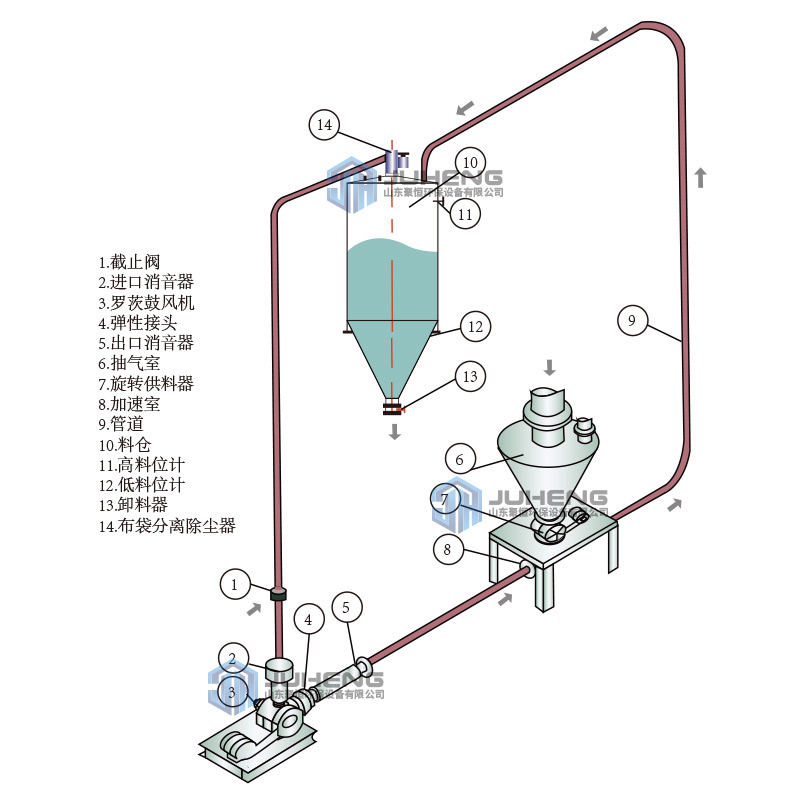
How does the negative pressure conveying system prevent air leakage? Negative pressure conveying system manufacturer answers your questions. When the system operates in a vacuum state, there is a high possibility of air leaking into the system from other sources due to the system being in a vacuum state. The rotary valve continuously unloads materials from the discharge hopper, causing air leakage into the system. This has an impact on the correct specification of the airflow rate required for the exhaust fan, just like the blower in a positive pressure system. For negative pressure delivery systems, care must be taken to prevent any source of air from leaking into the system. The problem here is that it will not be seen because it does not generate dust and cannot be heard under noise.
If this type of air leakage occurs in a positive pressure system, it will not cause any problems with the operation of the system. This is because the air loss along the length of the pipeline will compensate for the transported air, which can actually lead to performance improvement as long as the conveying air velocity is not lower than the minimum value of the material. However, in a positive pressure system, air loss caused by dust, bends, couplings, and flanges can easily be observed by nearby people.
Optimization and upgrade of existing positive and negative pressure conveying systems
How can the exhaust pipe system discharge some of the supply air into the atmosphere instead of being used to transport materials in the pipeline. Use suction devices to monitor the performance of positive pressure systems. In the negative pressure delivery system, it is actually an intake system that will be placed between the filter unit and the exhaust. Air is sucked into the downstream system of the conveying unit, so it is not used for conveying at all. Through this method, the exhaust fan discharges the rated airflow, but there is less air transported through the pipeline.
Monitoring the performance of negative pressure delivery system through bypass
The negative pressure pneumatic conveying system is located in a sealed pipeline, where the pressure inside the pipeline is lower than atmospheric pressure. The material is transported to the material warehouse through the pipeline. Therefore, the negative pressure pneumatic conveying system has a simple structure, can achieve flexible point-to-point transmission, and can also perform operations such as material weighing and batching. When choosing a pneumatic conveying system, one should choose a professional onePneumatic conveying system manufacturerWelcome to call for consultation