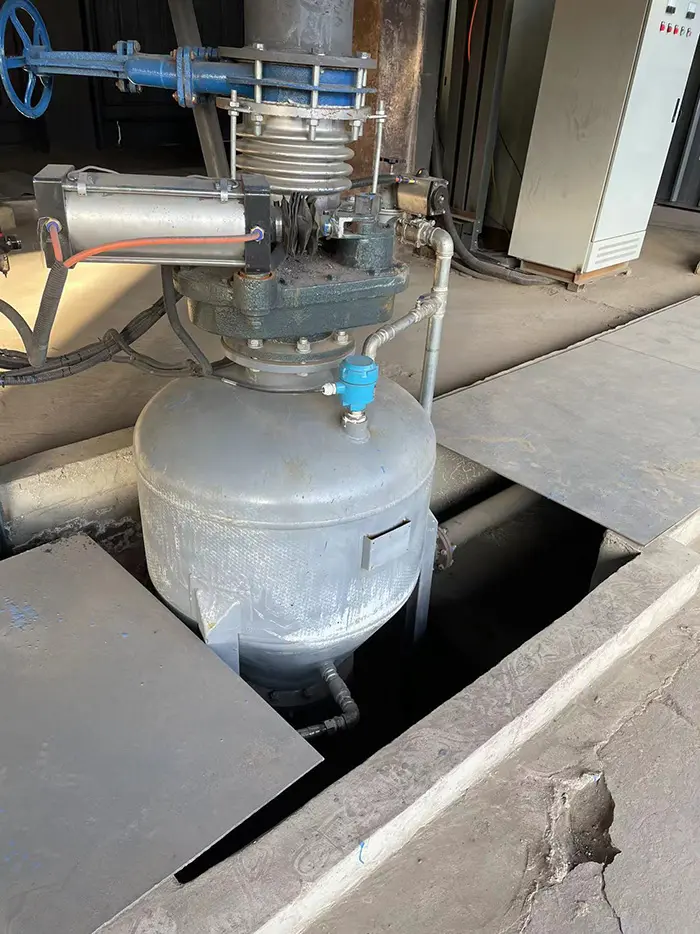
Fly ash pneumatic conveying
Fly ash pneumatic conveying is the mainstream technology for fly ash transportation in the industrial field, widely used in scenarios such as power plant fly ash collection, raw material transportation in building materials plants, and collaborative disposal in cement plants. Its core working principle is to use the kinetic energy of the airflow and the pressure difference inside and outside the pipeline to construct a gas-solid two-phase flow system in a closed pipeline, so that fly ash particles are directionally transported with the airflow. Finally, the material and air are separated through a gas-solid separation device, achieving the goal of dust-free and high-efficiency material transportation. Compared with mechanical conveying, this technology has no direct contact between mechanical transmission components and materials throughout the entire process, fundamentally solving problems such as fly ash dust, material crushing, and equipment wear. Fly ash itself has the physical characteristics of small particles, light texture, and good fluidity, which makes it easily entrained or pushed by air flow, making it an ideal material for pneumatic conveying technology. The essence of pneumatic conveying is to use the energy of the airflow to overcome the frictional and gravitational resistance of fly ash moving in the pipeline, so that the material can maintain a stable flow state in the pipeline until it is conveyed to the designated end point. 1、 The complete process of pneumatic conveying of fly ash does not require complex mechanical linkage, and is mainly completed through four key links that cooperate with each other to form a continuous and closed conveying loop: flow generation and gas supply: The gas source system is the power source of the entire conveying process, which inputs compressed air into the conveying pipeline through Roots fans, air compressors and other equipment, or creates a vacuum environment inside the pipeline through a vacuum pump, thereby establishing a stable pressure difference between the inside and outside of the pipeline, or forming an airflow with sufficient kinetic energy inside the pipeline, providing a power basis for material conveying. Uniform feeding: Fly ash is usually stored in equipment such as ash silos and silos. The feeding device is used to smoothly and evenly feed the fly ash from the silo into the conveying pipeline, avoiding material accumulation or sudden influx that may cause pipeline blockage. The feeding process will achieve preliminary mixing of materials and airflow according to different conveying processes, laying the foundation for stable conveying in the future. Pipeline transportation: When fly ash enters the transportation pipeline, it will fully merge with high-speed or high-pressure airflow to form gas-solid two-phase flow. According to the differences in airflow velocity, pressure, and conveying process, fly ash will exhibit two main flow states in pipelines - suspended flow or group flow. In a suspended flow, fly ash particles are completely entrained by the airflow and evenly dispersed in the pipeline as they move with the airflow; In the group flow, fly ash aggregates into material plugs or clusters, which move forward alternately under the push of airflow, and finally complete directional transportation along the pipeline from the starting point to the end point. Gas solid separation: When the mixture of fly ash and airflow reaches the conveying endpoint, the material needs to be separated from the air to complete unloading. The mixture first enters separation equipment such as cyclone separators and bag filters, where fly ash particles are intercepted and collected due to their own gravity or filtration, and fall into the final material bin; After separation, the air will be purified to remove residual fine dust, and then discharged or returned to the air source system for recycling, which not only avoids air pollution but also achieves reasonable disposal of the airflow. 2、 The working characteristics of the three mainstream process forms are based on the pressure state and airflow velocity inside the pipeline
- Negative pressure dilute phase transportation - centralized transfer from multiple dust removal points in power plants to ash storage
- Positive pressure dilute phase transportation - coordinated disposal from power plant ash storage to surrounding cement plants
- Dense phase/dense phase transportation - energy-saving renovation of ash conveying system in old power plants
- Dense phase transportation - long-distance transportation of cross regional fly ash
READ MORE