Lithium battery pneumatic conveying
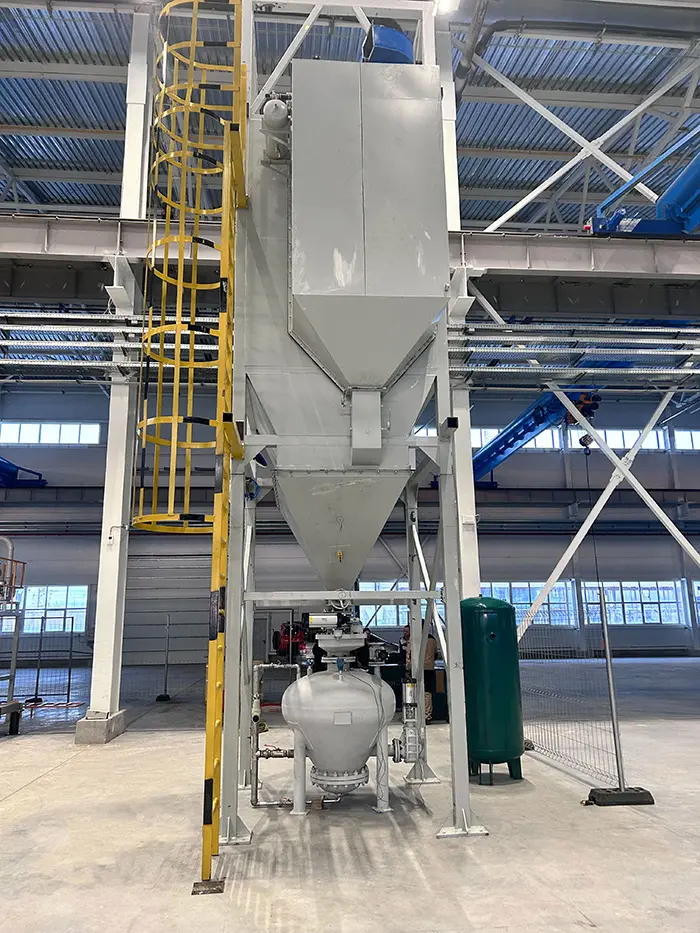
In the lithium battery industry, pneumatic conveying, as an advanced material conveying method, has significant application advantages but also faces some technical difficulties. Advantages of dust-free production environment: The pneumatic conveying system uses fully enclosed pipelines for material transportation, effectively avoiding the dust generated during the transportation of lithium battery positive and negative electrode powder materials, thus creating a dust-free production environment. This is not only beneficial for protecting the health of production workers, but also reduces environmental pollution and improves the overall cleanliness of the production workshop. Improving production efficiency: Pneumatic conveying systems can achieve continuous and efficient material transportation, with fast conveying speed and long distance, greatly improving production efficiency. At the same time, pneumatic conveying can be combined with automated control systems to achieve intelligent management of production lines and further improve production efficiency. Reduce labor costs: The pneumatic conveying system reduces the manual handling of materials, lowers the labor intensity of workers, and thus reduces the number of workers and labor costs. In addition, automated control systems can reduce production errors caused by human factors and improve production stability. Improving product quality: The pneumatic conveying system can accurately control the conveying volume and speed of materials, avoiding waste and pollution during the conveying process. At the same time, combined with the automatic batching system, precise measurement and mixing of materials can be achieved, thereby improving the quality and consistency of products. Environmental protection and energy conservation: The pneumatic conveying system uses gas as the power source, which can reduce energy consumption and carbon emissions compared to traditional mechanical conveying methods. At the same time, due to the reduction of dust pollution and material waste, it also conforms to the environmental protection concept of modern enterprises. Difficult material layering phenomenon: During pneumatic conveying, due to the conveying characteristics, powder materials such as lithium battery positive and negative electrodes are prone to layering, that is, low-speed conveying of large particles and high-speed conveying of small particles. This will affect the consistency of the material, thereby affecting the performance and quality of the battery. Metal content control: The metal content of lithium battery negative electrode materials is one of the important indicators for evaluating their quality. However, in the process of pneumatic conveying, the friction and collision of materials may lead to the mixing of metal impurities, thereby affecting the metal content of the material. High requirements for electrical control equipment: Due to the conductivity of lithium battery negative electrode materials, there are high requirements for electrical control equipment and electrical control cabinets. It is necessary to ensure that the equipment has good insulation performance and protection level to prevent electrical faults and safety accidents from occurring. Difficulty in gas-solid separation: Most negative electrode materials for lithium batteries are micron sized powder materials with small particle size and light weight, making gas-solid separation difficult. The design and operation requirements for cyclone separation dust collectors and other equipment are very high to ensure effective separation and recovery of materials. Blockage problem: In pneumatic conveying systems, if the material is not conveyed smoothly or the pipeline design is unreasonable, it may lead to blockage problems. This will not only affect the normal operation of the production line, but also cause material waste and equipment damage. Therefore, effective measures need to be taken to prevent and solve the problem of material blockage. In summary, pneumatic conveying has significant application advantages in the lithium battery industry, but there are also some technical difficulties that need to be overcome. With the continuous advancement of technology and the constant improvement of equipment
- Positive electrode material, high nickel ternary product to mixture
- Positive electrode material and lithium iron phosphate precursor transportation
- Long distance cross workshop transportation of negative electrode materials and artificial graphite
- Negative electrode material and low-temperature pre carbonization material transportation
READ MORE