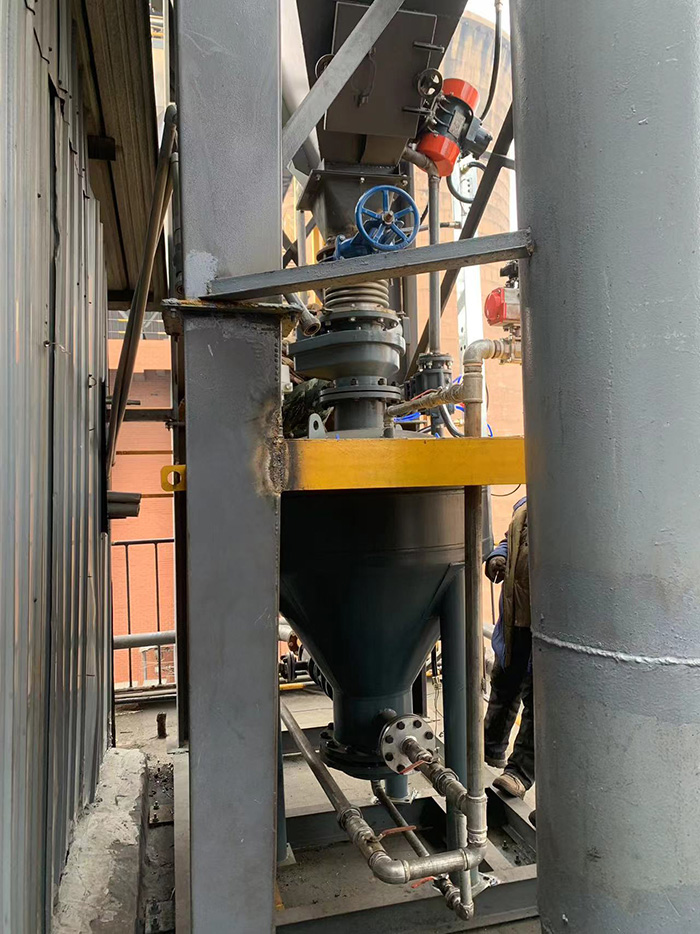
The product is widely used in industries such as electricity, cement, grain processing, metallurgy, building materials, mining, new energy, ports and terminals, chemical industry, desulfurization, food, and feed.
The core principle of gypsum powder pneumatic conveying is to use the kinetic energy of the airflow or the pressure difference inside and outside the pipeline to form a stable gas-solid two-phase flow in a closed pipeline. The gypsum powder particles are uniformly carried or pushed into a plug to the designated end point, and then separated from the air by a gas-solid separation device. The entire process relies on the closed pipeline to complete the transportation, solving the pain points of gypsum powder being prone to dust and moisture agglomeration. Compared with materials such as fly ash, although the conveying principle of gypsum powder is the same as gas-solid two-phase flow transmission, its working principle focuses on "moisture prevention, anti agglomeration, and stable flow rate" due to its strong moisture absorption, easy agglomeration, uniform particle size, and low abrasion properties. The overall process still follows the universal closed loop of pneumatic conveying, which is divided into four key links and corresponds to two mainstream process forms adapted to gypsum powder: 1. Universal core workflow gas supply and pressure building: the gas source equipment establishes a positive or negative pressure environment in the pipeline to form a continuous and stable airflow. Due to the fact that gypsum powder does not require high kinetic energy to be transported, the airflow only needs to meet the requirements of "carrying animal material flow and preventing material deposition", avoiding excessive suspension of materials caused by high-speed airflow. Anti blocking feeding: Gypsum powder enters the pipeline from the silo through a dedicated feeding device. The feeding process will synchronously complete the "material arch breaking+uniform feeding" to prevent the gypsum powder in the silo from being unable to fall smoothly due to moisture and compaction. At the same time, it ensures the initial mixing of the material and the airflow, avoiding pipeline blockage caused by sudden large feeding. Pipeline transportation: After gypsum powder enters the pipeline, it fully merges with the airflow to form a gas-solid two-phase flow, which presents two flow states depending on the process - suspended flow or plug flow. The entire pipeline is sealed to isolate external water vapor and prevent gypsum powder from getting damp and clumping. Gas solid separation unloading: After the gas solid mixture reaches the endpoint, it enters the separation device, and the gypsum powder particles are intercepted by gravity or filtration and fall into the endpoint material bin; The separated air is purified and discharged to meet the standard, without any leakage of gypsum powder dust. 2、 The working principles of the two mainstream processes are as follows: 1 The core principle of positive pressure dilute phase conveying is to use compressed air as the driving force to form a positive pressure airflow in the pipeline, pushing the gypsum powder towards the end point, and the material moves in a suspended state with the airflow. Adaptation logic: Taking advantage of the low workability and easy suspension of gypsum grinding, low kinetic energy airflow can be used to achieve short distance and small to medium flow conveying. The process is simple and the start stop is flexible, suitable for short distance transportation from the raw material warehouse to the production workshop in gypsum board factories and dry powder mortar factories. 2. Core principle of positive pressure dense phase transportation: High pressure and low flow velocity airflow is used to integrate gypsum powder into material plugs in the pipeline. The material plugs are separated by air columns, and the pressure of the air columns is used to push the material plugs forward at low speed. Adaptation logic: Low flow rate conveying can avoid static electricity or fine particle flying caused by high-speed friction of gypsum powder. At the same time, a sealed high-pressure environment can effectively isolate external water vapor and prevent gypsum powder from getting damp and clumping. It is suitable for "gypsum calcination kiln to finished product warehouse" or long-distance transportation across workshops, especially for high-end gypsum building materials production with high requirements for material purity and dryness. Case 1: Positive pressure dilute phase conveying - gypsum board production line batching conveying industry scenario: large-scale paper faced gypsum board production workshop. Need to be calcined