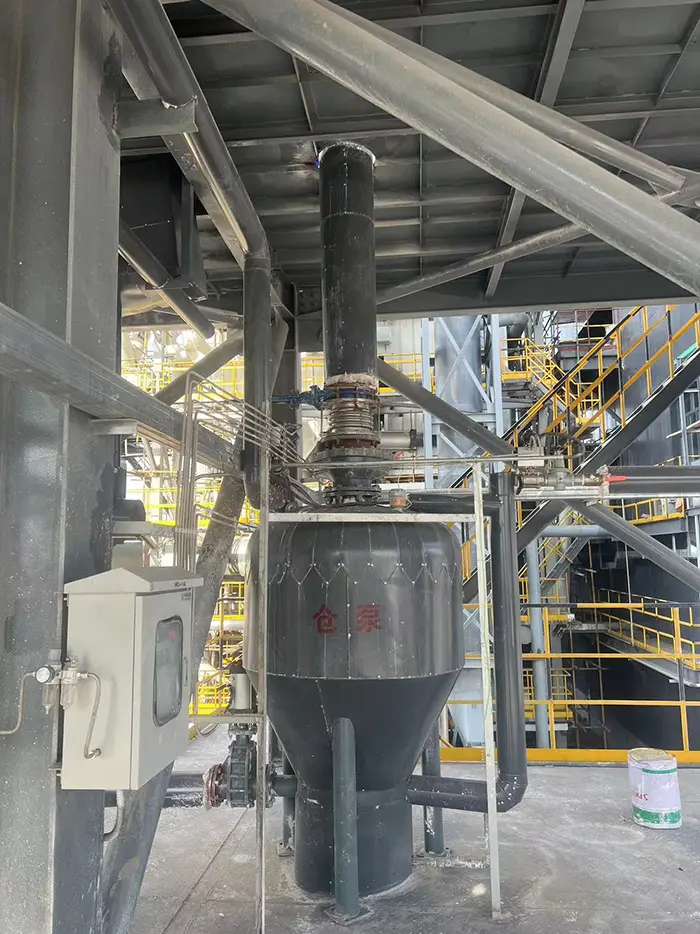
The product is widely used in industries such as electricity, cement, grain processing, metallurgy, building materials, mining, new energy, ports and terminals, chemical industry, desulfurization, food, and feed.
The core of calcium hydroxide pneumatic conveying is to utilize the kinetic or static pressure energy of air to form a stable gas-solid two-phase flow of calcium hydroxide powder in a closed pipeline, completing the transportation from the storage bin to the point of use, and achieving gas separation and exhaust gas purification at the end. Unlike ordinary mineral powder, calcium hydroxide has a fine particle size, high surface activity, and is prone to react with moisture in the air to form hard lumps. The key to its transportation principle lies in "preventing agglomeration, blocking pipes, and moisture absorption", rather than simply power transmission. The overall workflow still follows the three major links of "feeding conveying separation", but each link has a targeted principle adaptation. The mainstream is divided into three modes: positive pressure dilute phase, positive pressure dense phase, and negative pressure suction and delivery. The following is the general principle+sub mode core logic: 1. General core working principle arch breaking and bridge prevention - Calcium hydroxide is prone to forming "bridges" in the storage bin due to moisture absorption and aggregation, and cannot be naturally discharged. Therefore, before starting the conveying process, it is necessary to use warehouse wall vibration or arch breaking devices to break the material aggregation structure, making the powder loose and laying the foundation for subsequent uniform feeding. This is the unique pre principle that distinguishes calcium hydroxide transportation from other dry powders. Mixing of feed and gas - Loose calcium hydroxide is controlled and evenly fed into the conveying pipeline through a dedicated gas locking feeding device. At this point, the airflow enters the pipeline from the power source and is fully mixed with the material: the airflow breaks the adhesive force between the material particles, causing the calcium hydroxide particles to be carried or aggregated into loose clusters by the airflow, forming a gas-solid two-phase flow that can be transported. Key adaptation: The feeding device needs to have good airtightness to prevent external humid air from entering the pipeline and reacting with calcium hydroxide. Pipeline transportation - Gas solid two-phase flow moves forward in pipelines relying on the kinetic or static pressure energy of the airflow. Calcium hydroxide particles are lightweight and strongly influenced by air flow, but due to their tendency to aggregate, they need to be designed through pipeline air supply and optimized bend curvature to avoid particle deposition and agglomeration in the pipeline, which can cause pipe blockage. The entire pipeline is sealed to isolate external moisture and dust leakage. Gas material separation and exhaust gas purification - When the material reaches the endpoint, it enters the separation equipment. Calcium hydroxide particles separate from air under the action of gravity or centrifugal force and fall into the receiving bin; The exhaust gas carrying a small amount of fine dust enters the dust removal equipment for purification before being discharged. Key adaptation: Anti adhesive filter materials should be selected for dust removal equipment to prevent calcium hydroxide dust from adhering to the filter bag and causing blockage. 2、 The core working principle scheme of the three mainstream modes is scheme one: positive pressure dilute phase pneumatic conveying. The core power is to rely on the kinetic energy of the airflow to push the calcium hydroxide particles to be transported in a suspended state. Working logic: The power source provides positive pressure airflow at the starting point, and the feeding device continuously feeds the material into the pipeline. The airflow carries the material forward at high speed and reaches the receiving bin at the end point. Adaptation logic: Calcium hydroxide is lightweight and easy to transport. The dilute phase mode can meet the needs of medium to short distance and continuous feeding. The equipment structure is simple and easy to maintain, suitable for scenarios such as dry desulfurization tower calcium spraying and sewage treatment dosing. Option 2: Positive pressure dense phase pneumatic conveying core power: relying on the static pressure energy of the airflow, it pushes the calcium hydroxide to form loose material plugs and move forward. Working logic: intermittent feeding is adopted through the sending tank, and high-pressure air flow is used to make the materials in the pipeline in an alternating state of "material plug+air plug"