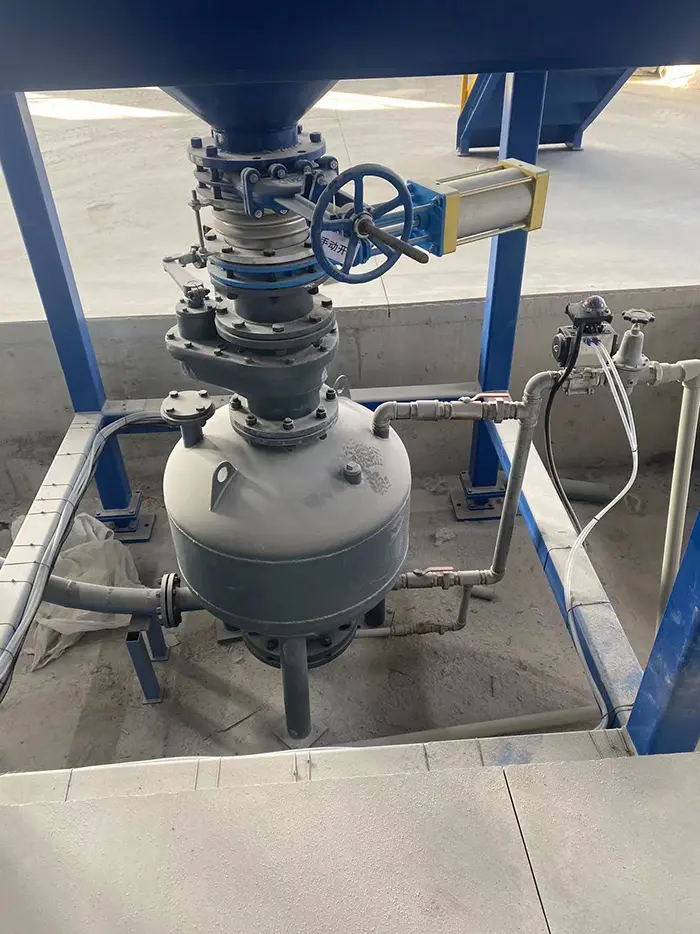
Cement pneumatic conveying
Cement pneumatic conveying is a technology that uses air as a power source to transport cement powder in a closed pipeline. Its core advantages are dust-free sealing, flexible layout, and high degree of automation. The two most commonly used schemes in cement plants are dilute phase positive pressure and dense phase high pressure. The selection is determined by the conveying distance, capacity, and anti-wear requirements. 1、 There are two mainstream conveying methods: positive pressure conveying (pressure conveying): the pressure inside the pipeline is higher than atmospheric pressure, and the material is pushed forward by thrust, suitable for long-distance and high flow conveying. Negative pressure conveying (suction): The pressure inside the pipeline is lower than atmospheric pressure, and the material is sucked in and conveyed by suction, suitable for short distance and multi-point material retrieval. 2、 Typical system composition gas source: provides airflow power, such as Roots blower, compressor, vacuum pump. Feeding device: evenly feed cement into pipelines, such as rotary valves, bin pumps, and Venturi feeders. Transport pipeline: a closed channel that can be arranged horizontally, vertically, or curved. Gas material separation: such as a cyclone separator, separates cement from the airflow. Dust removal and purification: such as bag filters, which treat exhaust gas before discharge. 3、 Basic workflow of feeding and mixing: Cement enters the feeding device from the silo and mixes with the airflow. In some scenarios, cement will be fluidized, making it easier to transport. Pipeline transportation: The mixed cement particles move along the pipeline in a suspended state (dilute phase) in high-speed airflow or in a slug/group flow (dense phase) at higher air pressure. Terminal separation: After reaching the destination, the separator intercepts the cement particles and drops them into the storage bin. Exhaust gas treatment: The airflow carrying fine powder is purified by a dust collector and discharged in compliance with standards. 4、 The core physical mechanism is gas-solid two-phase flow: air is the continuous phase, cement particles are the dispersed phase, and transportation is achieved by overcoming gravity and pipe wall friction through the drag force of the airflow. Fluidization: When the airflow passes through the cement layer, the gaps between particles are filled with gas, presenting a fluid like state and reducing transport resistance. Dilute phase and dense phase: The dilute phase maintains particle suspension by high airflow velocity; Dense phase relies on air pressure to push the material plug or group forward, with lower speed but higher conveying concentration. Case 1: Bulk Cement Truck Unloading and Storage System (Application of Negative Pressure Suction System) Application Scenario: The raw material station or finished product warehouse of a cement plant unloads bulk cement from transport vehicles into the factory storage. System composition: mobile/fixed suction nozzle, telescopic hose, conveying pipeline, negative pressure separator (cyclone), bag filter, vacuum pump. Working process: After the system is started, the vacuum pump forms a negative pressure airflow in the pipeline. Insert the suction nozzle into the discharge port of the car tanker during operation, and the atmospheric pressure will mix the cement and air inside the tanker and press it into the conveying pipeline. The gas mixture is sucked along the pipeline to the factory area, first entering the separator. Cement settles into the storage due to gravity, and the dusty airflow is filtered by a bag filter. The purified air is then discharged into the atmosphere by a vacuum pump. Case 2: Conveyor from finished cement warehouse to packaging workshop/bulk head (application of positive pressure dense phase conveying system) Application scenario: In the finished product section of the cement plant, the materials in the cement warehouse are transported to the packaging machine silo or the bulk shipping point of the truck. System composition: bottom unloader, bin pump, air compressor, conveying main pipe, branch valve, dust collector. Working process: Cement enters the silo type conveying pump from the bottom of the warehouse, and the pump body is inflated to make the material fluidized and establish pressure. When reaching the set point
- Bulk cement truck unloading and warehousing system
- Finished cement warehouse to packaging workshop/bulk head conveyor
- Raw material grinding waste gas collection and ash return system
READ MORE