Pneumatic conveying of soybean meal powder
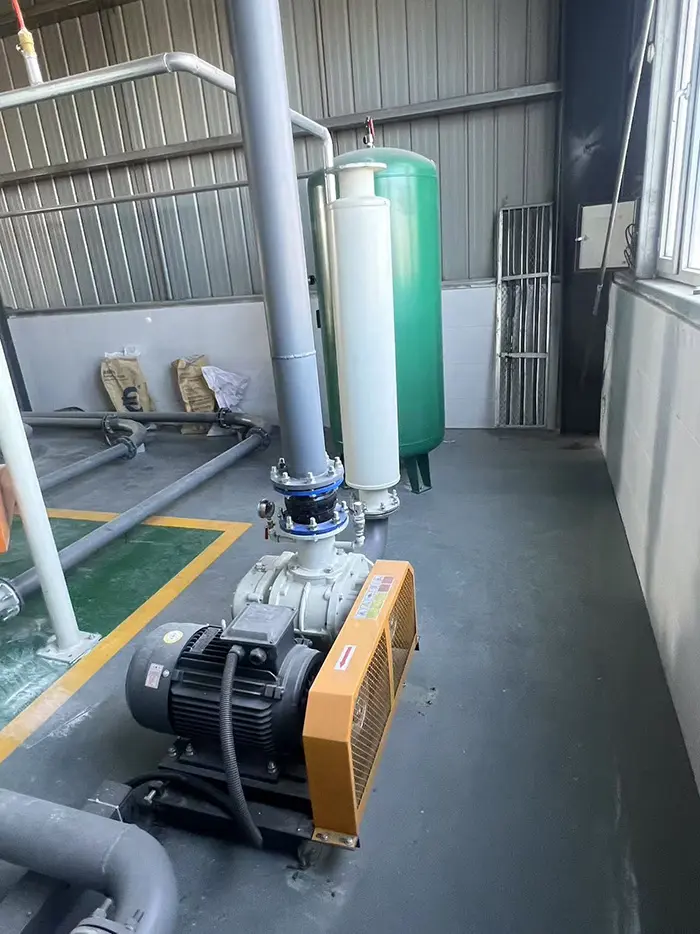
The core principle of pneumatic conveying of soybean meal powder is to use a gas source to form a pressure difference and airflow in a closed pipeline, so that the particles of soybean meal powder are suspended or move in groups with the airflow, achieving material conveying; The material is separated from the air by a gas-solid separation device at the end, and the exhaust gas is purified before being discharged. The following are three mainstream process forms for adapting soybean meal powder, all of which are qualitative descriptions without parameters: 1. The negative pressure power end is at the end of the system, and a negative pressure environment below atmospheric pressure is formed in the pipeline through a vacuum pump or negative pressure fan. The pressure difference draws external air and soybean meal powder into the pipeline together from the feed inlet, and the material is entrained by the airflow to form a gas-solid two-phase flow. After the mixture is transported to the end, it is first subjected to coarse separation by a cyclone separator, and then fine powder is filtered by a bag filter. The separated soybean meal powder falls into the silo. The purified exhaust gas is discharged after being silenced by a fan, and the entire process is sealed without dust escaping, suitable for the working condition of multi-point feeding to single point conveying. 2、 The positive pressure power end is located at the beginning of the system, and compressed air is introduced into the pipeline through a compressor or Roots blower to create a positive pressure environment higher than atmospheric pressure. Soybean meal powder is quantitatively fed into the pipeline through a feeder, and is transported forward along the pipeline in the form of suspension or group flow under the push of airflow. After reaching the destination, the material is discharged into the silo through the separator, and the remaining air is purified by the top dust collector before being discharged. Suitable for single point feeding to multi-point unloading, or long-distance, high-volume soybean meal powder transportation scenarios. 3、 The positive pressure dense phase adopts intermittent conveying mode, and the soybean meal powder first enters the bin pump tank. After completing the feeding, the feeding valve is closed. Inject compressed air into the warehouse pump to create a high-pressure environment inside the tank, while using the bottom gasification device to make the material fluidized and avoid accumulation. Open the discharge valve, and high-pressure airflow pushes the material into the pipeline in the form of a group flow, transporting it to the final material bin. After the transportation is completed, release the pressure inside the tank and enter the next feeding cycle, suitable for transporting high concentration and short distance soybean meal powder, which can effectively reduce pipeline wear. 4、 The key points of the process for transporting soybean meal powder are anti blocking and fluidization: Soybean meal powder has a certain degree of adhesion, and its flowability needs to be improved through gasification and arch breaking devices. At the same time, a suitable airflow pattern should be selected to avoid pipeline blockage. Sealing and dust removal: The entire process adopts sealed pipeline transportation, and the end is equipped with dust removal equipment, which not only prevents material loss but also meets environmental protection requirements. Explosion proof and protection: Soybean meal powder belongs to combustible dust, and the system needs to use explosion-proof equipment and set up anti-static grounding to avoid safety hazards. Case 1: A large feed factory in East China, as a leading enterprise in feed production in the region, needs to receive a large amount of soybean meal powder raw materials every day. The traditional unloading method is not only inefficient, but also due to the fine and easily flying characteristics of soybean meal powder particles, the dust pollution in the raw material receiving area of the factory is serious, and manual unloading is prone to material residue, increasing raw material loss. In response to this pain point, the factory adopts a mobile negative pressure suction unit in the raw material receiving process, which is specifically used for unloading and storing soybean meal powder in bulk tankers. During operation, the operator only needs to flexibly insert the suction nozzle into the discharge port of the tanker truck. After the vacuum pump at the end of the system is started, a stable negative pressure environment is quickly formed in the closed pipeline. Under the pressure difference, the external air enters the conveying pipeline with the soybean meal powder in the tanker truck, forming a uniform gas-solid mixture
- Unloading and storage of soybean meal powder tanker truck in feed mill
- Collect crushed soybean meal powder from small-scale oil and fat factories
- Transportation of soybean meal powder ingredients in the workshop of a large feed mill
- Transportation of soybean meal powder from grain and oil processing plant to packaging machine
READ MORE