
The principle of material gas separation in pneumatic conveying system
Pneumatic conveying systemThe exhaust emissions enter the pneumatic conveying system from the front production unit, and after a certain conveying distance, are sent to the rear unit by the gas-solid separation system, resulting in exhaust emissions. The pneumatic conveying system transports materials and belongs to the production process equipment. In the solid gas separation system, the powder material will be separated, so it usually consists of multiple stages, including a combination of cyclone dust collector and bag dust collector. The positive and negative pressure pneumatic conveying system process and exhaust emission source. If the feeding device can be a feeder or an upstream process equipment, it is not included in the pneumatic conveying system.The negative pressure pneumatic conveying system uses suction to discharge gas. After a certain conveying distance, the material and air are separated using a dust collector. The purified exhaust emissions meet national standards and are then discharged back into the atmosphere.
In general, the first few stages in the multi-stage solid gas separation of a pneumatic conveying system are considered as material separation facilities, and the final stage is considered as a pollution control facility. The source strength can be obtained through engineering calculations or actual measurements.
Environmental characteristics of pneumatic conveying
The pollution generating links of pneumatic conveying system include:
1. Powder feeding inlet fugitive dust source;
2. Exhaust gas from gas-solid separation system;
3. The powder enters the dust source of the downstream production unit, which is a scattered dust source;
If a positive pressure conveying system is used, there will be trace dust leakage at various static sealing points (flanges, etc.) of the pipeline.
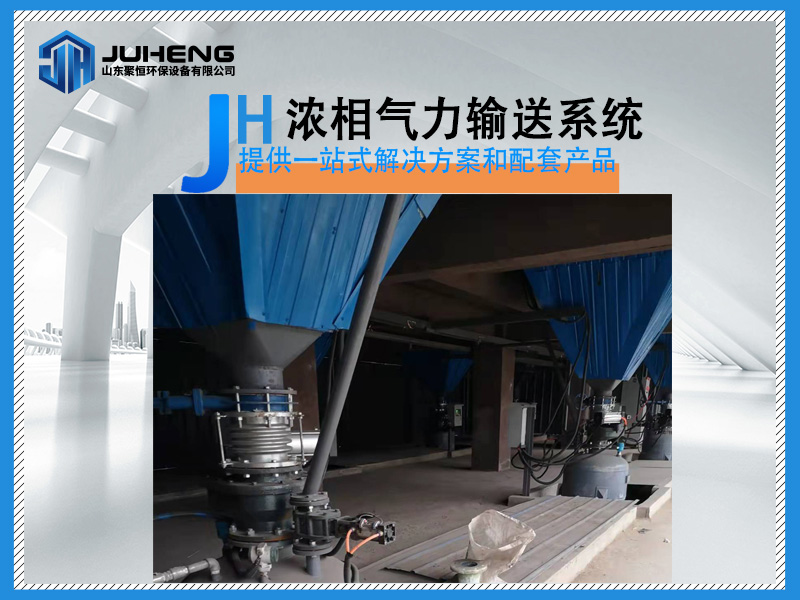
The environmental characteristics of pneumatic conveying systems are:
1. Generally, the total separation efficiency of pneumatic conveying systems is not less than 99.9%;
From the perspective of environmental management, the end gas solid separation facility can be referred to as a "dust collector", and the concentration and rate of material dust in the exhaust gas should meet the requirements of emission standards;
Compared with the collection/dust removal system of conventional fugitive dust sources, the gas-solid separation exhaust gas of pneumatic conveying systems has a smaller exhaust volume; High concentration.
Gas solid separation efficiency of pneumatic conveying system
Pneumatic conveying systemThe applicable range of material particle size and density is very large. For high-density powders and large particle size particles, the gas-solid separation efficiency of pneumatic conveying presents a different characterization from that of conventional ventilation and dust removal systems.