
How is blockage in pneumatic conveying pipelines caused
Inpneumatic conveyingHow did the blockage of the pipe occur? In general, pipe blockage is sent at the beginning stage of the outlet of the bin pump, because the airflow velocity is low and the flow rate is unstable during the outlet stage. As the frictional resistance during transportation consumes the energy of compressed air, the pressure in the pipeline gradually decreases, the specific volume increases, the volume of compressed air expands, and the flow rate increases, making it less prone to blockage. Even if the later section of the pipeline is blocked, because the later section usually adopts a diameter expansion design to control high flow rate, prevent wear, increase pipe diameter, reduce concentration, and have a higher initial velocity than the earlier section, it will automatically clear. Therefore, large particles are deposited at the bottom of the pipe, and when the flow velocity is within a certain range, the bottom flow can continue to be transported; When conveying materials with relatively large particle size in a plug like mannerThere may be airflow passing through the middle. At the same time, the pressure in front of the blocked area increases after embolization, which increases the static pressure for pushing the plug, causing the plug body to collapse and clear, and the delivery continues. Of course, when the bolt collapses, it can cause pressure fluctuations, vibrations, and sounds, which are commonly referred to in jargonIt is called 'shooting' in Chinese. Therefore, in the design, on the one hand, it is necessary to control the conveying speed reasonably, and on the other hand, attention should be paid to the strength of the rear pipe support and the clearance of the sliding support to avoid damaging the support and pipeline during "blasting" and causing accidents. The pipeline in pneumatic conveying is shown in the figure:
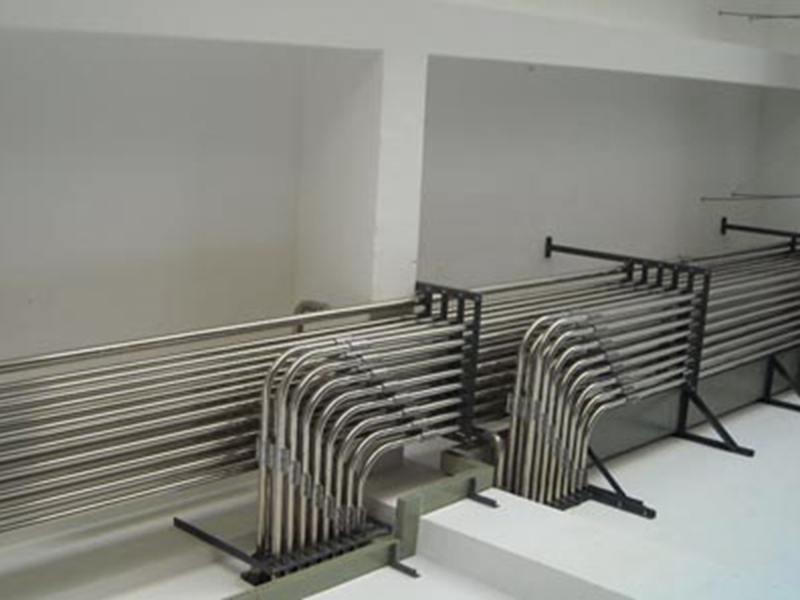
Pneumatic Pipeline
Pipeline blockage. There are many reasons for the blockage, such as the bend turning radius being too small or the diameter change not meeting the specifications. The key issue is to control the speed, and the blockage may be caused by one or more of the following reasons:
During the operation of pneumatic conveying, if the air source equipment is turned off, the material will deposit in the pipeline, causing blockage when the air source equipment is turned on again.
2. The failure of the wind source equipment leads to insufficient wind pressure and airflow in the pipeline, or when the gas supply station supplies gas, a large amount of gas leaks, resulting in insufficient wind pressure and gas volume, causing materials to deposit in the pipeline and form blockages.
3. Air pipeline leakage between the wind source equipment and the bin pump or ash conveying pipeline.
When designing a pneumatic conveying system, incorrect selection may result in low pressure or flow rate of the air compressor, leading to pipeline mismatch and inability to fully suspend and flow materials. When the inlet or outlet door of the warehouse pump leaks under conveying conditions, it is easy to cause pipe blockage in this situation.
5. In the operation of multiple bin pumps, leakage can lead to prolonged delivery time and also cause pipeline blockage during the delivery of other bin pumps.
6. The gap between the horseshoe tubes of the warehouse pump is too large, resulting in a high concentration of transportation and blockage.
7. Improper air regulation of the warehouse pump leads to high concentration and blockage.
8. Excessive material in the warehouse pump leads to insufficient gasification of the material, resulting in poor material fluidity and easy blockage.
9. The bag filter at the tail of the ash conveying pipe is not functioning properly, and the ash on the filter bag cannot fall off. The conveying back pressure is too high, causing blockage.
10. Due to the malfunction of the coal or electrostatic precipitator, the temperature of the fly ash decreases, the particles become coarse, the moisture and ash content increase, or the chemical composition changes, making the system unable to adapt to changing operating conditions.
11. The oil ash or cold ash during the initial start-up of the boiler is not suitable for the designed conveying conditions.
When transporting special materials, such as fly ash, due to moisture caused by rainwater, the ash conveying pipe cannot be fully opened, resulting in high local resistance or insufficient air supply, poor gasification of the ash hopper, poor material fluidity, and excessive material blockage caused by moisture in the ash removal pipe.
13. InPneumatic conveying systemWhen turned on, the opening sequence is not accurate. When the bin pump is turned on, the air compressor's air volume is still insufficient, resulting in material accumulation in the conveying pipe and pipeline blockage.