
The fluidization process and fluid characteristics of pneumatic conveying
pneumatic conveyingFluidization, also known as fluidization, is a process that involves bringing a solid particle layer (bed) into contact with gas moving through it, transforming it into a fluid like state that facilitates the flow of particulate materials, chemical reactions, and heat exchange.
1、 Ideal fluidization process and fluid like characteristics
1. The ideal fluidization process is equipped with a cylindrical container and a porous plate (sieve plate or gas distribution plate) installed at the bottom. Stack a layer of granular material (i.e. bed layer) on the porous plate.
When the gas velocity v is low, the velocity flowing through the particle gaps is also small, and the particles remain in contact with each other and remain in a stationary state. The bed height h remains unchanged, and this type of bed is called a packed layer or a fixed bed (see Figure 1). In a fixed bed, the void ratio e remains constant and the BF line remains constant; Due to the constant cross-sectional area of the gap flow, the gap gas velocity v varies with the empty tower gasSpeed v increases proportionally, AF line; If the gap channel size and gap velocity in a fixed bed are small, then the Re number is very small. Most of them are laminar motions, and their pressure loss is proportional to the power of v. Therefore, Δ p increases proportionally with v. CF line.
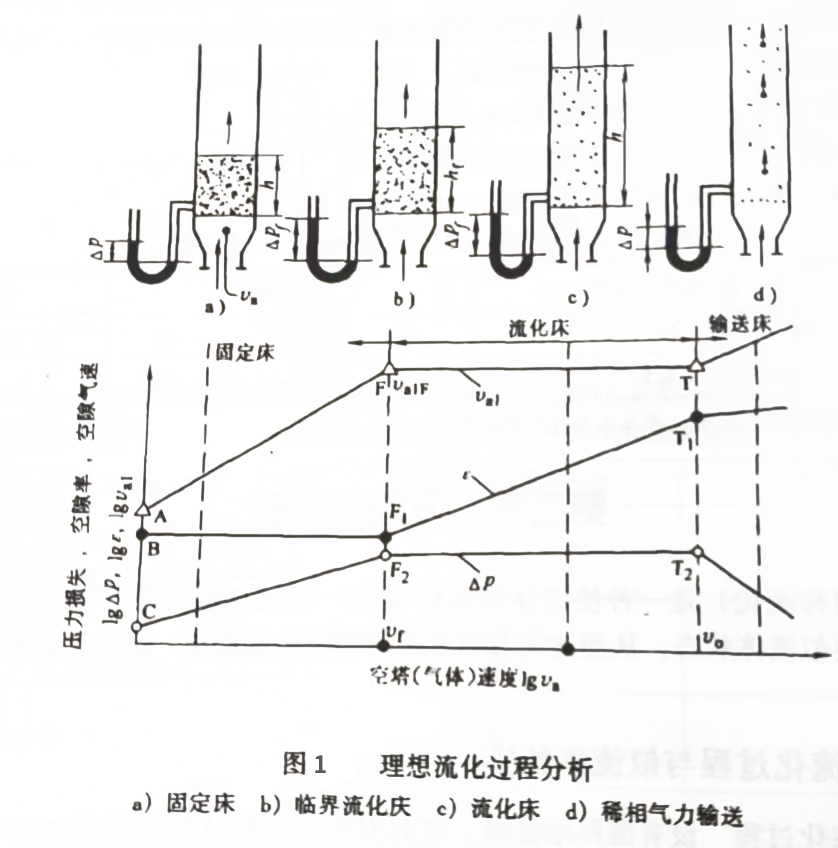
When the airflow velocity in the pneumatic conveying system increases to a certain value, there is slight movement between particles, but they still maintain contact. However, the bed becomes loose and slightly expands, and the bed height increases to h. At this time, the bed is in the initial or critical fluidized state, which is called the critical fluidized bed, and the empty tower velocity v at this time is called the critical fluidized velocity. Each particle in the critical fluidized bed is essentiallyThe air flow is suspended, so its pressure loss should be equal to the floating weight of the material layer per unit cross-sectional area of the empty tower, that is, the Δ p (=h (1-e()) (p-p) g at point F in 1, and the void velocity is the vaFo shown at point FWhen the airflow velocity is greater than v, the particle clusters loosen and disperse in the bed, the bed increases in height, and each particle floats in the airflow. But there is a clear upper interface. At this time, the gas-solid two-phase system has a flowability similar to that of a liquid, that is, an inlet fluidized bed, which is called a fluidized bed. In a fluidized bed, the bed height increases with the airflow velocity vThe void ratio increases proportionally with v, as indicated by the middle FT line. Due to the fact that the pressure loss in a fluidized bed is always equal to the floating weight of the upper layer per unit cross-section, the pressure loss in each stage of the fluidized bed is Δ p; And keeping it constant, the middle FT horizontal line will be proven later that H (1-;)=constant, which is more helpful for understanding. FT horizontal line indicatesThe void velocity remains constant in each stage of the fluidized bed because all particles are suspended by the airflow in each stage, and this suspension velocity is essentially.
2. The liquid like properties of fluidized beds involve a substance with a lower density than the bed layer floating on the bed surface, just like a substance floating on the water surface, and obeying Archimedes' law of buoyancy. When tilting the container, the interface on the bed remains horizontal, similar to the fluidity of a liquid. Make a hole in the wall of the device, and the gas-solid mixture will be subjected to a pressure difference (p-pa)Use it and let it flow out through the small hole. Under the pressure difference caused by the height difference Δ h between the two fluidized beds, they flow through the opening to the right until the interface between the last two beds is level. The pressure difference Op between any two points in a fluidized bed can be measured using a U-shaped differential pressure gauge, which is essentially equal to the floating weight of particles in the bed per unit cross-section between the two points. The above five situations,It has been demonstrated that the gas-solid two-phase mixing system in fluidized beds exhibits liquid like physical properties.
Pneumatic conveying systemThe disciplines and fields of design are very extensive, requiring not only strict calculations but also years of conveying experience. Shandong Juheng Environmental Protection Equipment Co., Ltd. has 13 years of experience in pneumatic conveying. If you need pneumatic conveying equipment, please feel free to contact us.