
Suspension velocity of particle groups in pneumatic conveying
Inpneumatic conveyingIn gas-solid two-phase flow, most of the materials transported are irregularly shaped particle groups.
1. The influence of irregularly shaped particles on suspension velocity: Among materials of the same weight, spherical particles have the highest suspension velocity, while other irregularly shaped particles have correspondingly lower suspension velocities. This is because the resistance coefficient of irregularly shaped particles is greater than that of spherical particles. Even for the same irregularly shaped particle, its drag coefficient varies due to its different orientations relative to the airflow. Therefore, in order to utilize the suspension velocity formula for spherical particles already obtained above, it is necessary to convert irregularly shaped particles into equivalent spheres. Use the diameter d of the volume equivalent sphere as the particle size of the irregularly shaped material for correction calculation.
According to the general expression of fluid dynamics (resistance) obtained earlier, when both are in suspension in the same pipeline and fluid medium, the floating weight W is in equilibrium with the fluid resistance. If we follow the formula, then
For irregularly shaped particles (with a volume of Vc)
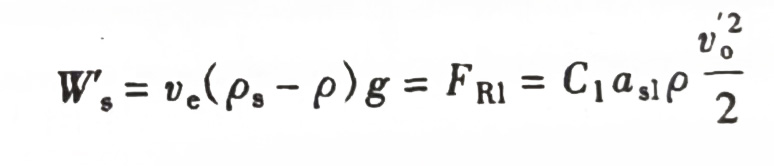
2. The suspension velocity of particle groups in pneumatic conveying and classification selection refers to the movement of a large number of particles within a certain range. Due to the fluid displacement caused by the falling particles, additional upwelling flow is generated. At this point, particle settling is not only subject to fluid resistance, but also to interference resistance from other particles due to the large number of particles, that is, particle group settling is subject to both direct and indirect resistance. Direct acting resistance refers to the friction and collision between particles and between particles and the pipe wall, resulting in resistance; The resistance of the interaction refers to the fluid displacement caused by the falling particles, resulting in additional upward flow resistance.
The resistance in these two aspects is related to the volume fraction of the particle group, denoted as. (where. is the ratio of the particle volume v to the air volume v, i.e..=Va/Va). The larger the volume fraction, the slower the settling (i.e. suspension) velocity. When the volume fraction is the same, the finer the particles and the more particles there are, on the one hand, the larger the surface area of the particles, the greater the resistance, and on the other hand, the more opportunities for friction and collision between particles, the greater the resistance, resulting in a decrease in settling velocity. So the interference settling velocity of the particle group, that is, the suspension velocity (Vn) of the particle group, is smaller than the free settling velocity (vo) of a single particle.
If you needPneumatic conveying equipment Welcome to contact us, our experts will develop a free plan based on the venue.Welcome to call 18660786555 for free consultation