
Actual fluidization process in pneumatic conveying
The previous article wasIdeal fluidization processThe relationship curve between pressure drop and gas velocity is very regular. The relationship curve between pressure drop and gas velocity in the actual fluidization process of pneumatic conveying is shown in Figure 1
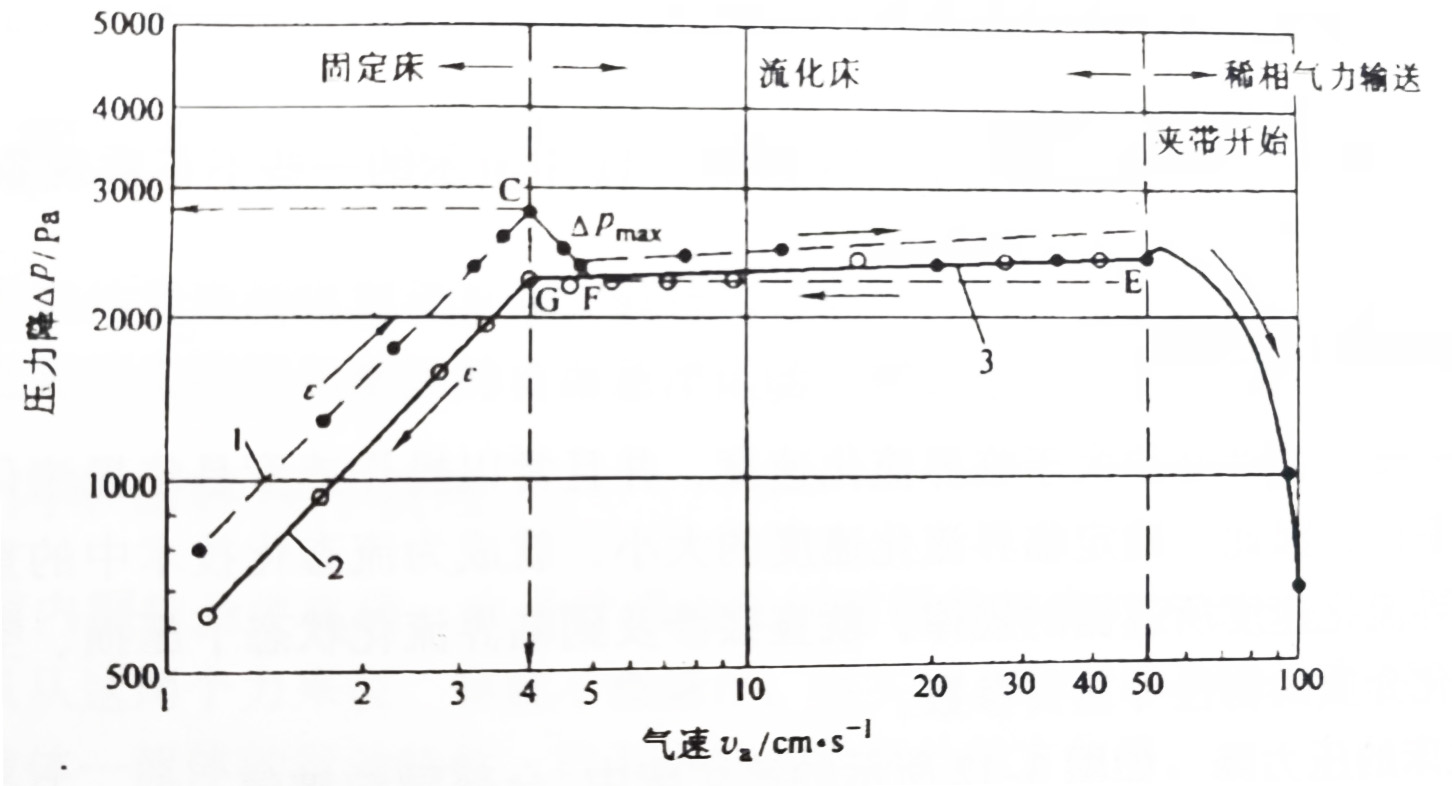
Figure 1
1. Fluidization experiment process
(1) The experiment of increasing the gas velocity v from small to large: the pressure drop at point C along curve 1 is the largest (Δ max), which is due to the transition of the particle group from static contact to loose dispersion, and the large inertial resistance entering fluidization. At this point, the particle group has already suspended, and the air aging rate e increases, resulting in an increase in gas velocity v. As e increases further, e increases even more, and its Δ p decreases, leading to a "hump" in the CF segment. After point F, it is the fluidization stage. As the bed height increases, the inertia resistance of particles further discretizes and the airflow resistance due to the increase in air velocity also increase. Therefore, in the fluidization stage after point F 6, Δ p gradually increases slightly with the increase of v, which is basically equal to the floating weight of the material layer. After point E, fine particles are carried by the airflow, and the retention decreases significantly, resulting in a significant decrease in particle pore resistance and a sharp decrease in Δ p.
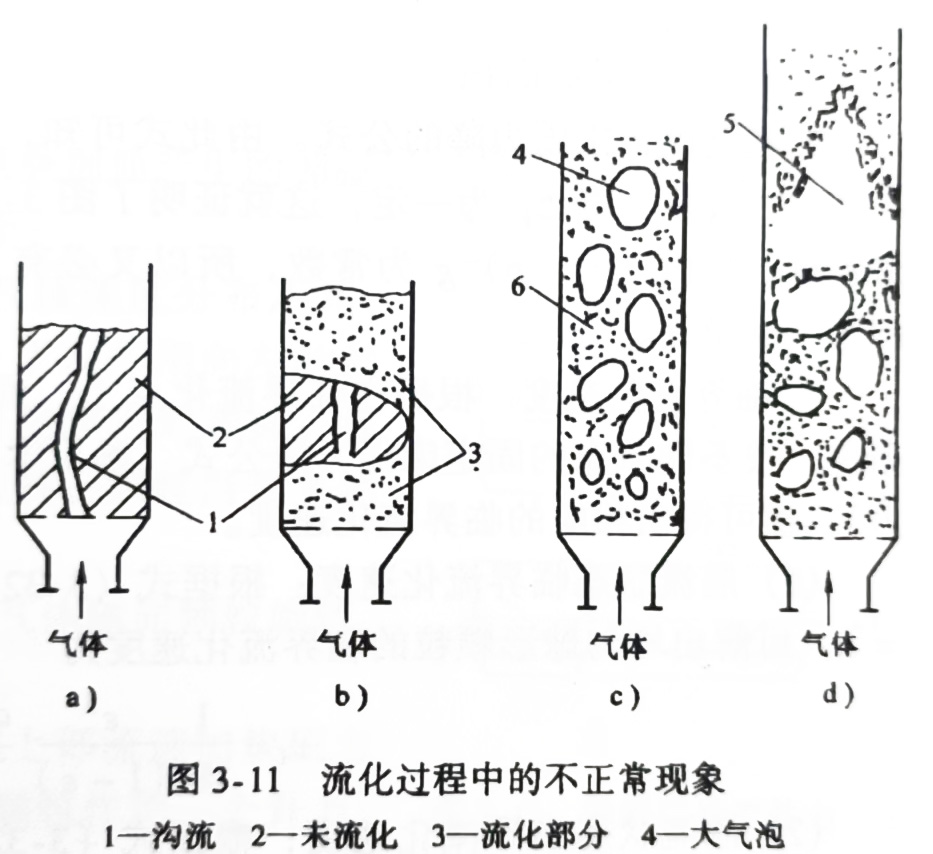
Figure 2
(2) Experiment with decreasing velocity: Under the condition of a) b) c) d) v in the fluidized curve 3, gradually decrease the velocity. Δ p still returns along curve 3, but does not return through the "hump", but returns along FG and then along line 2. This is because there is no inertial resistance as described in (1) when returning from a fluidized bed to a fixed bed.
2. The void fraction, boiling phenomenon, and abnormal phenomenon of the fluidized bed slow down along the 2nd line after fluidization and return to the fixed bed. Compared with the fixed bed stacked on it, it has the highest void fraction. But for fluidized beds, it is the smallest porosity, known as the critical porosity Ef0
It is emphasized that in the actual fluidization stage after point F in Figure 2, the air mainly rises in the form of bubbles in the bed, and aggregates or splits, causing particle clusters to become turbulent. When the airflow reaches the bed surface, it ruptures and carries out and splashes out particles. Due to the lower gas velocity at the interface compared to the gas velocity at the interface, these particles fall back again. The above complex situations result in frequent fluctuations and rolling of the upper interface, similar to the boiling phenomenon when a liquid reaches the boiling point. Therefore, gas-solid fluidized bed is also known as fluidized bed. Due to the complex phenomenon mentioned above, the pressure drop curve of the actual fluidization process is not the straight line 3 in Figure 2, but rather has a certain amplitude of pulsation above and below the line 3.
Due to the complexity of the fluidization process, abnormal phenomena such as channeling, large bubbles, surging, or air pockets often occur as shown in Figure 2.
Therefore, in pneumatic conveying, theoretical values cannot be used as data references. Only by combining the actual vulcanization process and years of experience can the designed pneumatic conveying system achieve the ideal state. If you needPneumatic conveying equipment If you are interested in learning about pneumatic conveying systems, please feel free to contact us.