
The influence of airflow velocity in pneumatic conveying
pneumatic conveyingAirflow velocity: When designing a suction type pneumatic conveying system, it is extremely important to determine the reasonable conveying airflow velocity for different materials correctly, which is related to the reliability and economy of the device's operation. This is also the key to determining the performance of the conveying device. Usually, each material has an optimal air velocity that can ensure the particle group is in a suspended state for normal transportation, which is called the safe transportation air velocity or economic velocity. If the selected conveying speed is much higher than the safe speed, although the device can safely convey materials, the pressure loss generated by the system is too high, the power consumption increases, and it will also exacerbate the wear of the piping system (such as bends and the bottom wall of the horizontal pipe connected to them), causing the breakage of brittle materials. This is not allowed for certain materials with strict quality requirements, such as seeds, grains, and certain raw materials. On the contrary, if the selected airflow conveying speed is lower than the safe speed, it is easy to form pulsating flow, and the pressure loss will also increase sharply. Moreover, the pipeline is prone to blockage, especially for high humidity and viscous granular materials, which can easily settle and bond near the bend and feeding device, at the bottom of horizontal or inclined pipes, causing the device to malfunction. From this perspective, in order for the device to reliably and economically transport, it is necessary to select a reasonable conveying airflow speed based on safety speed. The safe speed is related to many factors such as the particle size, weight, shape and surface state of material particles, pipeline layout and structural characteristics, mixing ratio, suspension speed, etc. It is difficult to accurately calculate and is generally determined by experiments and practical experience.
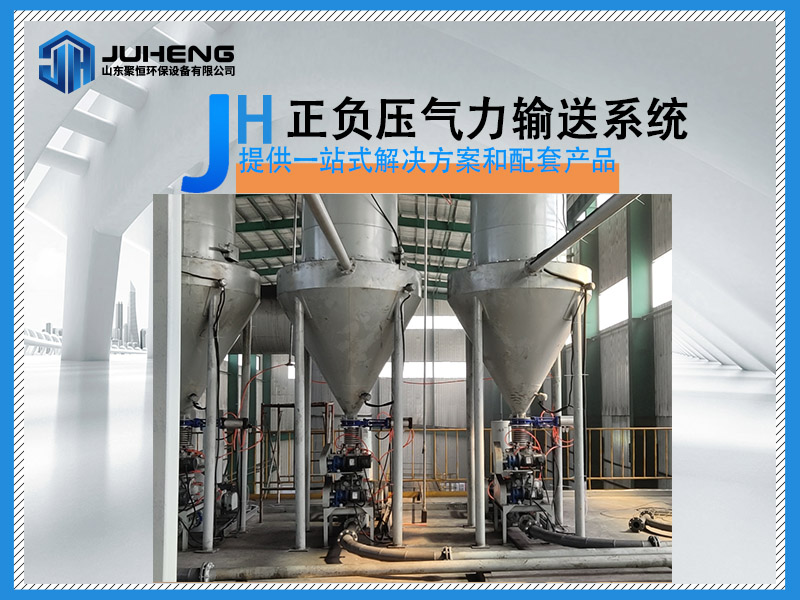
Positive and negative pressure pneumatic conveying system
Due to the limited experimental data on the safe speed of various materials, in practical design, the reasonable conveying airflow speed is often determined by the suspension speed of the materials. According to theory, materials can be transported by pneumatic conveying in a vertical pipe with an airflow velocity slightly higher than their suspension velocity. However, in the actual transportation process of materials, due to collisions, friction, adhesion between particles and between particles and the pipe wall, as well as the loss of kinetic energy when material particles flow around the bent pipe, and considering that the pneumatic transportation of materials in horizontal pipes is more prone to sedimentation and blockage compared to vertical pipe transportation, it is required that horizontal pipes have a higher transportation speed than vertical pipes. Therefore, the reasonable transportation speed of various materials generally requires several times higher than the suspension speed. Moreover, the determined reasonable conveying speed must also ensure that the device can transport materials normally for a long time. Therefore, the following factors should be considered for their possible impact:
1) Changes in the working performance of the blower. After long-term operation, the blower inevitably contains dust in the air it sucks in, especially in suction devices with low dust removal efficiency, which can cause wear and tear on the fan impeller and housing, resulting in increased internal slip flow of the fan and a decrease in the conveying air volume, leading to a decrease in the conveying air speed of the conveying pipe.
2) Leakage in the piping system. After long-term operation, pneumatic conveying devices often experience loosening of certain connecting components in the piping system or wear and leakage of certain moving parts such as rotary elbows, telescopic conveying pipes, impeller unloaders, and ash unloaders, resulting in a decrease in the conveying speed of the conveying pipes.
3) Possible changes in the variety of conveyed materials and the physical properties of a certain type of material. The reasonable conveying wind speed required for conveying a single variety of materials is basically fixed and the selection is relatively simple. However, in practical applications, even materials of the same type (such as coal, sand, etc.) often have very different physical properties (such as average particle size and particle size distribution, humidity, brittleness, flowability, etc.), so the required conveying wind speed is also different. Some similar materials have different varieties, such as grains (rice, wheat, peanuts, soybeans, corn, etc.), and their required conveying speeds are also different. As for the multi-purpose conveying device that requires the transportation of multiple materials, the required conveying wind speed is even more different. Therefore, when selecting a reasonable conveying wind speed, it is necessary to comprehensively consider the possible changes in the characteristics and types of the transported materials, and determine the reasonable conveying wind speed based on the material with the largest and most representative conveying volume.
4) The pneumatic conveying system requires a certain reserve of conveying capacity. During the operation of the conveying device, it is often necessary to temporarily stop the operation due to the failure of its supporting machinery or the device itself, or for some other reason, or to stop the device during normal operation due to the failure to completely suck and unload the materials inside the pipe, resulting in the accumulation of materials in the conveying pipe. In this case, when the device restarts operation, a higher wind speed is required to blow through the residual material inside the pipe and restore normal operation of the device.
5) Changes in meteorological conditions. Usually in suction typepneumatic conveyingWhen designing and calculating the system, the conveying airflow velocity (i.e. the reasonable conveying wind speed at the starting section of the conveying device) is calculated based on the air volume under standard conditions. In practical use, the conveying device mostly undergoes changes in meteorological conditions throughout the year. The air sucked in is free air, so the actual conveying wind speed and calculated value are different due to changes in air density and temperature at different times, which also affects the conveying state.
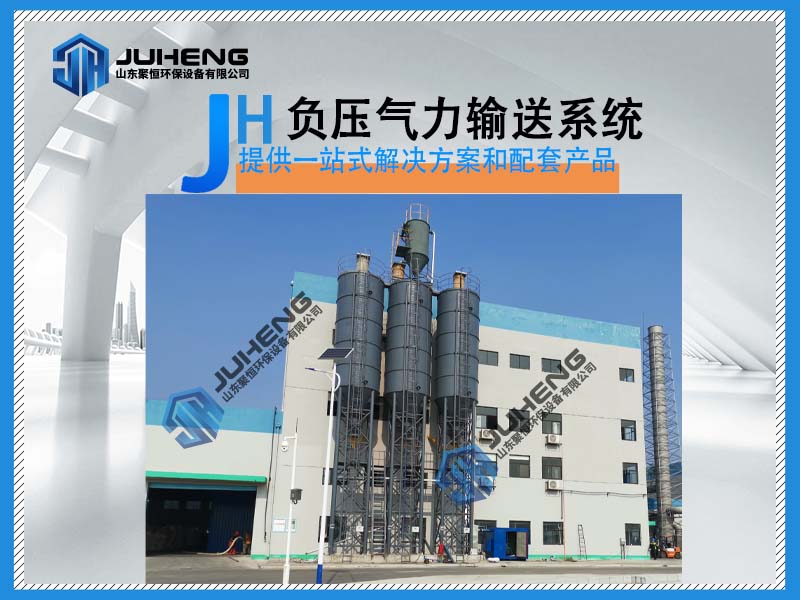
Negative pressure pneumatic conveying system
Taking into account the various influencing factors mentioned above, as well as the characteristics of the conveying distance and number of bends of the device's conveying pipe, the reasonable conveying speed selected must be higher than the safe speed. For loose materials with uniform particle size, a reasonable conveying speed of 1.5-2.5 times their suspension speed is generally taken to ensure normal conveying. For materials with non-uniform particle size distribution, such as coal, if the reasonable conveying speed is determined based on the maximum or minimum particle suspension velocity, it will result in the disadvantage of high or low conveying speed. Practice has shown that when conveying materials with non-uniform particle size, due to the higher conveying speed of fine particles compared to large particles, the force diagram of small particle groups bypasses large particles and promotes the advancement of large particle materials during the conveying process, allowing materials with different particle sizes to be transported normally. Therefore, in practice, using an airflow velocity twice as high as the suspension velocity measured by the largest particle group with the highest proportion of particle size distribution as the reasonable conveying speed for this material can basically ensure normal conveying. For example, for coal with particle sizes ranging from powder to 200mm, the weight of particles with particle sizes below 7mm accounts for more than 60% to 70%. The suspension velocity of coal particles with particle sizes of 7mm was measured to be 9m/s. Therefore, a reasonable air flow conveying speed of 18-20m/s can be used for normal conveying. As for powdered or fibrous materials, although their suspension speed is generally low, some materials are prone to residue and adhesion to the pipe wall during transportation, and a sufficiently high airflow speed is necessary to disperse them. Therefore, it is often necessary to use airflow speeds several times or even ten times higher than the suspension speed for normal transportation, such as cement.