
The conveying speed of pneumatic conveying materials
The movement speed of the conveyed material:pneumatic conveyingIn the middle, the movement speed of the transported material particles is slower than the airflow speed, and there is a speed difference between the two. The aerodynamic force that drives particle movement is the resistance generated by the velocity difference of the airflow passing around the particles. In other words, the energy that causes particle movement is transferred from the airflow to the particles through the velocity difference. Therefore, the velocity of material particles in the conveying pipe is the basis for calculating the pressure loss of two-phase flow.
Due to the complexity of two-phase flow testing technology, it is still difficult to provide complete and accurate data on material movement speed. Therefore, in the actual calculation of suction conveying systems, some approximate solving methods are still used.
For vertical conveying pipes, the velocity of material particles reaching stable motion vs (m/s) can be approximately taken as
Vs≈Va-Vo
In the formula, Va--Airflow velocity (m/s);
Vo--Material suspension velocity (m/s).
The particle velocity V of the material in the vertical acceleration stage can be determined based on the parameter m1 and the presence of Va/V. The Vs/Va value can be obtained from Figure 1, and based on the known Va value, the Vs value can be calculated. Parameter m can be calculated using the following formula:
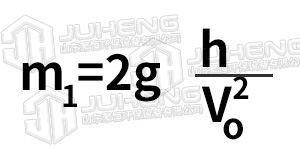
In the equation, g represents the acceleration due to gravity, g=9.81m/s2;
H - Vertical conveying pipe height (m).
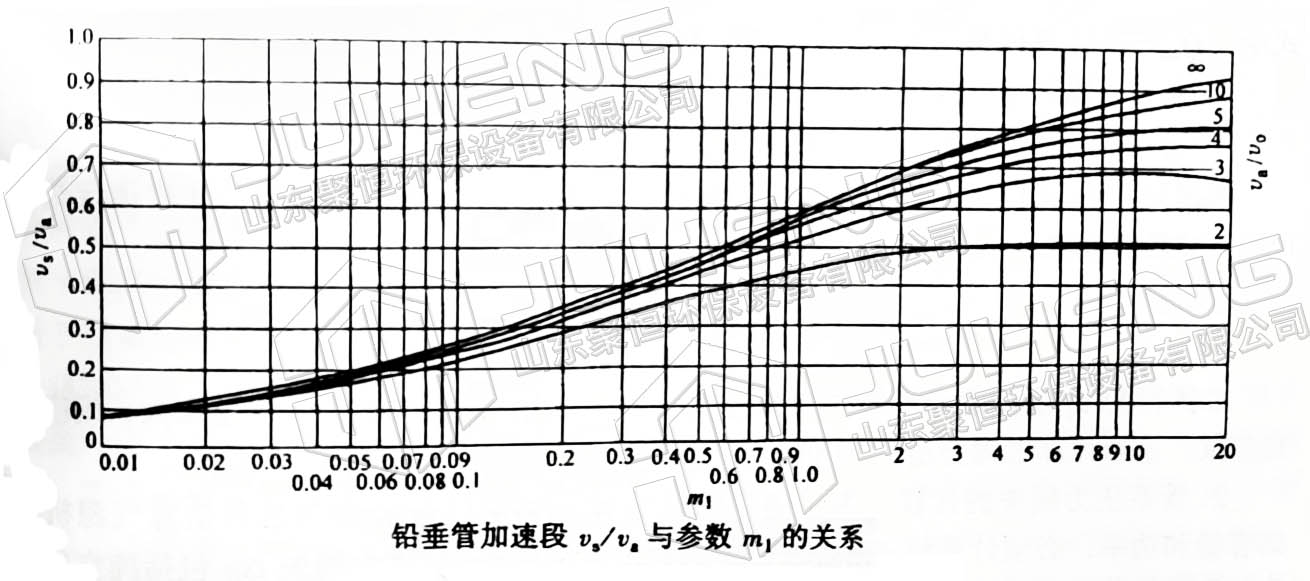
Figure 1
For horizontal conveying pipes, the velocity of material particles reaching stable motion vs (m/s) can generally be approximated by the following equation:
Vs≈(0.7~0.85)Va
For particles with larger particle size and density, the v value should be taken as the smaller value, otherwise the larger value should be taken.
In the horizontal acceleration stage before reaching a stable motion state, the particle's motion speed v can be determined based on the parameter mz and v./v during stable transport. Value, obtained by checking v/v. The value of v can be calculated based on the known value of v;sValue.
Parameter m2It can be calculated by the following formula:
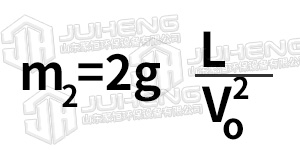
In the formula, the length of the L-horizontal conveying pipe (m).