
Calculation method of pneumatic conveying system
When designing calculations, the first step is to meet the required conveying performance. In addition, the production task and future planning shall be carefully considered. The selected equipment shall be progressiveness in performance, and the convenience of use and maintenance shall be fully consideredpneumatic conveyingTherefore, in the calculation, estimation and continuous adjustment are first carried out, followed by correction to make the calculation results closer to reality.
The calculation of pressure pneumatic conveying mainly includes the following main parameters:
When the airflow velocity v of pneumatic conveying is in the pipeline, particles can be transported when they are subjected to the action of the airflow and the airflow velocity is greater than the settling velocity of the particles.
From the perspective of reducing the power of the gas source machinery, the lower the airflow velocity, the better. But if the speed is too low, it may cause blockage; If it is too large, the power will increase, and it will exacerbate the wear of pipelines, especially bends, and also increase the size of separators and dust collectors. The minimum speed of conveying materials varies with the physical properties of material particles, mixing ratio, structure of the sending tank, and the diameter and length of the conveying pipe. Therefore, choosing the appropriate conveying airflow speed is crucial. The general method for determining the conveying airflow velocity is to first calculate or measure the settling velocity of particles based on the design, and then select an empirical coefficient based on the length and mixing ratio of the conveying pipe to determine the appropriate conveying airflow velocity. Empirical coefficient for conveying airflow velocity. When the mixing ratio is large, a larger value can be taken.
2. The required air volume for pneumatic conveying is
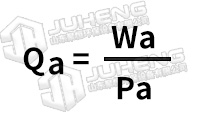
in the formula Wa - the weight of air required for transportation, Wa=Ws/m;
Ws - weight of material transported per unit time;
M - mixing ratio
Pa - density of air
Therefore:
In fact, air is compressible and expands in the conveying pipe. The calculation method for pressure loss of air compressibility should be segmented to obtain the total pressure loss. The pressure loss value calculated considering air compressibility is smaller than when not considered, but closer to reality, so it is reasonable to calculate according to the above formula.
Power air compressors are traditionally measured by the power consumption per cubic meter of gas per minute (kw) at an exhaust pressure of 0.68 MPa, which is the specific power. For compressors with 10m/min ≤ Vm ≤ 100 ㎡/min, the specific power is N,=5.0~5.5.
Refer to the product catalog based on the calculated power to determine the corresponding air volume and pressure for the air compressor. The power of the selected product is generally slightly higher than the calculated value.
It is worth noting that the pressure value of the selected air compressor must be greater than the calculated value, otherwise it must be redesigned or the feeding pipe diameter must be increased to reduce the mixing ratio; Improve the direction of the conveying pipe, shorten the conveying distance, improve or select system equipment with low resistance loss, and reduce conveying pressure.
in designPneumatic conveying systemWhen it comes to transportation, it is not only necessary to make precise calculations, but also to combine years of transportation experience to design the optimal transportation plan based on different sites and materials.