
What are the factors that affect the working performance of the rotary feeder
influencerotary feederThe working performance of rotary feeders is generally affected by factors such as air leakage, number of blades, feed inlet width, rotational speed, material characteristics, blade shape, etc. Let's take a look at the factors that affect the working performance of rotary feeders.
(1) Leakage: Due to the pressure difference between the feeding and discharging sides of the rotary feeder, the upward high-pressure airflow brought in through the gap leakage and impeller compartment will hinder the smooth entry of material particles into the rotary feeder compartment, resulting in a decrease in the filling coefficient and throughput capacity of the rotary feeder, and also accelerating the wear of internal components of the rotary feeder. A large amount of reverse airflow leaks through the rotating feeder, which can also reduce the gas flow through the conveyor line and lower the conveying wind speed, potentially leading to deterioration of conveying conditions and decreased productivity. When the air leakage is severe, it can even cause blockage of the conveying pipeline. In order to ensure the normal and stable delivery of the system, more margin must be considered when selecting fans, which means that the energy consumption of the system will also increase accordingly. Therefore, air leakage is the first issue that should be taken seriously in affecting the performance of rotary feeders and gas conveying systems, and should be carefully considered in design. Usually, the leakage rate of the rotary feeder can reach 12% to 15% of the total air volume of the fan.
(2) Number of blades: Determining the number of wheel blades is also crucial for reducing air leakage and improving the performance of the rotary feeder. Generally speaking, a 6-bladed impeller can ensure that at least one blade on each side between the inlet and outlet effectively functions as a labyrinth seal during operation; An impeller with 8 blades has at least 2 blades, and an impeller with 10 blades has at least 3 blades that can provide a labyrinth seal. In terms of limiting air leakage from the perspective of pressure difference, a 10 blade impeller is suitable for a pressure difference of 50-100kPa (gauge pressure), 8 blades are suitable for a pressure difference of 50kPa, and 6 blades are suitable for a pressure difference of 20kPa
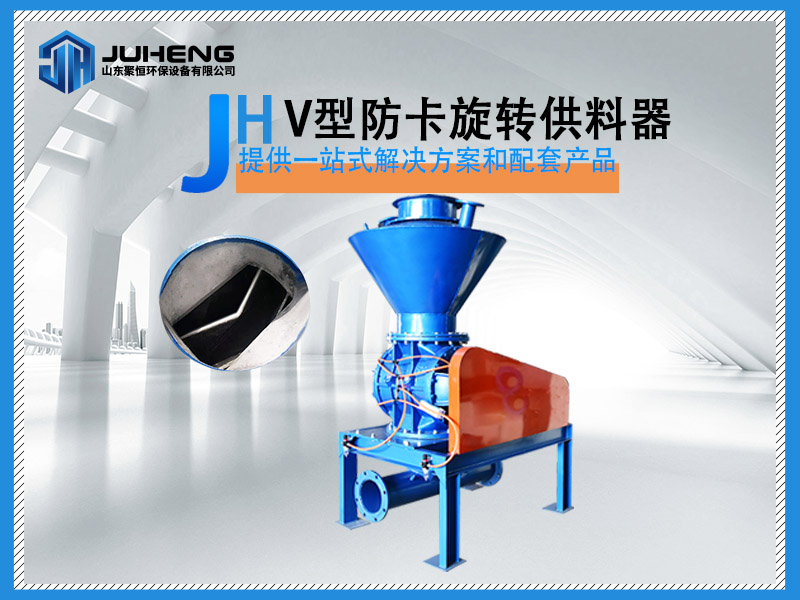
For high vacuum suction systems, the rotating feeder impeller should ensure that at least two blades are in contact with the housing on each side from the feed inlet to the discharge outlet during operation.
If the number of blades is too small, it is not enough to prevent leakage. If the number is too large, the angle between the blades will become smaller, causing the grid formed by the blades to narrow, which may make it difficult for the material to fall down from the impeller and hinder the entry and discharge of larger pieces of material. For powder materials with good fluidity and high sealing requirements, a larger number of blades can be used, but the maximum number should not exceed 10.
(3) Feed inlet width: The quantity of material entering the feeder under the specified rotation is related to the feed speed and feed cross-section. When the feeding speed and the length of the feeding port (usually equal to the effective length of the impeller) are given, the throughput of the rotating feeder and the filling coefficient of the impeller compartment are only related to the width of the feeding port. Under the condition of meeting the structural airtightness requirements, as the width increases, its throughput capacity and filling coefficient will also increase and improve accordingly. The minimum cross-sectional area of the feed inlet of the rotary feeder should ensure that the material can fall freely, and generally should be 2-4 times larger than the cross-sectional area of the conveying pipe.
(4) Rotational speed: It also has a significant impact on the ability of the rotor. At low speed, the impeller chamber has sufficient time to feed into the feed inlet, and at this time, the throughput capacity increases proportionally with the speed. In theory, its maximum throughput capacity can only reach the maximum feeding amount value limited by the cross-section of the feeding port. In fact, due to the rotation of the impeller, pressure difference, and leakage airflow, the feeding speed is the most affected, and its effective maximum throughput capacity is always lower than the theoretical maximum feeding amount. When the passing capacity reaches its maximum value with the increase of rotational speed, if the impeller speed continues to increase, the impact rebound effect of particles on the blades will intensify, causing the feeding speed of the material to decrease, and its passing capacity will actually decrease. From the perspective of the discharge port, particles obtain angular velocity due to rotation within the impeller, and they do not fall completely vertically at the discharge port. When the speed is low, the particles have sufficient time to decrease, and the material in the compartment can be completely emptied. But at high speeds, some particles cannot be discharged in time and are brought back, resulting in a decrease in throughput capacity. For lightweight materials, this effect is more pronounced due to their low free fall speed.
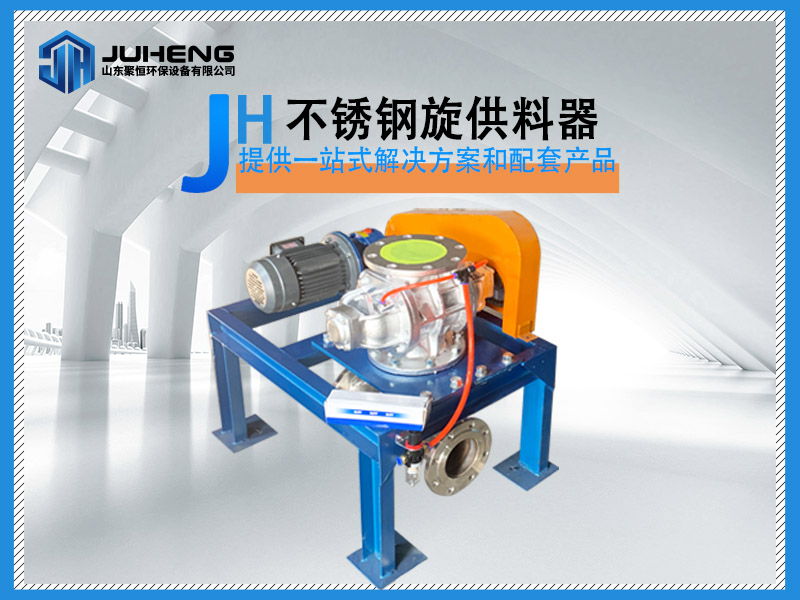
The rotation speed of the rotary feeder is usually selected between 15~50r/min, and should be comprehensively considered based on the material characteristics and the structural form of the rotary feeder.
(5) Material characteristics: The material characteristics that affect the performance of the rotary feeder mainly include fluidity, density, and bulk density, particle size distribution, viscosity, grindability, corrosiveness, hardness, flowability, etc. These physical properties have practical significance in determining the structural form and manufacturing materials of the rotary feeder, the filling coefficient of the rotary feeder, and related parameters. Generally speaking, particles with smooth surfaces, uniform particle size, good flowability, and high density can be smoothly fed and discharged due to their high falling speed and low resistance during the loading and discharging process, thereby increasing the filling coefficient and throughput capacity of the rotary feeder.
(6) Blade shape: During the process of feeding materials into the rotating feeder, the blade shape has a significant impact on the filling condition of the compartment. Through the analysis of the particle motion trajectory of the rotating feeder, it is found that the most widely used central feeding and radial linear blade discharge feeding conditions are not very favorable because some of the material flowing into it will be bounced back by the blades. For the central feeding situation, if blades bent in the direction of rotation that are adapted to the particle motion trajectory are used, the feeding conditions are better, and the friction and collision effects of particles entering the cell are smaller, resulting in higher filling coefficients and passage energy-
(7) Feeding angle: The feeding angle is one of the important structural parameters of the rotating feeder. The feed angle refers to the central angle between the radial vector of particle gravity at the intersection of the feed inlet centerline and the outer circle of the impeller, and the vertical centerline of the impeller. It determines the feeding position on the circumference of the rotating feeder housing, that is, the eccentricity of the feeding. In the case of eccentric feeding, it is possible to obtain the shortest possible particle radial feeding trajectory on the impeller by selecting appropriate and coordinated impeller outer radius, angular velocity, feeding velocity, and feeding angle. Therefore, using radially installed blades can achieve a higher filling coefficient. The experiment shows that the radial linear blade impeller with eccentric feed (feed angle>15 °) offset towards the direction of rotation has a greater passing capacity than the forward curved blade impeller with central feed. The filling coefficient of eccentric feeding with the feeding port moving against the rotation direction is different from that of the central feeding. This is because the shape of the blades is not consistent with the trajectory of the particles, and the particles entering the impeller are disturbed by the impact and rebound of the blades, which interferes with the filling process.
(8) Discharge port: Its position is generally determined by the structure and conveying process requirements, with the majority located in the center. The length of the discharge port section is usually equal to the effective length of the impeller, just like the feeding port. In order to achieve a high throughput capacity for the rotary feeder, in addition to requiring the compartment to be filled as much as possible, it is also necessary to empty it as completely as possible. Therefore, the width of the discharge port section should be based on the emptying conditions of the compartment, that is, the discharge angle (at the moment when the discharge starts, it is at the bottom of the compartment)
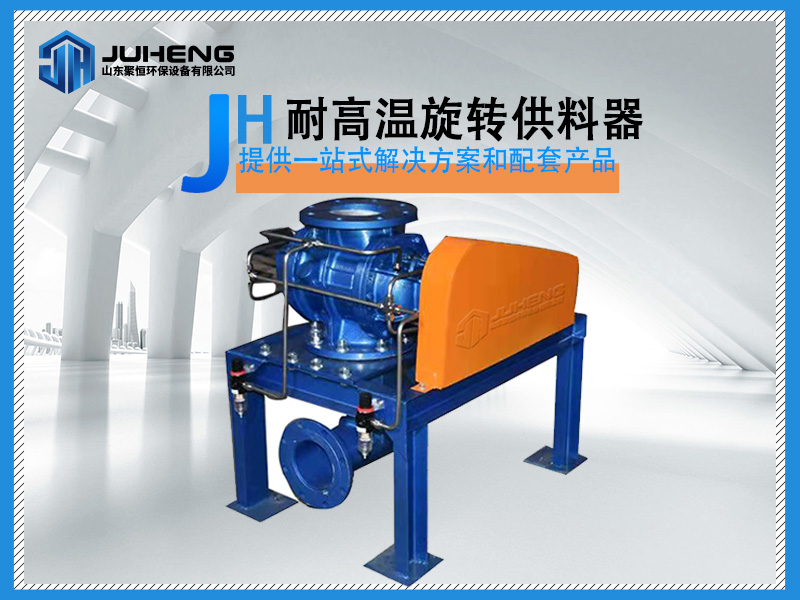
The angle between the radial vector of particle gravity and the radial vector of gravity when the particle moves to the outer circle of the impeller and is discharged from the impeller should be at least equal to or greater than the chord length corresponding to the discharge angle.
In addition to the aforementioned factors, there are also factors that affect the performance of the rotary feeder, such as temperature, structural strength, stiffness, manufacturing accuracy, and assembly quality of the rotary feeder body.