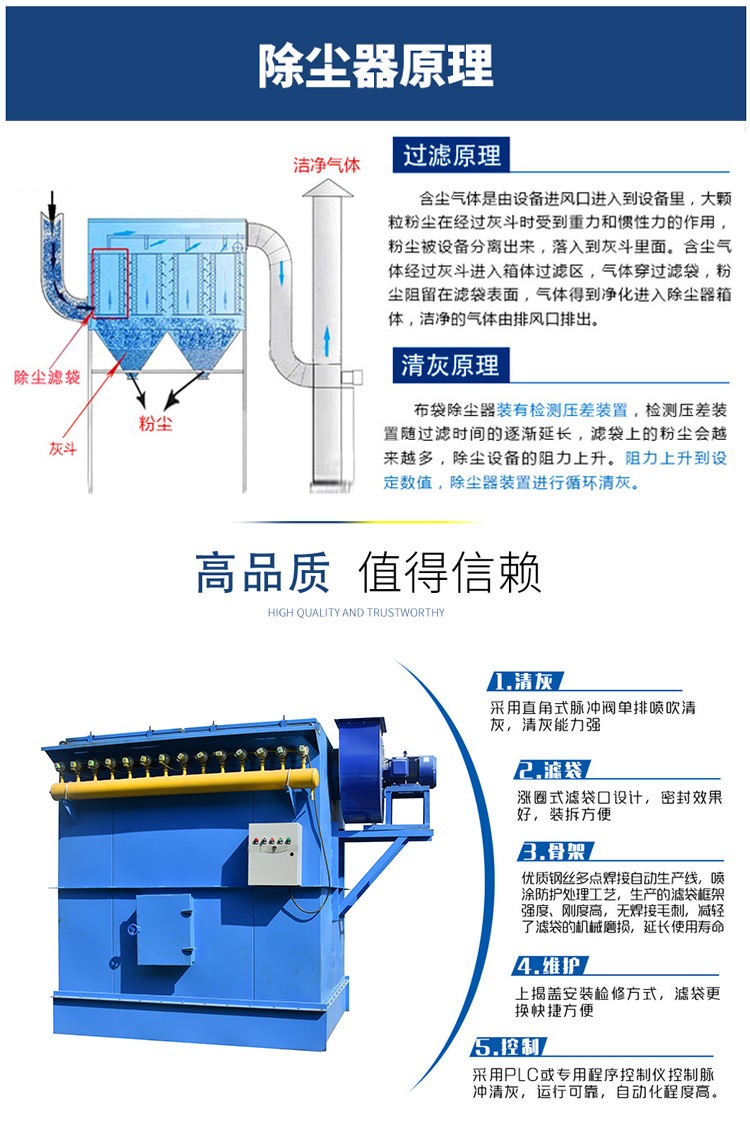
Working principle of pneumatic conveying bag filter
bag filterIt is an efficient purification device that uses filter bags made of organic or inorganic fiber fabrics to filter out dust in the airflow. Used to capture non sticky, non fibrous industrial dust and volatiles. The capture of dust particles can reach 0.1pm, and the efficiency is generally stable at over 99%, but it is not suitable for filtering dust containing oil mist, condensed water, and viscosity. It has a large volume, high equipment investment and maintenance costs, and a complex control system.
1. Working principle: Currently, there are many types of bag filters, but there are only two ways to filter dust: one is the external filter type, where the dusty gas flows from the outside to the inside of the filter bag, and the dust is trapped on the outer surface; Another type is the internal filter type, in which the direction of the dusty gas is opposite to the former, and the dust is trapped on the inner surface of the filter bag.
(1) Gravity settling: Dust with large particles and high specific gravity settles under the action of gravity.
(2) Screening effect: When the particle size of dust is larger than the pore size between the filter cloth fibers or the pores of the dust layer adsorbed on the surface of the filter material, the dust is retained.
(3) Collision effect: When the dusty airflow approaches the filter fiber, dust with a particle size greater than 1um remains in its original direction due to inertia and collides with the filter fiber to be captured. This collision effect increases with the increase of dust particle size and wind speed.
(4) Hooking effect: When the dusty gas flows around the filter fiber, fine dust still remains in the streamline. Due to the tight streamline, if the radius of the dust particles exceeds the distance from the center of the dust to the edge of the fiber, the dust particles will come into contact with the filter fiber and be "hooked" and captured. This effect is enhanced as the density of the filter fiber, i.e. the porosity, decreases.
(5) Diffusion effect: Due to the power transmission generated by the Brownian motion of gas molecules, fine dust particles deviate from the streamline and move irregularly, thereby increasing the chance of contact between dust and fibers and trapping dust. This diffusion effect is influenced by the wind
The decrease in speed and the reduction in fiber and dust particle diameter enhance the strength.
(6) Electrostatic effect: When the charge of dust is opposite to that of the filter material, the dust will be adsorbed on the filter material, improving the filtration efficiency, but dust removal is more difficult. When the charges of dust and filter media are the same, dust particles will be repelled and the filtration efficiency will decrease. This electrostatic effect is only manifested when the dust particles are less than 1m and the wind speed is very low. If an external electric field is applied, it can enhance this effect. Improve dust removal efficiency.
The above effects often play a comprehensive role in the actual filtration process, but their impact on filtration performance varies with changes in filter material material, pores, dust characteristics, airflow, and other factors. For example, pores in plain cloth exist between warp, weft, and fibers (the latter accounting for 30% to 50% of all pores). When starting to filter dust, most of the airflow passes through the pores between warp and weft, with only a small portion passing through the gaps between fibers (almost not through high twist yarns). Due to the embedding of coarse dust particles into the pores, the airflow through the fiber gaps increases, and some fine dust particles are also embedded in the middle of the fiber gaps. In this way, the filter cloth and the embedded coarse and fine dust particles together form an effective filtering medium. Due to the above effect, a certain thickness of dust layer will accumulate on the surface area of the filter host, forming a so-called secondary filter medium. The filtration and capture of dust are mainly carried out by the dust layer of the above-mentioned dust containing filter material and secondary filter medium. Velvet is a fabric made of plain cloth that is pulled and scraped into a pile with fluff by a velvet machine. When this filter material starts filtering dust, the dust particles are first captured by the porous fluff layer covering the pores of the yarn. The warp and weft woven fluff mostly serves as a load-bearing support for the porous fluff layer of the velvet fabric itself and the thicker dust layer adsorbed on the fluff layer, resulting in a larger dust holding capacity and higher filtration efficiency than plain fabric.
Generally speaking, the high efficiency of bag filter mainly relies on the dust layer established on the filter material. The filtering effect of the dust layer is more important than that of the filter material itself, and the filter material usually plays a skeleton support role.
The working temperature range of bag filter. Generally speaking, the minimum temperature of the dusty airflow entering the dust collector should be about 10 ℃ higher than the dew point to prevent moisture condensation from causing clumping of the dust layer on the surface of the filter bag, which is difficult to shake off and affects the continued operation of the dust collector. The maximum operating temperature depends on the filter material.
Bag filter plays a role in separating material and gas in pneumatic conveying,Shandong Juheng Environmental Protection Equipment Co., LtdThe bag filter produced has the characteristics of high reliability, stable dust removal, high degree of automation, and meticulous workmanship.