
Installation and commissioning of pneumatic conveying system
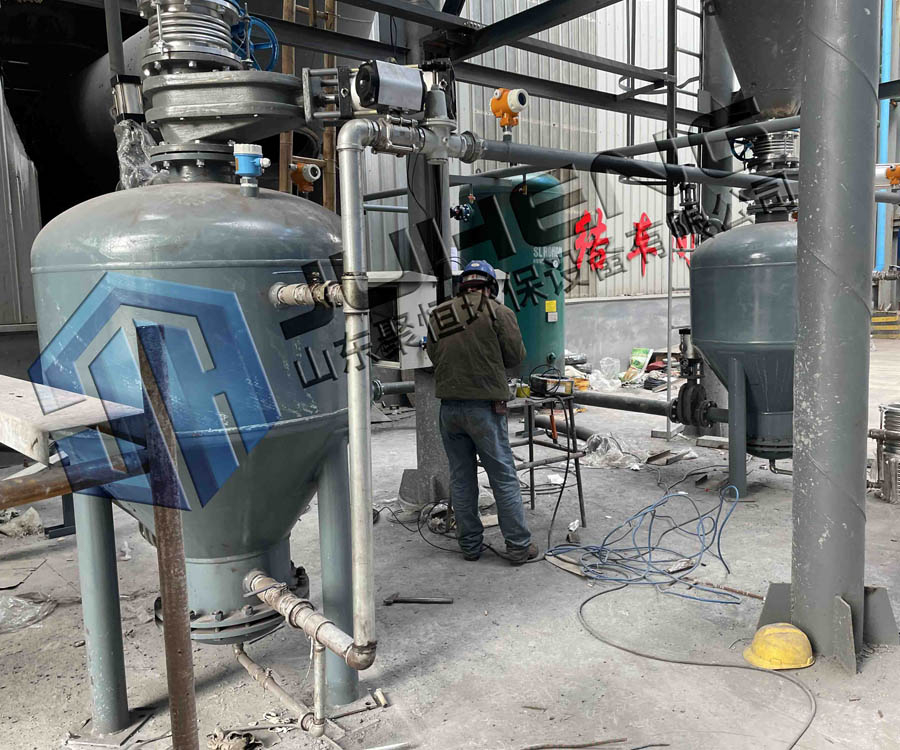
pneumatic tube conveyor It is usually a conveying system composed of multiple machines and components, so the installation workload is relatively large and the installation process is also complex, involving lifting, fitter, pipeline, electrical and other occupations. The quality of installation often determines whether the entire device can be used normally, so it should be given sufficient attention. For large-scale pneumatic conveying devices, specialized pneumatic machinery is often installed simultaneously.
1. The installation points of the pressure feeding pneumatic conveying device must first check the civil engineering data, including pit depth, platform height, reserved hole size, etc; Secondly, according to the equipment user manual and in accordance with the provisions of the "Construction and Acceptance Specification for Equipment Installation Engineering", the relevant equipment should be positioned, adjusted for levelness and verticality, and then tightened. When installing pipelines, it should be ensured that there is no misalignment at the connection points and no extrusion of gaskets between flanges. Before installing compressed air pipelines, the inner wall should be rust proofed, and all pipeline connections should be evenly sealed. Finally, connect the power supply of the control equipment, connect the control circuit and control pipeline.
2. The key points for debugging the pressure feeding pneumatic conveying device are to adjust the exhaust volume and exhaust pressure properly; Adjust the working pressure of the safety valve on the gas storage tank; Adjust the flexibility of the actions and reliability of the seals of the plug-in valve, bell cover valve, butterfly valve, ball valve, etc. on the sending tank; Adjust the sequence of actions and sensitivity of opening for each air supply and pressure boosting facility; Adjust the actions and working positions of various unloaders and turnouts; If a dust collector is installed, it should be adjusted. Through the above adjustments and adjustments, the entire device can be supplied with sufficient gas, maintain stable pressure, operate accurately, coordinate and be sensitive before feeding and conveying. Finally, in actual transportation, parameters such as conveying pressure and speed are adjusted under load to achieve stable and reliable transportation.
The adjustment of the pressure feeding pneumatic conveying device also includes the assessment of the tightness of the storage bin. Once a leak is found, it should be repaired immediately. In some cases, it also includes the debugging of explosion-proof devices, anti-static devices, and silo level gauges to ensure safe operation.
3. Installation points of suction type pneumatic conveying device: All suction type pneumatic conveying devices have air source machinery, such as centrifugal fans, Roots blowers, water ring vacuum pumps, etc. Some devices, such as grain suction machines, assemble gas source machinery, dust collectors, separators, suction nozzles, etc. on a mobile mechanism to form a mobile suction device. Therefore, for this mobile suction device, it is essentially an assembly process of assembling various components (or single machines) together, while for the installation process of fixed suction devices, in addition to complying with the installation requirements of compression pneumatic conveying devices, in order to determine the pressure loss and air leakage at various locations, measuring holes are often added before and after the suction nozzle (or throat pipe), bend pipe, separator, dust collector, and at the inlet and outlet of the fan during the installation process of suction pneumatic conveying devices. For large suction and delivery devices, a start-up gate should be installed at the mechanical inlet of the gas source. Vibration reduction and noise prevention measures should be taken for gas source machinery. Each locking device should be flexible and reliable.
4. After the installation of the pneumatic conveying device, the key points for debugging should first check whether it is tight at all places. Usually, the "hissing" suction sound can be heard at the flange connection or the location where the sealing device is installed, or a light gauze strip can be used to detect whether there is a tendency to be attracted. In case of severe air leakage, it can also be felt by touching with hands. When necessary, instruments such as pitot tube pressure gauges can be used to accurately measure the air volume at various locations through measuring holes, which can quantitatively determine the degree of air leakage. Once a gas leak is detected, the cause should be identified and dealt with promptly, otherwise it will affect the productivity of suction and delivery. After confirming that the air leakage is within the allowable range, the material can be added for trial delivery, and the productivity, air volume, air pressure (i.e. vacuum degree), and motor power should be recorded at the same time. During the debugging process, the reliability of the control system should be verified