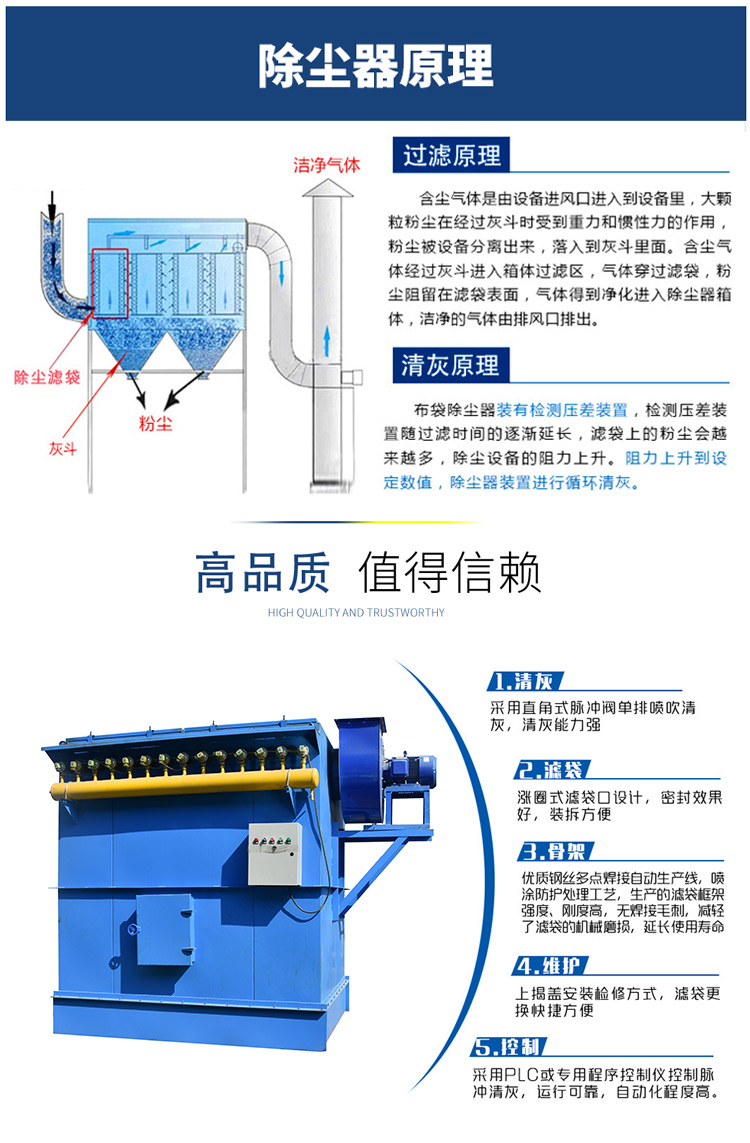
Structure of pulse dust collector
pulse dust collectorThe structural form of a bag filter is generally composed of filter elements - filter bags, cleaning mechanisms, ash discharge mechanisms, boxes, and other departments.
1) Filter bag is an important component of bag filter. The filter bag consists of two parts: filter material and frame. The properties of filter media have a significant impact on the performance of bag filters. A high-performance filter material should not only have high filtration efficiency, large dust holding capacity, good air permeability, and low filtration resistance, but also be resistant to wear, corrosion, high temperature, and wrinkle resistance. It should have high mechanical strength, long service life, low cost, low moisture absorption, and easy removal of adsorbed dust. Generally based on dusty gases
Choose based on physical and chemical properties, temperature and humidity, particle size of dust, adhesion, corrosiveness, etc.
① There are many types of filter media, including natural fibers, synthetic fibers, ceramic fibers, carbon fibers, metal fibers, charged fibers, composite fibers, inorganic fibers, etc. There are three commonly used types: natural, synthetic, and inorganic fibers.
a. Below, the lowest grid includes cotton fabric, woolen fabric, cotton wool mixed fabric, and tussah silk. Wool fiber filter material woven from wool has finer fibers than cotton fibers and can generally be made into flannel fabric. It has the advantages of good breathability, large dust holding capacity, low resistance, high filtration efficiency, easy dust removal, and good acid and alkali resistance. It can work at 90-95 ℃.
b. Fiber free refers to glass fibers, with a smooth surface and almost complete circular cross-sections. It has the advantages of low resistance, good filtration performance, non hygroscopicity, easy dust removal, good chemical stability, high temperature resistance, and low price. At 200 ℃, its strength increases with the temperature. After treatment with aromatic based organosilicon, polytetrafluoroethylene, graphite and other methods, its wear resistance, hydrophobicity, acid resistance and flexibility are improved, and it can handle dusty gases up to 300 ℃. Bag filters are widely used in the cement industry.
c. Synthetic fiber filter materials, such as 208 industrial polyester flannel, have the advantages of high filtration capacity, low resistance, high efficiency, high strength, temperature resistance of 130 ℃, and low moisture absorption, and are widely used. Nimotte 2 and Nimotte 4 filter cloths are made by blending synthetic fiber nylon velvet with natural fibers, and have good wear resistance, filtration capacity, and breathability. In recent years, China's textile sector has successfully developed needle punched polyester air filter felt (referred to as needle punched felt) filter material, which has low pressure loss, high dust removal efficiency, and can increase filtration wind speed, and has been welcomed by the using departments.
② The filter bag frame is a cage shaped frame welded with several steel wires and support rings, with a circular chassis at the bottom and an interface at the upper end for connecting porous plates. The function of the frame is to support the filter bag from being sucked down. When welding the frame, it is required that the welding points are smooth and free of burrs, otherwise it will directly affect the service life of the filter bag. The connection methods between frames and porous plates generally include plug-in, four point card mouth, expansion ring fixed, spring fixed, screw mouth, etc. Currently, the plug-in type is widely used. In recent years, the application of spiral spring type frames made by winding a whole steel bar has been increasing. Its upper end is a plug-in circular chassis with hooks underneath, which can be hung on a fixed frame when the filter bag is installed. This type of frame has good rigidity and minimal wear on the filter bag. When installing or repairing the filter bag from the top, it requires less upper space.
2) The dust cleaning mechanism is a mechanism that regularly or irregularly removes the dust layer attached to the filter bag during operation, in order to restore (or approach) its original state and continue working with greater filtration capacity and less resistance. There are several methods for cleaning dust, including manual vibration, mechanical vibration, swinging, swinging and twisting, and air blowing.
① Manual vibration is used on simple small bag filters.
② Mechanical vibration is to directly hang the filter bag on the vibration frame, and the motor installed on it drives the eccentric block to rotate. Due to the centrifugal force generated by the rotation of the eccentric block, the vibration frame and the bag are driven to vibrate together, taking turns to remove the accumulated dust on each group of filter bags. Filter bags are often subjected to mechanical forces and are prone to damage, resulting in a large amount of maintenance work.
Airflow blowing is currently the most widely used method for cleaning dust. It has two methods: air ring blowing and pulse spraying.
a. Air ring blowing is the use of an air ring with several nozzles installed on the outside and inside of the filter bag, which is moved up and down along the bag by a mechanical transmission mechanism. Compressed air is sprayed out from the nozzle to blow off the dust layer attached to the inner surface of the filter bag. The QH-24, QH-36, QH-48, and QH-72 bag filters produced in our country adopt this blowing method.
b. The pulse blowing system consists of control instruments, actuators, gas storage tanks, and injectors. The executing mechanism includes control valves and pulse valves; The injector consists of a spray tube and a Venturi tube. The number of pulse valves is determined based on the processing capacity of the dust collector. The inlet of each pulse valve is connected to the gas storage tank, and the outlet is connected to the spray pipe. There are several 6.4mm diameter blowing holes along the axis of the blowing tube, and the centers of the holes are aligned with the center of the Venturi tube and the filter bag. The back pressure chamber of the pulse valve is connected to the control valve, which is then connected to the pulse controller. The working principle of the pulse blowing system is that when the pulse controller does not issue a command, the control and pulse are in the closed state, and the filter bag is in the filtering process. When the pulse interval sends out a dust cleaning competition according to the pressure loss requirements of the dust collector, the control valve is opened, and the gas in the back pressure chamber of the pulse valve is discharged through the control valve exhaust hole. The pulse valve is opened, and the compressed air in the gas storage tank is sprayed out from the spray hole of the spray pipe (called primary air), and enters the bag through the Wen tube. When a high-speed airflow passes through the Venturi tube, some of the gas in the surrounding air box is carried into the filter bag together (called secondary air, with an air volume 5-7 times that of European air). The primary and secondary air entering the filter bag forms a reverse high-pressure airflow opposite to the filtered airflow. Under the action of the reverse blowing air wave from top to bottom, the airflow being filtered is blocked, and the part that enters the filter bag is purified. The gas then passes through the filter bag and returns to the filter box. At the same time, the filter bag underwent bulging deformation, which cleared the dust layer attached to the surface of the filter bag. When the air wave rushed to the chassis and turned back upwards, the filter bag underwent a second cleaning.
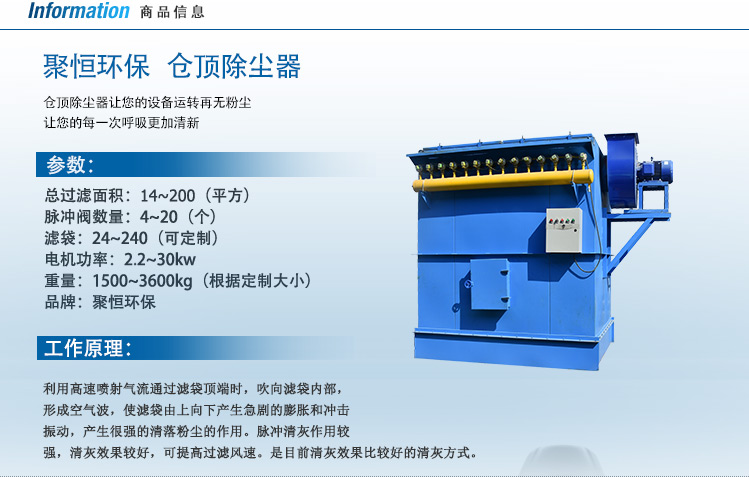
In the process of pulse blowing, the time for blowing a row of filter bags is called pulse time, also known as blowing time or pulse width. The interval time between the pulse blowing of two rows of filter bags is called the pulse interval or blowing interval. Each row of filter bags undergoes a pulse cold spraying time, which is called a pulse cycle or spraying cycle. These parameters are the main factors ensuring the normal operation of the dust collector and can be adjusted through control and control. The pulse controller is the main control instrument of the blowing system, and its performance directly affects the cleaning effect of the blowing. At present, pulse control devices for pulse bag filters can be roughly divided into three types: electric control, electric control, and mechanical control,
The control valve is the control switch of the pulse valve, and its opening and closing are controlled by the pulse controller. According to the type of pulse controller, the uncontrolled valve can be divided into three types: solenoid valve, pneumatic valve, and machine controlled valve.
3) There are currently two types of ash discharge mechanisms used: rotary blade type ash unloaders and ash seal readers. For small (24 bag cargo) dust collectors, the ash discharge mechanism consisting of a impeller type ash unloader, an electric motor, and a reducer can be directly connected to the dust collector; Without the above dust collectors, due to the large structure of the lower box, an indirect connection method is used. The cleared dust is first continuously transported to the ash discharge port by the ash collection screw at the lower part of the lower body, and then discharged outside the dust collector through the ash unloader installed at the lower end of the ash discharge port.
The ash sealed valve consists of a shell and a movable baffle, with one end connected to the ash collection screw. At the junction of the screw and the valve, there is a section of spiral blades that form an ash column to block gas. The characteristic of this valve is its simple and compact structure, which is not affected by the amount of ash discharged. The distance between the ash port and the spiral centerline is very short, reducing the overall height of the dust collector. The disadvantage is that the spiral blades near the ash discharge port are vulnerable and not suitable for high vacuum or high-pressure systems.
4) The box is generally composed of an upper box (also known as a clean air box), a middle box (dust filter box), and a lower box (dust collector). The hair is installed inside the middle box, and dust filtration is carried out from here. There is a sealed maintenance door on the side of the middle box body. Used by maintenance personnel to inspect and replace filter bags and repair other components. A porous plate is installed between the upper and middle boxes to secure the bag and separate them. The dusty airflow can only enter the upper box and be discharged through its outlet after being purified by the filter bag. A corner shaped protective cover made of angle steel or steel plate bent along the length direction is installed at the center of the bottom of the lower box to prevent the aggregate screw from being crushed due to excessive dust accumulation, which may overload the driving motor. A grid made of steel is also installed to prevent damage accidents caused by filter bags or bag fragments falling into the aggregate spiral due to malfunctions.
There are three ways for dusty airflow to enter the dust collector: upper, middle, and lower. The inlet for the upper intake is located on the upper part of the middle box. The low dust airflow directly flushes the filter bag, and a guide plate is installed at the inlet. Due to the fact that the dusty airflow enters the box from top to bottom, when blowing the filter bag, the dust settles into the lower box in the direction of the airflow, resulting in less suspended dust and therefore less dust being returned to the lower box. In this way, better dust cleaning effect can be achieved under the same blowing conditions, and pressure loss can be reduced.
The inlet of the middle intake is located at the lower part of the middle box and connected to the lower box. Due to the large import area, large inclination angle of the bottom plate, and the presence of a guide plate, the wind speed is reduced and local resistance is reduced, avoiding the accumulation of dust and the scouring of the filter bag by dusty airflow in populated areas.
The inlet for the lower air intake is located at the upper part of the lower box. Its characteristic is that when the dusty gas enters the lower box, its velocity suddenly decreases, causing larger particles of dust in the gas to settle and fall into the lower box, while the remaining fine dust rises with the airflow and is adsorbed on the filter bag. Due to the fact that the airflow distribution is from bottom to top, some of the fine dust blown off the filter bag will be brought back to the filter bag during the falling process because its settling velocity is lower than the airflow velocity, causing the resistance of the blown filter bag to quickly rise again. Under the same blowing conditions, the resistance of the equipment is greater than that of the upper intake type. In order to maintain a limited device resistance, it is necessary to increase the number of blowing cycles appropriately. This air intake method has the advantages of filter bags not being washed away by dusty airflow and convenient pipeline connection, and is currently widely used.