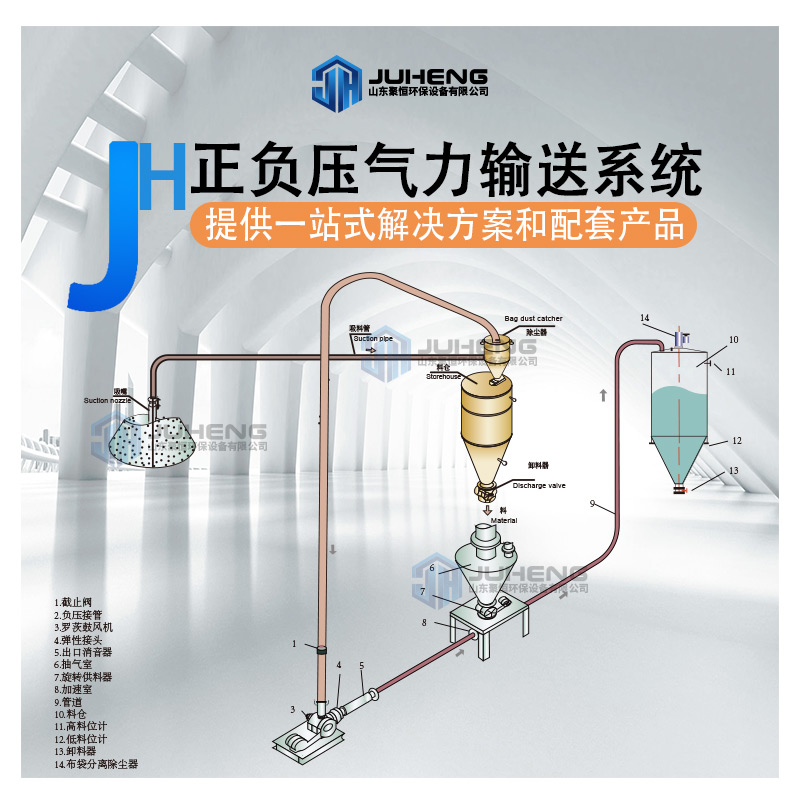
How to prevent blockage in pneumatic conveying
The blockage is inpneumatic conveyingOne of the difficulties is how to avoid pipe blockage. Through Juheng's research, the following aspects have been summarized.
1) When designing force transmission, it is necessary to determine the force structure based on the actual conditions such as material performance, productivity, and transmission distance, and reasonably determine the various process parameters of the device according to the above conditions.
2) When arranging the conveying pipes, the characteristics of pneumatic conveying should be fully considered, and the number of bends should be minimized as much as possible. The installation should be straight, without misalignment or air leakage, and the entire pneumatic conveying system requires good sealing.
3) Setting up a booster at an appropriate position in the conveying pipeline is an important measure to prevent blockage. Install a turbocharger in areas that are prone to blockage or have significant resistance loss. It is reported that in the design of a pneumatic conveying device for conveying viscous materials in Japan, the total length is 32m and it is equipped with 7 boosters.
4) The design of the gas supply system should be reasonable to ensure sufficient gas supply. There should be pressure reducing valves and quick opening valves in the system. It is best to control the working pressure between 245~392kPa.
5) The following measures can be taken to prevent sand sticking to the conveying pipe and sending tank:
① It is best to process the inner wall of the transmitter to make its surface smooth. To prevent rusting, the sending tank can be made of stainless steel or coated with a layer of industrial enamel on the inner wall.
② For certain materials, corresponding lubricants may be considered. The type of lubricant depends on the different materials used.
③ Regularly clean the pipeline, remove the adhesive layer, and keep the pipeline smooth and unobstructed.
④ For the transportation pipes laid outdoors in winter, if there is a possibility of condensation or freezing of the transported materials, insulation measures should be taken for the transportation pipes, and heating measures can also be used locally.
6) To prevent blockage of the conveying pipe of the suction type pneumatic conveying device, an air inlet can be pre-set in the easily clogged part to introduce outside air to push the material that has just stopped here to continue moving with the conveying airflow. This additional air should be considered in advance during design.