
Maintenance and upkeep of pneumatic conveying system
pneumatic tube conveyor Whether it can be smoothly applied in production, in addition to design, manufacturing, installation, and operation, daily maintenance and upkeep are also very important. Especially for pneumatic conveying devices that operate in a sealed state, many hidden faults are difficult to detect, which highlights the importance of timely maintenance and upkeep.
Pneumatic conveying devices can generally be divided into: gas source machinery, air ducts, feeders, conveying pipes, forks, separators, unloaders, dust pipes, dust removal systems, and electrical control systems. The maintenance points of each part are described as follows:
1. Maintenance points of pneumatic conveying: In the pressure conveying pneumatic conveying system, the air source machinery mainly refers to the air compressor and Roots blower. Due to the use of exhaust for transportation, there will be no special maintenance issues for the compressor itself. The product manual of Shandong Juheng Environmental Protection Equipment Co., Ltd. can be repaired and maintained according to the requirements for general machinery.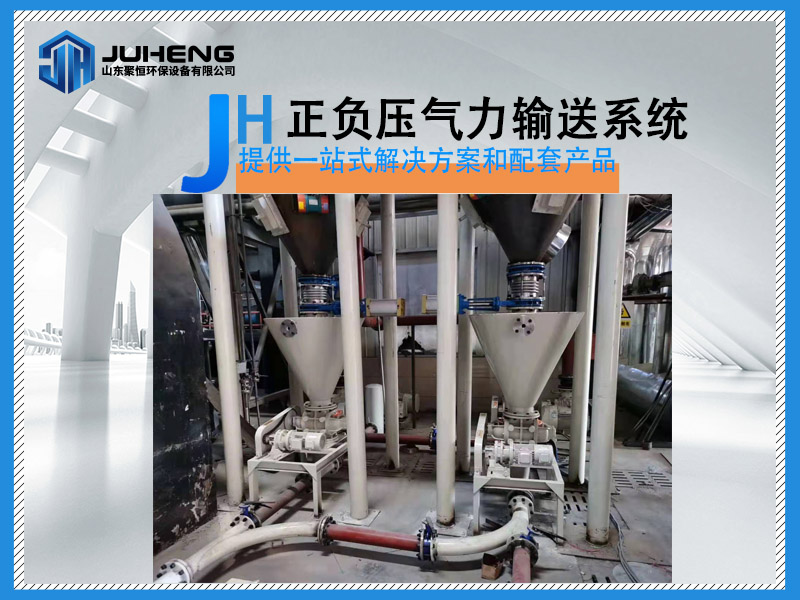 In suction type pneumatic conveying systems, water ring vacuum pumps and blowers are usually used as mechanical air sources. Due to the use of suction for transportation, if dust is present in the suction, it will accelerate the wear of the fan and affect its performance; There may also be dust adhering to the inside of the fan, which not only reduces the performance of the fan but also generates vibration, and in severe cases, can affect the lifespan of the fan. For this reason, it is necessary to regularly clean the inside of the fan to remove any adhered dust. Once the blades of the fan are found to be worn, they should be replaced in a timely manner to ensure good operation.
2. Maintenance points of air ducts: In suction pneumatic conveying systems, air ducts refer to the pipelines between the dust collector and the fan inlet, as well as between the fan outlet and the air cap. Generally speaking, the maintenance of these two parts of the pipeline is not significant, but it is necessary to pay attention to the sealing condition of the air duct connection and regularly check whether the air duct body is corroded. Damage to the hood can cause rainwater to seep in, and it should be repaired promptly.
In the compressed air conveying system, the air duct includes the inlet from the gas compressor discharge port to the feeder (or sending tank), along with the intermediate gas storage tank, gas water separator, gas supply system, and corresponding piping.
Gas storage tanks and gas water separators belong to pressure vessels, and their safety should be regularly checked in accordance with the requirements for the use of pressure vessels. At the same time, special attention should be paid to whether the pressure setting of the safety valve is accurate. The oil and water accumulated in the gas storage tank and gas water separator should be discharged in a timely manner.
The gas supply system consists of pressure reducing valves, quick opening valves, pressure transmitters, etc. The maintenance of the main valve box should be based on ensuring that the various pneumatic components mentioned above are always in the best condition, and relevant maintenance should be carried out in accordance with the product manual of the pneumatic component manufacturer.
3. Maintenance points for feeders: Due to the diverse structures of feeders, it is difficult to list the maintenance and upkeep points for each one. Here is a brief explanation of common issues:
1) Any rotating parts, such as impeller feeders, spiral feeders, etc., must be regularly checked for wear to ensure good sealing performance; It is necessary to replace the bearings in a timely manner and ensure good lubrication to make the rotation flexible and lightweight.
2) The sealing rings of the gate valve and bell jar of the warehouse pump should be replaced regularly to prevent the sealing effect from being affected by aging. When using a warehouse pump to transport viscous materials, attention should be paid to preventing adhesion to the inner wall of the sending tank. If there is adhesion, it should be cleaned up in a timely manner. Attention should be paid to preventing blockage of the nozzle airway.
3) When using a cooling feeder to transport hot materials, it is necessary to protect the smooth flow of the cooling water pipeline to ensure the cooling effect.
4) For some materials, when the temperature of the feeder wall is too low, condensation may occur, causing the material to adhere to the inner wall of the feeder. To prevent this adhesion, the feeder wall should be insulated or heated. The most convenient heating method is to use electric heating felt attached to the outer wall of the feeder and then wrapped with insulation material.
4. Maintenance points for conveying pipes include straight and bent pipes. The main issue in maintenance is to prevent blockages and reduce wear and tear.
5. Maintenance points for fork roads
1) Airtightness is a key performance of crossroads, and it must be given special attention.
2) The switching should be flexible and the positioning should be accurate. Only flexible movements and accurate positioning can facilitate directional changes. For this reason, it is necessary to regularly inspect and lubricate the guide rails, guide wheels, and drag cylinders leading to the track to ensure flexible and reliable operation.
3) For flexible pipes, branching bends, and other parts that may experience wear and tear, it is even more necessary to regularly inspect and replace them in a timely manner.
6. Maintenance points of the separator: The function of the separator is to separate gas and collect materials. For centrifugal separators, wear and tear are inevitable, and once worn and leaked, the function of separating materials will be lost, causing the entire system to malfunction. Therefore, it is necessary to regularly inspect and promptly repair and replace vulnerable parts to ensure sealing performance.
7. Maintenance points of the unloader: The unloader is used to discharge the materials collected by the separator, and at the same time, it plays a role in isolating the pressure difference between the separator and the atmosphere, which is very important for the normal operation of the pneumatic conveying device. Most unloaders are electric rotary blade type, and sometimes double plate discharge valve type is used. The maintenance points for the rotary blade feeder are the same as those for the rotary blade feeder. The main maintenance points of the double plate discharge valve unloader are to ensure good sealing at the interface and flexibility of the action.
8. Maintenance points for dusty pipelines: Pay attention to timely detection of wear and tear on dusty pipelines, and repair and replace them in a timely manner. In addition, attention should be paid to observing whether there is dust trapped in the dusty pipeline. If there is, it should be promptly eliminated to reduce resistance loss.
9. Maintenance points for dust collectors: Dust collectors used in pneumatic conveying devices are mostly standardized products, so maintenance should be carried out in accordance with the manufacturer's instructions.
10. Maintenance points for electrical control systems are important in large-scale applicationsPneumatic conveying systemThe working condition of the electrical control system is crucial for the entire device to function properly. Therefore, it is necessary to strictly follow the maintenance points of the manufacturer and strengthen daily maintenance work.