
Positive pressure pneumatic ash removal system
The positive pressure pneumatic ash removal system uses compressed air as the conveying medium to transport dry ash to ash silos or other designated locations. Due to its characteristics of long conveying distance, large conveying volume, and few system equipment, it is widely used in coal-fired power plants in China.
Positive pressure pneumatic ash removal mainly consists of feeding, gas source, aggregate equipment, and pipeline control system. The types, performance, and layout of equipment used in different types of pneumatic ash removal systems are different, divided into two types: centralized feeding and direct feeding. The centralized feeding system is a system where multiple ash cows share the same platform and storage pump. The direct coupled feeding system refers to one ash hopper with one storage spring. When there are a large number of ash hoppers in the electrostatic precipitator, using centralized feeding can reduce the number of storage systems, simplify the entire ash removal system, reduce the number of removal pipelines, and lower the investment of the ash removal system.
Multi pump positive pressure pneumatic ash removal generally uses an upward flow dense phase fluidized bed bin pump, which is composed of multiple bin pumps to form a conveying unit. During the conveying process, the bin pumps of the same conveying unit operate synchronously. The bin pumps of one conveying unit operate as a whole, and each conveying unit is equipped with a set of intake valves and discharge valves. Its control method is similar to that of a single bin pump. Its characteristics are simple system configuration, reducing the number of discharge valves, making the system more reliable and safe, with high system output, simple configuration, and less maintenance workload.
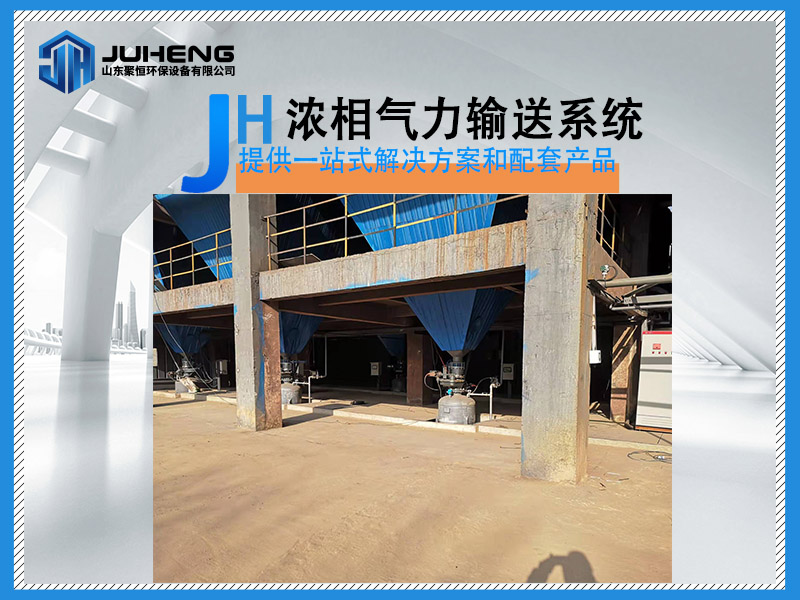
Another form is three electric fields and three ash hoppers under the electrostatic precipitator. Each ash hopper is equipped with a bin pump and transported by a set of pipelines. After each bin pump is independently transported, it switches to another bin pump for transportation. The sequential transportation method is controlled by PLC program and dynamically displayed through a simulation screen, making the system easy to monitor.
The characteristics of this system are:
1) The concentration of ash gas is relatively high, generally ranging from 30 to 60, and the air consumption is 1/3 to 1/2 of other systems.
2) The conveying speed is relatively low, with an average flow velocity of 8-12m/s, resulting in a significant reduction in pipeline wear.
3) The conveying pressure is relatively high, usually 0.2-0.4 MPa, which requires high equipment sealing and increases equipment costs.
4) The conveying distance is relatively long, usually around 150m, and the longest can reach over 1000m.
5) Due to its small size, the storage pump is easy to install and maintain.
6) Flexible and convenient layout, suitable for different working conditions.
7) High degree of automation, simple operation, dynamic system display, complete functions of fault, alarm and handling, and can form a centralized control center with the electrostatic precipitator.