
Double tube turbulent pneumatic ash conveying system
With the widespread application of pneumatic ash conveying technology and the advancement of comprehensive utilization technology of fly ash, there is a demand for ultra long distance conveying of fly ash (greater than 1000m) in the power industry. Technical measures such as double casing special pipeline structure are adopted to achieve long-distance conveying. The process flow and equipment composition of this system are basically the same as those of conventional positive pressure pneumatic ash removal systems. The bin pump still adopts an upward flow fluidized bin pump. The difference is that the conveying pipeline adopts a special structure to maintain continuous turbulence of the conveying air. This turbulence is achieved by using a second pipeline, which is equipped with a smaller diameter inner pipe at the upper part of the conveying pipeline, and the inner pipe has a specific opening at regular intervals. When there is a blockage of material in a certain part of the conveying pipe, the conveying pressure behind the blockage increases, forcing air to flow into the inner pipe. The compressed air entering the inner pipe flows out at a higher speed from the downstream opening of the blockage, thereby disturbing and blowing through the blocked material (see Figure 1), ensuring the normal conveying of the material in the pipe.
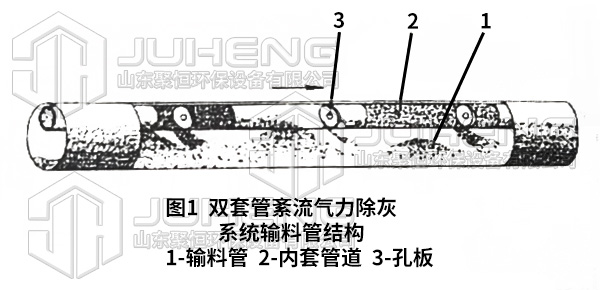
Characteristics of a dual pipe turbulent pneumatic ash removal system:
1) Due to the unique working principle of turbulent flow in the dual pipeline, the pneumatic ash removal system pipeline is not easily blocked. Even if it is restarted after a short shutdown, it can be quickly cleared, improving the safety and reliability of pneumatic ash removal.
2) Low conveying speed and minimal pipeline wear. The initial velocity of the pneumatic ash removal system is 2-6m/s, the final velocity is 15m/s, and the average velocity is 10m/%. The initial velocity of the dilute phase pneumatic conveying system is 10m/s, the incoming velocity is 30m/8, and the average velocity is 20m/. The wear of the pipeline is proportional to the third power of the conveying velocity, with the former being 1/8 of the latter's pipeline wear, and the service life of the pipeline being 8 times that of the latter.
3) Low operating costs. According to statistics, the unit power consumption of dilute phase pneumatic ash removal is generally 7-10kW · h/(t · km), while that of casing pneumatic ash removal systems is generally 4-6kW · h/(t · km), resulting in low energy consumption.
4) Great output. The output of the double tube pneumatic ash removal system can reach over 100/h, and the conveying distance can reach over 1000m.
The casing flow pneumatic ash removal technology has been accepted by people and widely promoted and applied both domestically and internationally. In 1992, China first introduced the double tube pneumatic ash removal system from Mollen Company in Germany, which was used in the Jiaxing Power Plant (2x300MW) unit. The equipment cost was 2.73 million US dollars, and the total cost was over 4 million US dollars. The geometric length of the conveying distance was 1100 meters, the height difference was 30 meters, and there were 10 90 ° elbows. The first and second electric field ash hopper bin pumps had a capacity of 2.15 square meters, and the third electric field bin pump had a capacity of 1 square meter. Each fluidized bed boiler was equipped with 26 bin pumps, which were put into production in 1995 and operated normally. This system has many advantages, mainly manifested in long conveying distance, low conveying speed, no blockage, high output, high conveying concentration, low energy consumption and wear of the system. It is a relatively advanced pneumatic ash removal system.