
Application of Pneumatic Conveying Technology in Railway Engineering
In the current high-speed railway trains, due to the steep slope of the track and climate changes such as snow or rain, the adhesion friction coefficient between the vehicle and the track decreases. To prevent wheel slippage, the driver opens the valve of the sand storage box on the locomotive and sprays sand onto the contact surface between the track and the wheel to increase friction and ensure the normal operation of the train. The new diesel locomotives are equipped with sand storage tanks, with 5 sand storage tanks on each side of the locomotive head, for a total of 10 on both sides. The sanding system for locomotives is generally set up in the preparation yard of the locomotive depot according to the overall layout of the road surface, to complete locomotive maintenance, refueling, water addition, and sanding work. The sand used for locomotives is dry silica sand, with a particle size controlled below 6mm.
The locomotive sanding system consists of two parts: one is sand preparation, including screening, drying, and dust removal; The second is to use two-stage pneumatic conveying to transport sand to the 10 sand adding towers in the preparation yard of the locomotive depot. Sand preparation generally uses a three pass sand drying drum, fluidized bed sand drying device, or hot air flow sand drying system. Pneumatic conveying selects negative pressure pneumatic conveying system or positive pressure dense phase pneumatic conveying system according to production requirements and specific conditions of the preparation site.
A set of positive pressure locomotive pneumatic conveying belt system designed by Shandong Juheng Environmental Protection Equipment Co., Ltd.
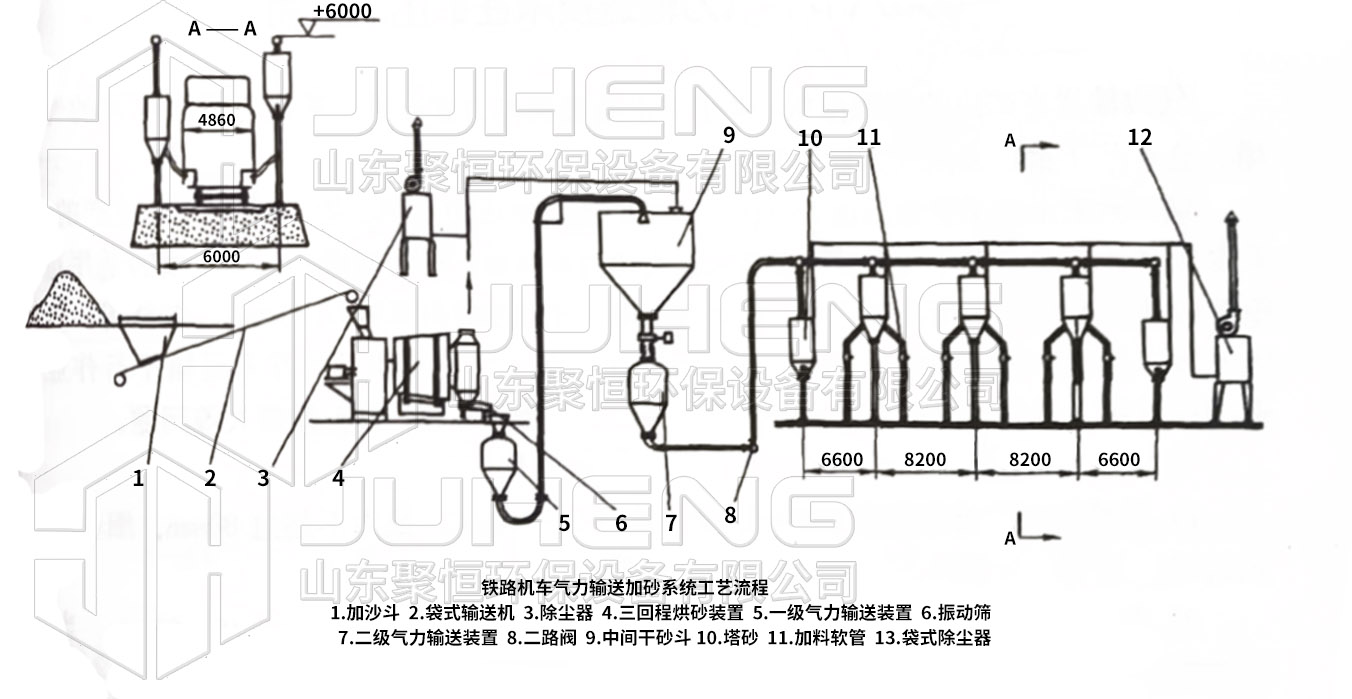
The system consists of a wet sand transportation and drying device, a first level pneumatic conveying system and storage for dry sand, a second level pneumatic conveying system, and a sand adding device for locomotives. Wet sand is added to the sand hopper manually or by a claw bucket, and then enters the three return sand drying device through a belt conveyor. Diesel is burned and sprayed into the furnace to generate hot air, which dries the wet sand through heat exchange. The dried dry sand is transported to the intermediate hopper through the first stage pressure and then to the locomotive sand adding yard through the second stage pressure and transportation. There are a total of 10 sand towers or 10 discharge points, and the discharge is carried out using a three-way distribution valve. There is a material level control meter on the sand tower. When there is no sand in the sand tower, a signal is sent, and the pneumatic conveying automatically starts sand feeding, achieving PLC fully automatic control.
After the locomotive enters the sand filling yard, there are 16 sand filling points in 10 sand towers, and sand is added to the locomotive sand box separately. The manual butterfly valve is opened, and the dry sand is directly poured into the sand box through a rubber hose. The amount of sand added is manually controlled.
Main technical parameters of the system:
1) Transport capacity: greater than or equal to 3/h.
2) Sending tank model: Y91D-4 eddy current sending tank.
Capacity: 0.4 square meters.
3) Conveying distance: The first level pressure conveying is 12m long and 6m high.
Secondary pressure delivery length 64m, height 8m
4) Air source: Screw air compressor Exhaust rate: 6.5m/min (shared by 2 sets of compressed air).
Exhaust pressure: 0.75MPa.
Delivery pressure: 0.3~0.4MPa Motor power: 37kW.
5) Number of unloading points: 10 Number of sand towers: 10, a total of 16 sanding hoses.
Sand tower volume: ≈ 1.2m.
Locomotive sand box volume: ≈ 0.1m.
6) Dust collector: Processing air volume of 2000-3000m3/h (2 units in total).