
Calculation of air volume and pressure for pneumatic conveying equipment
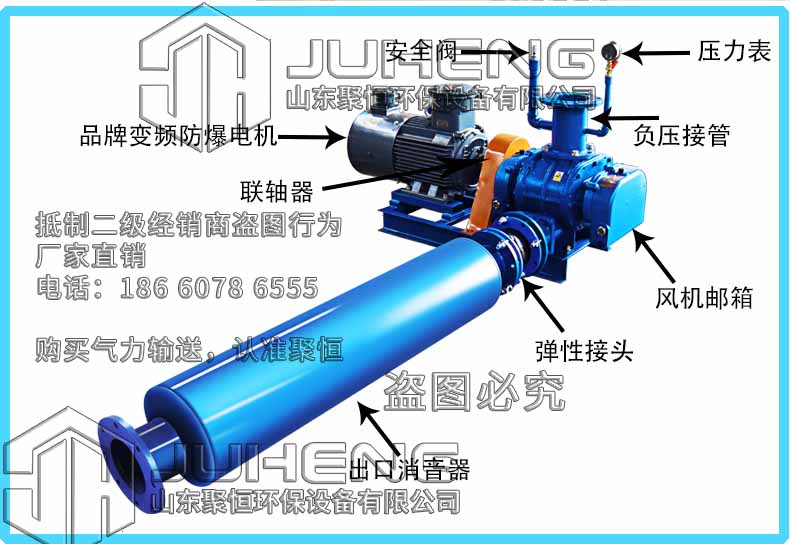
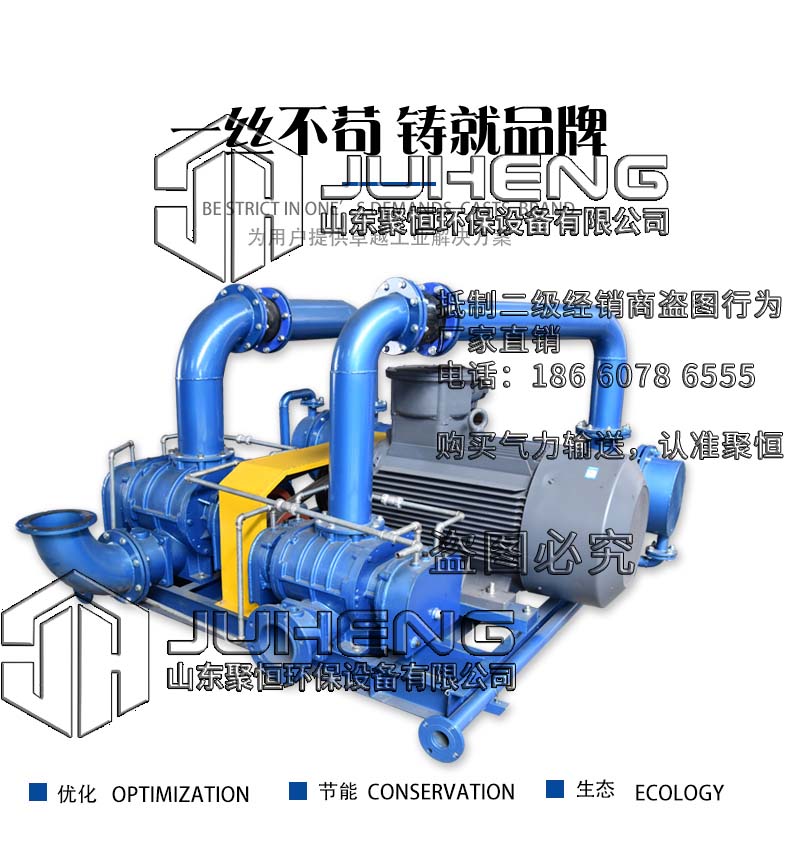
InDilute phase pneumatic conveyingIn terms of wind source equipment, we generally choose Roots blower as the power source. Roots blower is a positive displacement air machine, so its pressure rise is high, flow rate is small and stable, suitable for long-distance pneumatic conveying. The smaller air volume is conducive to using high concentration conveying and the exhaust dust collector has a smaller processing capacity. In addition, during the operation of Roots blowers, there is almost no other frictional motion except for transmission mechanisms such as bearings and gears, so the mechanical efficiency is high, there are few vulnerable parts, and the service life is long; At the same time, the cylinder and rotor work without contact, lubrication, or any pollution; Due to these characteristics, the main reason why compressed air conveying systems usually use Roots blowers as the gas source.
Roots blower is a positive displacement blower, which has the characteristics of forced gas transmission, clearance, and no air valve, making it safer to transport dust containing gas; By calculating the material conveyed by the Roots blower, the pressure loss, resistance, and required air volume can be obtained to determine the Roots blower model, specifications, and motor power.
Calculation formula for air volume of Roots blower:
Q=GS/mS ·ρ B (m3/h)
GS refers to the material conveying capacity, kg/h; ρ B refers to the air density at room temperature, kg/m3Ms refers to the mixing ratio;
The selection of mixing ratio is quite complex, but for low-pressure conveying, it can be below 15 for pressure conveying; The suction can take up to 10.
In the process of pneumatic conveying, air leakage is inevitable. Therefore, in order to ensure the normal operation of the fan and achieve the predetermined conveying capacity, a reserve coefficient of 1.1-1.2 is taken
Q wind=1.2Q meter (m3/h)
Fan pressure calculation
P wind=Δ P loss x 1.2kPa
Δ P loss refers to the total pressure loss of gas and materials during transportation, after passing through horizontal and vertical pipelines, bends, and various conveying devices. Its calculation is quite complicated, but it includes several aspects of pressure loss:
① Pressure loss in pure air pipelines;
② Friction pressure loss in conveying pipelines;
③ Pressure loss of bent pipes;
④ Pressure loss of feeding device;
⑤ Accelerated pressure loss during material transportation;
⑥ The pressure loss that causes the material to suspend;
⑦ Pressure loss caused by material lifting;
⑧ Pressure loss of collector (separator)
The general low pressure loss is below 50 kPa, and the low pressure transmission distance should not exceed 100 meters.
Shandong Juheng Environmental Protection Equipment Co., LtdProfessional pneumatic conveying for 13 years. If you need pneumatic conveying equipment, please feel free to contact us