
What is dilute phase pneumatic conveying
What isDilute phase pneumatic conveyingWhen the airflow velocity in the pipeline is high enough and particles are transported in a suspended state in the airflow, it is called dilute phase transport. In pneumatic conveying, the commonly used mixing ratio or conveying concentration or solid gas ratio R represents the solid concentration in the airflow. According to the ratio of materials and airflow in the pipeline and the characteristics of two-phase flow, pneumatic conveying systems are divided into three types: dilute phase conveying (suspension flow conveying), dense phase conveying, and plug flow conveying. The pneumatic conveying with a mixing ratio of R=1-5 and a maximum value of about 15 is called dilute phase conveying. In dilute phase conveying, the airflow velocity is relatively high, usually 12-40m/s, and the solid particles are in a suspended state.
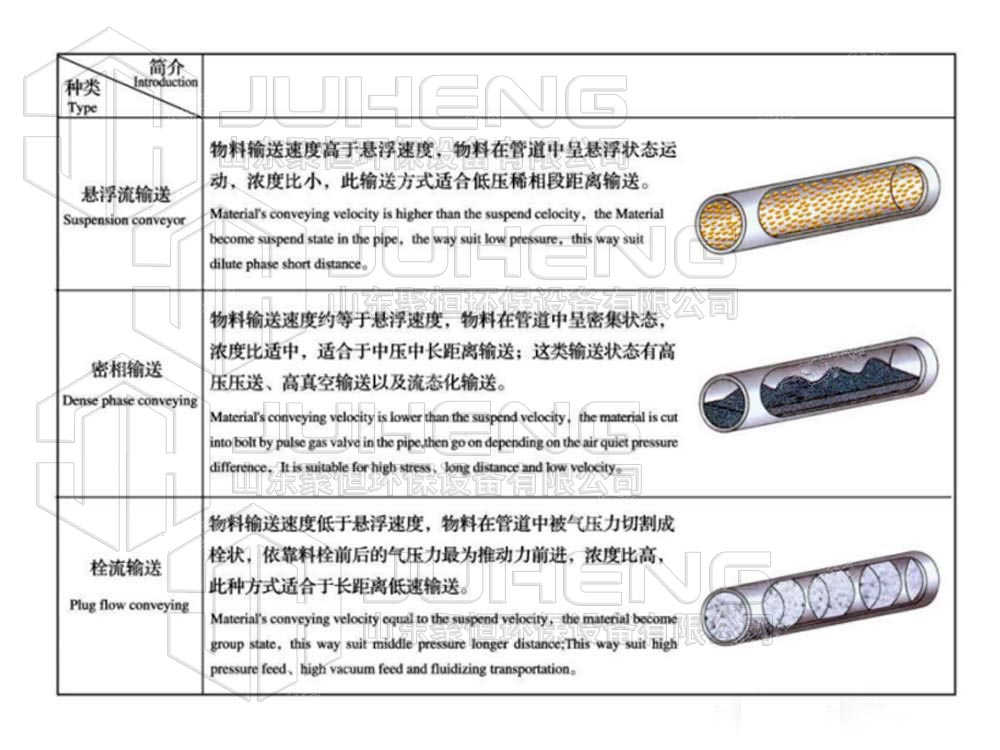
Suspended state refers to dilute phase pneumatic conveying
In terms of name, the so-called dense phase refers to the relatively dilute phase, which means that under the same conveying conditions, the ash to gas ratio of a plug flow conveying system is higher than that of a suspension conveying system; And we cannot simply evaluate whether a system is rich or lean based on the value of the ash to gas ratio, because the value of the ash to gas ratio varies greatly under different transportation conditions. We know that the value of the ash to gas ratio is inversely proportional to the distance of transportation. When the transportation distance is less than 400m, the ash to gas ratio can reach 30-40kg/kg, or even 50kg/kg, which is called rich phase. However, when the transportation distance is greater than 1000m, the ash to gas ratio can still reach 20-30kg/kg, which can also be called rich phase transportation. Pneumatic conveying is mainly divided into dynamic pressure conveying and static pressure conveying based on its working principle; Dynamic pressure conveying, which converts the pressure energy of gas into kinetic energy for operation, is called suspension conveying. When the ash to gas ratio is less than 40, it belongs to dilute phase conveying. Static pressure conveying, which converts the pressure energy of gas into thrust for operation, is called plug flow conveying or plunger conveying. If the ash gas ratio is greater than 40, it belongs to dense phase conveying. Advantages of pneumatic conveying system:
1) The entire conveying process is sealed and minimally affected by climatic conditions, which not only improves the working environment but also prevents the conveyed material from absorbing moisture, staining, or mixing with other impurities, thereby ensuring the quality of the conveyed material;
2) Simple equipment, compact structure, flexible process layout, small footprint, and easy selection of conveying routes;
3) During the transportation process, mixing, crushing, grading, drying, and certain chemical reactions can be carried out simultaneously;
4) Inert gas transportation can be used for unstable chemicals, ensuring safety and reliability;
5) Easy to achieve centralized control and automation of the entire system;
6) Compared to traditional mechanical conveying, its conveying efficiency is higher.