
Roots blower accessories and component names
Roots blowerAs a gas power source for a system or a local system, it has a wide range of applications; It is a positive displacement blower with forced gas delivery characteristics, almost unchanged with pressure, and has the advantages of simple structure, few vulnerable parts, and easy operation. No matter how durable the equipment is, damage is inevitable. What are the accessories for Roots blowers? We list the components of Roots blower from the structure:
The names of Roots blower accessories include: casing, sealing gasket, flat key, driving rotor, driven rotor, side plate, sealing blanket, wall panel, bearing seat cushion, bearing seat, bearing, bearing pressure plate, stop washer, locking nut, skeleton oil seal, sealing gasket, oil slinger, auxiliary oil pan, elongated oil gauge, driving gear, driven gear ring, stop washer, main oil tank, water jacket cover, O-ring seal, small bearing seat cushion, small bearing, round nut, small bearing cover, circular oil gauge, oil gauge seat.
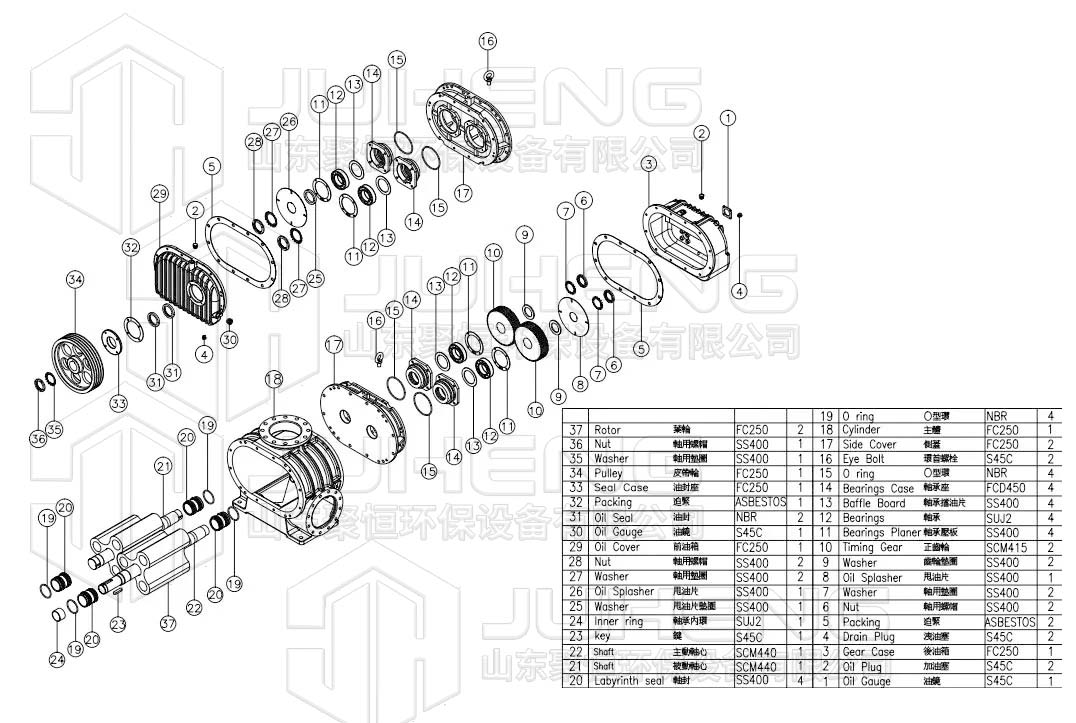
The casing is a cylinder body with an elliptical cross-section, generally made of high-strength cast iron. Stainless steel casting can be used to transport corrosive gases; The cylinder body is equipped with inlet and outlet ports, and reinforced ribs and mounting feet are cast on the outside. It is mostly an integral structure, and some large-sized casings adopt a horizontal split structure, with pin positioning between the upper and lower casings.
The wall panel is located between the casing and the main and auxiliary fuel tanks, serving as an end cap to seal the two ends of the casing; The second is to serve as a support, supporting both ends of the rotor. The one near the axis extension end is called the front wall panel, and the other end is the rear wall panel. Some wall panels have side panels that can be embedded into the casing port during assembly to meet the radial positioning requirements of the rotor. The advantage of this is that even if wear occurs during operation, only the side panels need to be replaced, so as not to render the entire wall panel useless; Wall panels are often made of high-strength cast iron, and when transporting corrosive gases, they are made of stainless steel material, just like the casing.
The rotor is usually composed of an impeller and a shaft that are combined through a hot sleeve or cold compression, and can be divided into active and passive types; The shaft is made of high-quality carbon steel or high-strength alloy steel, and the driven shaft is relatively short; The impeller is generally made of high-strength cast iron, and stainless steel is used for corrosion prevention. The small rotor can also be made by integrating the impeller with the shaft, using high-strength ductile iron casting; To reduce weight, the impeller head is often made into a hollow structure.
The synchronous gear serves to transmit power and determine the clearance between the two impellers to ensure synchronous operation of the two rotors. The main and driven gears have the same meshing parameters and are a pair of cylindrical gears with a transmission ratio of 1:1; For the convenience of circumferential adjustment, the driven gear is mostly composed of a ring gear and a wheel hub. When adjusting, the rotation should be carried out in the specified direction. When rotating in the opposite direction, the gear backlash will be left vacant on the other side of the tooth groove, and the clearance between the main and secondary impellers will change accordingly.
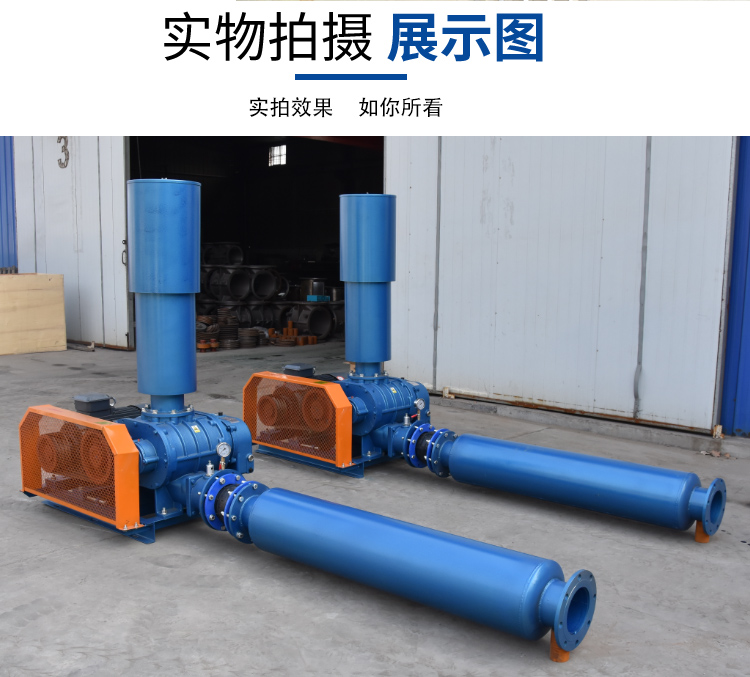
Bearings are mainly subjected to radial loads. When the synchronous gear is spur or herringbone, there is no axial force; When using helical gears, a certain axial force will be generated, but the load is relatively small. Common types of bearings include deep groove ball bearings, self-aligning roller bearings, angular contact ball bearings, and cylindrical roller bearings; Cylindrical roller bearings are mostly used as load-bearing bearings, while other types of bearings can carry loads and also provide axial positioning for rotors.
Sealing is mainly to prevent gas and lubricating oil leakage. The quality of sealing can to some extent reflect the level of product design and manufacturing, as well as the performance of its use. Especially when transporting flammable, explosive, or toxic gases, sealing is a key factor in ensuring the safe operation of Roots blowers. There are two types of seals: static seal and dynamic seal. Static seal has a simple structure and is often made of rubber asbestos board, O-ring seal, etc; Dynamic seals also have complex shaft seal structures, including labyrinth seals, skeleton oil seal groups, expansion ring seals, packing seals, and mechanical seals.