
Pneumatic conveying feeding equipment
Inpneumatic conveyingThe type of feeding method used in pneumatic conveying depends on the system type. The feeding equipment is the key equipment of the entire system and the "throat" of pneumatic conveying. Whether its structure is reasonable and its use is appropriate has a significant impact on improving productivity and reducing pressure loss. Therefore, how to design and select the feeding equipment correctly is an important link to improve the efficiency of pneumatic conveying technology. In positive and negative pressure pneumatic conveying, the role of the feeder is also very important.
The feeder, also known as the receiver, in the negative pressure pneumatic conveying system is mainly used to fully mix the material and air and feed them into the conveying pipe. Common feeding equipment:
1) The three-way connector is composed of two basic parts: the feeding flow pipe and the air duct. Depending on the placement of the air duct, it can be divided into two forms: vertical three-way connectors and horizontal three-way connectors;
2) Inductive feeder is a variation of vertical three-way feeder;
3) The elbow feeder has a rectangular cross-section, with one end connected to a circular feeding pipe through a deformation pipe and the other end connected to a flow pipe through a deformation pipe. Suitable for receiving materials under milling or rice milling machines, and capable of absorbing a large amount of air from the machine, cooling the machine and materials to ensure material quality and extend equipment service life;
4) A double tube suction nozzle consists of an inner tube with a horn shaped inlet and an outer tube that can be adjusted up and down; Used to directly extract granular bulk materials from warehouses or vehicles.
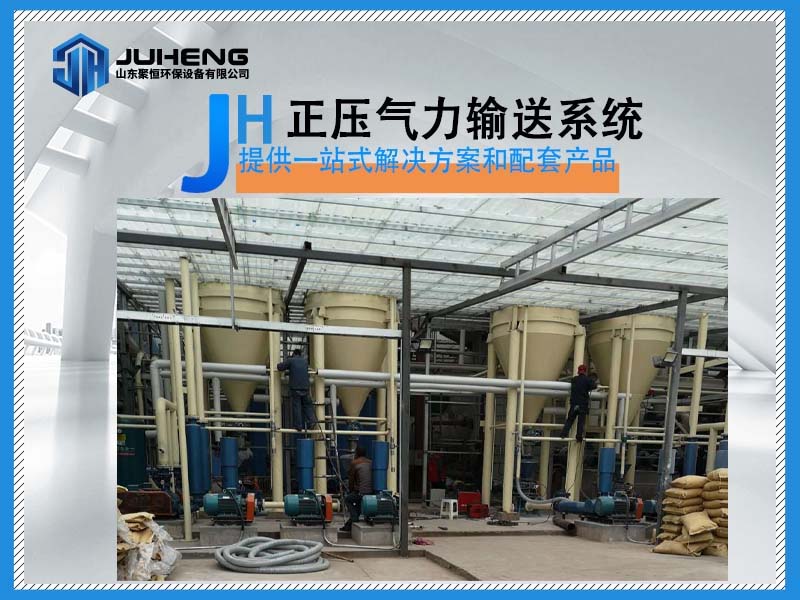
There are also various feeding methods in positive pressure pneumatic conveying systems, and the feeding equipment includes:
1) Jet feeding pneumatic conveying is mainly used for low-pressure continuous pneumatic conveying. Its principle is that when the airflow enters the jet feeder and is sprayed out by the nozzle, due to the throttling effect, a certain degree of vacuum is formed in the mixing chamber, and the material is sucked into the mixing chamber for conveying. It is divided into low-pressure jet feeder and high-pressure jet feeder;
2) Rotary feeders, also known as star feeders, air locks, etc., are used for medium and low pressure pneumatic conveying. Their advantages are that the feeding amount can be adjusted after changing the speed, and the pressure loss is small; According to the on-site process, there are types such as through type, backpack type, anti jamming type, wear-resistant type, etc;
3) Warehouse pump pneumatic conveying is a sealed pressure vessel in which materials are loaded into the warehouse pump and mixed with compressed air through a conveying pipe to be transported to the discharge point.
The general principles for the design and selection of pneumatic conveying feeders are:
1. Can provide quantitative, uniform, and dispersed feeding, and ensure sufficient mixing of materials and air;
2. No air leakage, no material leakage, and no crushing of material particles, which can allow air to enter smoothly and reduce energy loss in air flow;
3. Low resistance and power consumption, try to make the direction of the airflow consistent with the flow of the material as much as possible, and avoid reverse feeding;
4. Smooth feeding, easy operation, long equipment life, and durability;
5. The airtightness of the feeder should be good to ensure its feeding capacity and prevent air leakage;
6. The structure should be simple and the footprint should be small.