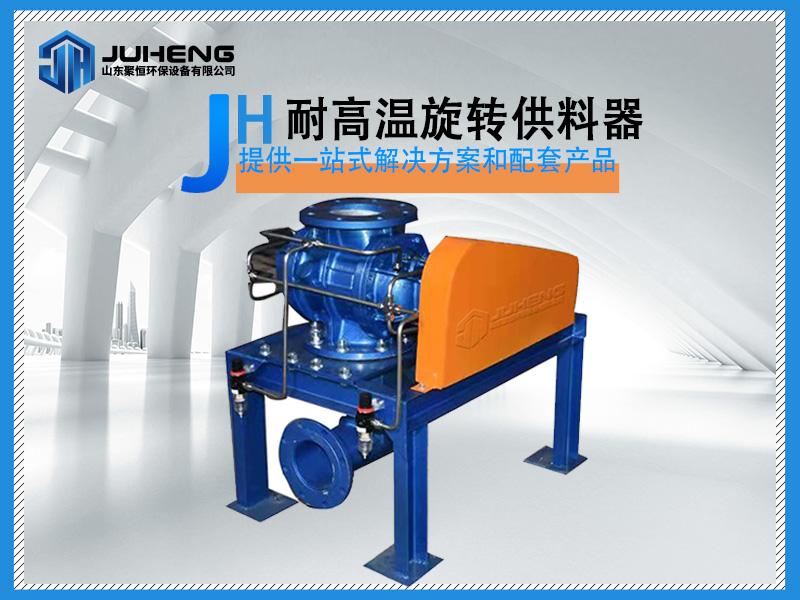
star feeder
rotary feederAlso known as a star shaped unloader, it is mainly composed of a cylindrical shell and a star shaped impeller inside the shell. There are various designs for star shaped impellers, and in order to achieve maximum throughput capacity, a solid impeller with deep compartments can be used; The number of blades depends on the number of sealing blades required between the shell and the impeller. In order to reduce air leakage, a 6-plate impeller should have at least two blades in the shell on the side from the inlet to the outlet of the feeder for sealing; Increasing the number of blades in the impeller will reduce the angle between the two blades, making the impeller cavity narrower and making material unloading more difficult. The corresponding measures are to increase the wheel hub and use corner filling strips, reduce the depth of the grid cavity, and obtain a shallow grid chamber impeller, which can make the material easy to unload, but the capacity of the feeder is reduced.
For viscous materials, a polytetrafluoroethylene liquid can be sprayed on the surface of the impeller, and after high-temperature treatment, a smooth low friction lining can be formed, allowing most viscous materials to be smoothly discharged; For some damp and sticky materials, an integral impeller with a cutting angle of 10-30 ° can be used around and at both ends of the blade. To maintain a tight gap with the shell, the middle of the blade edge should be about 3mm. This type of blade functions as a scraper for materials stuck inside the shell, with low frictional resistance during operation, thus requiring less driving power. In order to make the feeder wear-resistant, the blades are made of wear-resistant materials, and the shell material must also be wear-resistant and have a hardness greater than that of the impeller, so as to wear out the impeller as much as possible first, because repairing and replacing the impeller is easier than repairing the shell; For the convenience of maintenance, wear-resistant inserts can be installed at the blade ends of the impeller, which are generally made of chloroprene rubber, nylon, polytetrafluoroethylene, etc. The inserts are fixed on the edge of the blade and can be adjusted or replaced after wear.
The inlet and outlet of commonly used rotary feeders are circular, square, or rectangular according to the shape of the flange connected to them. They are used as unloaders under the cyclone separator or bag filter of the pneumatic conveying device, and can be circular according to the cone outlet of the separator; When used as a feeder in suction or pressure feeding devices, both circular and rectangular inlet and outlet ports can be used, but the centerline of the impeller must be perpendicular to the centerline of the feeding pipe.