
Solution to material crushing and wall sticking in pneumatic conveying
Pneumatic conveying devices rely on high-speed airflow to transport materials. During the transportation process, collisions between particles, collisions between particles and pipe walls, as well as particle breakage during feeding and gas-solid separation, cannot be avoided; Particle materials can be broken by forces such as friction, shear, compression, or tension; In addition, thermal stress or electrical action can also cause particle breakage.
Due to the different properties of materials, the magnitude and form of external forces acting on various materials are also different, resulting in different forms and degrees of fragmentation. At the same time, environmental conditions such as temperature, humidity, and pressure also have a certain impact on crushing.
When there are strict requirements for the uniformity and distribution of material particle size in production, special attention should be paid to the crushing of materials during transportation. For example, industrial products such as soda ash, urea, resin, as well as high-end foods such as seasonings and sugar, all the way to ordinary grains such as rice, corn, and soybeans, if crushed to a certain extent, it will affect the quality.
Many research data indicate that granular materials are most easily broken through bends, because the stress generated inside the particles when they collide with the pipe wall at the bend is proportional to the impact energy received by the particles, and the impact energy is proportional to the square of the particle's velocity. Therefore, to avoid particle breakage, it is necessary to reduce the airflow velocity during pneumatic conveying. Practice has shown that using low airflow velocity for conveying is an effective method to prevent material breakage.
There are various forms of particle breakage, and the breakage rate decreases with the increase of conveying volume. This is due to the reduced chance of collision between particles and the pipe wall.
The influence of airflow velocity
The material crushing rate increases sharply with the increase of airflow velocity. The airflow velocity is the main factor affecting material crushing. Other factors such as material moisture content also have an impact on crushing. According to experiments on wheat, when the moisture content is at 15.2%, the crushing rate is the lowest, and increasing or decreasing the moisture content by 12% will increase the crushing rate. In addition, the mixing ratio also has an impact on the crushing rate, generally increasing the mixing results in a decrease in crushing rate.
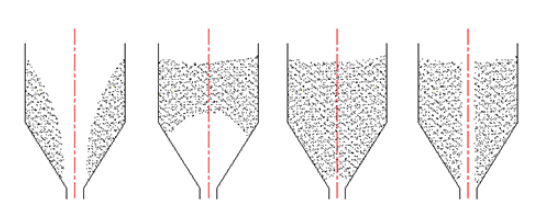
Some measures to prevent pipeline wall sticking:
1. Reasonably choose the air flow rate. The speed of pneumatic conveying directly affects the motion state of two-phase flow. A high airflow velocity results in high energy consumption and a high rate of material fragmentation during transportation. But in general, it is beneficial to control material adhesion to the wall. The minimum airflow velocity can be determined through the jet airflow method. Even if the airflow passes through a breathable board or fabric containing the material, the adhesion strength can be determined based on the minimum airflow velocity required for particle scattering. But for some materials, the greater the impact force, the greater the deformation, and the more severe the adhesion.
2. The inner wall of the conveying pipeline must be processed smoothly to prevent particle materials from easily adhering or being quickly carried away by the airflow after adhesion.
3. Clear requirements must be set for the temperature, pressure, humidity, and static electricity content during the transportation of various materials. Materials that do not meet the requirements cannot be transported.
4. Different requirements should be put forward for the particle size and particle size distribution, physical and chemical properties of materials. Some materials are ultra-fine, easy to stick to the wall, and difficult to remove, so pneumatic conveying is not suitable for such materials.
5. For materials with high moisture content, when moisture content plays a major role in wall adhesion, they must be dried before transportation.
6. For materials that are prone to sticking, it is recommended to use a conveying diameter greater than 100mm. In pipeline layout, the shortest conveying distance should be selected as much as possible to reduce the number of bends. Large diameter and small degree bends should be used. For materials with longer conveying distances, it is recommended to use a speed reducer.