
What are the forms of pneumatic conveying systems?
When conveying materials such as powder particles, we generally use pneumatic conveying, which not only has no dust pollution, but also reduces energy consumption, increases production capacity, and greatly improves production efficiency. Pneumatic conveying can be divided into:Air suction pneumatic conveying system、Pressure fed pneumatic conveying system、Hybrid pneumatic conveying systemThey each have their own characteristics, and their design principles are generally as follows:
1. Inhalation pneumatic conveying system
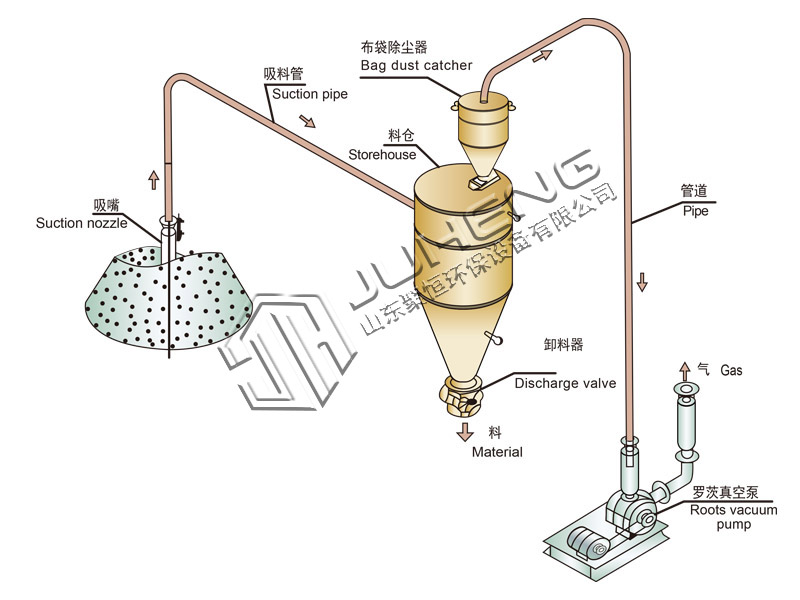
Inhalation pneumatic conveying, also known as vacuum conveying, generally connects one end of the system pipeline to a vacuum pump and extends the other end into the material warehouse through a suction nozzle. After the vacuum pump is started, the air in the system pipeline is sucked away, forming a pressure difference at both ends. The powder is sucked in due to the pressure difference and finally sent into the designated material bin with the airflow, achieving the purpose of airflow transportation.
This system is relatively convenient for feeding, as it can be connected to several feeding bins through hoses and suction nozzles, and feeding can be done simultaneously, making feeding more convenient. However, due to the significant pressure loss along the pipeline, the distance and productivity of material transportation are limited, resulting in high energy consumption and high requirements for pipeline sealing. At the same time, due to the negative pressure inside the pipeline, material leakage can be reduced during the transportation process, greatly reducing pollution to the surrounding environment. It can generally be used to transport materials that cause significant environmental pollution, such as coal powder, fertilizers, etc.
2. Pressure fed pneumatic conveying system
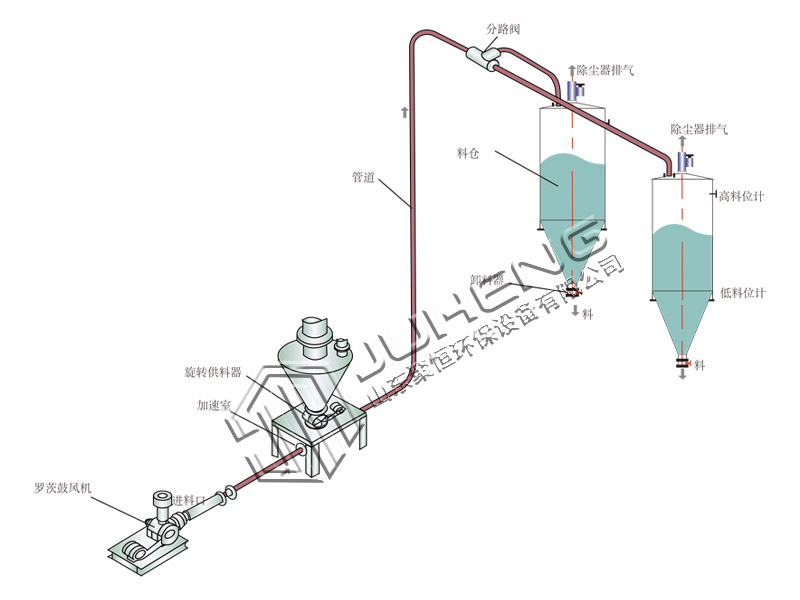
Pressure conveying pneumatic conveying, also known as pressure conveying. Generally, the system air inlet pipeline is connected to a blower. The blower sucks in air through the air inlet, compresses the air to form a high-pressure airflow, and the high-pressure air flows along the conveying pipeline, carrying animal materials into the designated position along the pipeline. Finally, the purified air is discharged through a purification device.
This system can transport materials to several locations over a long distance, with high production efficiency and relatively low requirements for pipeline sealing. It is a commonly used powder conveying solution.
3. Hybrid pneumatic conveying system
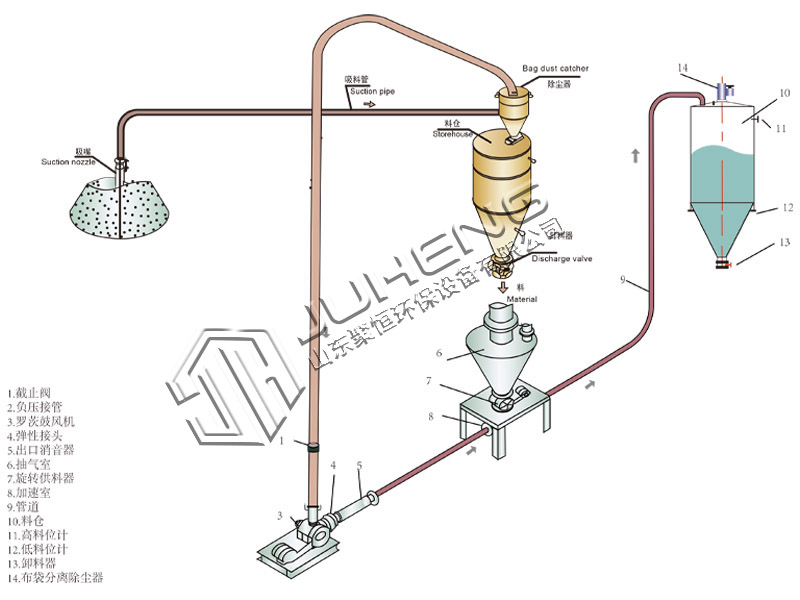
Hybrid conveying, also known as vacuum pressure conveying, combines the advantages of the two conveying methods mentioned above. It can be used for multiple material pick-up and unloading, and has a long conveying distance. However, the entire system structure is complex and energy consumption is also high.
The air inlet of the system is connected to a material separator, which can suck materials from multiple places into the separator. After the materials are sent into the separator with the airflow, they separate from the air. The separated air enters the filter through the air pipe, the purified air enters the blower, and finally is pressed into the material conveying pipeline to form a high-pressure airflow. The material in the separator uniformly and continuously enters the material conveying pipeline under the action of the rotating feeder, and enters the storage bin with high-pressure airflow. The air is finally discharged through the filter.
The pneumatic conveying system has low energy loss, long conveying distance, and high lifting height during the conveying process. When conveying materials such as powders and particles, it can reduce dust pollution, make the environment clean and tidy, and meet the national environmental protection standards. In this way, production efficiency is improved and pollution is reduced.