
Classification of dilute phase pneumatic conveying systems
The process of conveying materials at low pressure and high speed is called dilute phase pneumatic conveying system. Generally, materials that are not easily broken, have low wear, and have a low material to gas ratio are transported in a suspended manner in pipelines, also known as suspended flow. The transportation of most materials is related to particle size, shape, or density. Powder with low density, fine in nature, and less air retention capacity, suspended in a dilute mode with a low proportion of material in air. Under different process requirements, different schemes can be designed to achieve the highest work efficiency.Shandong Juheng Environmental Protection Equipment Co., LtdWith 13 years of experience in pneumatic conveying, we provide free on-site design solutions, free machine testing, one-year warranty for the entire machine, and lifelong maintenance services.
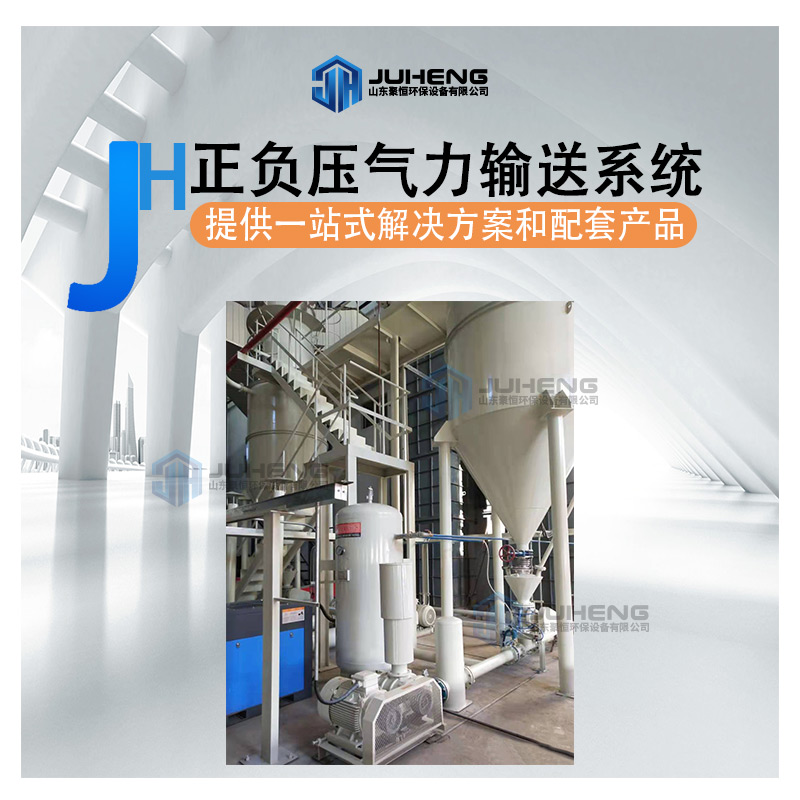
1. Positive pressure dilute phase pneumatic conveying system:
The positive pressure dilute phase conveying system operates above atmospheric pressure and is used to transport bulk materials with a medium distance larger than that of a vacuum system. With a diversion valve, multiple receiving points can be easily arranged with the positive pressure system for one destination after another.
Multiple feeding points entering a common route can also provide assurance of appropriate selection and airflow, as well as special rotating airlock valves for conveying.
2. Negative pressure dilute phase pneumatic conveying system:
The negative pressure dilute phase conveying system operates when the air pressure is lower than atmospheric pressure, applying vacuum pressure at the destination and sucking the material into the airflow through a rotary airlock valve (RAL) or a suction tool.Due to the advantage of gas leakage inward, the problem of spraying dust into the atmosphere is almost eliminated.
The negative pressure dilute phase conveying system is crucial for toxic and explosive materials, which can operate without a closed system as long as appropriate safety measures are taken, such as exhaust.