
How to solve common problems in dilute phase pneumatic conveying
Pneumatic conveying equipment A large amount of materials can be transported from the feed inlet to the other end. The principle of pneumatic conveying is to use air mixture to transport powder materials in pipelines. Manufacturing enterprises all know that gas conveying equipment can transport large amounts of materials from one place to another. Gas conveying equipment uses air to propel powder materials in pipelines. In most cases, bulk solids are in dry powder or granular form and are transported using gas conveying equipment. It can be transported to containers/mixers, chemical raw materials can be transported to reactors, and polymer particles can be loaded into hoppers above extruders or injection molding machines. According to the conveying method, there are two main types of gas conveying equipment: dense phase gas conveying equipment and dilute phase gas conveying equipment; Dense phase gas transport equipment is a high-pressure device used to transport materials over long distances, and due to its low-speed characteristics, it is particularly suitable for fragile or abrasive materials. Dilute phase gas transportation equipment is a low-pressure high-speed device that has the greatest flexibility in handling a range of materials. Air flow can be generated by air compressors or Roots blowers.
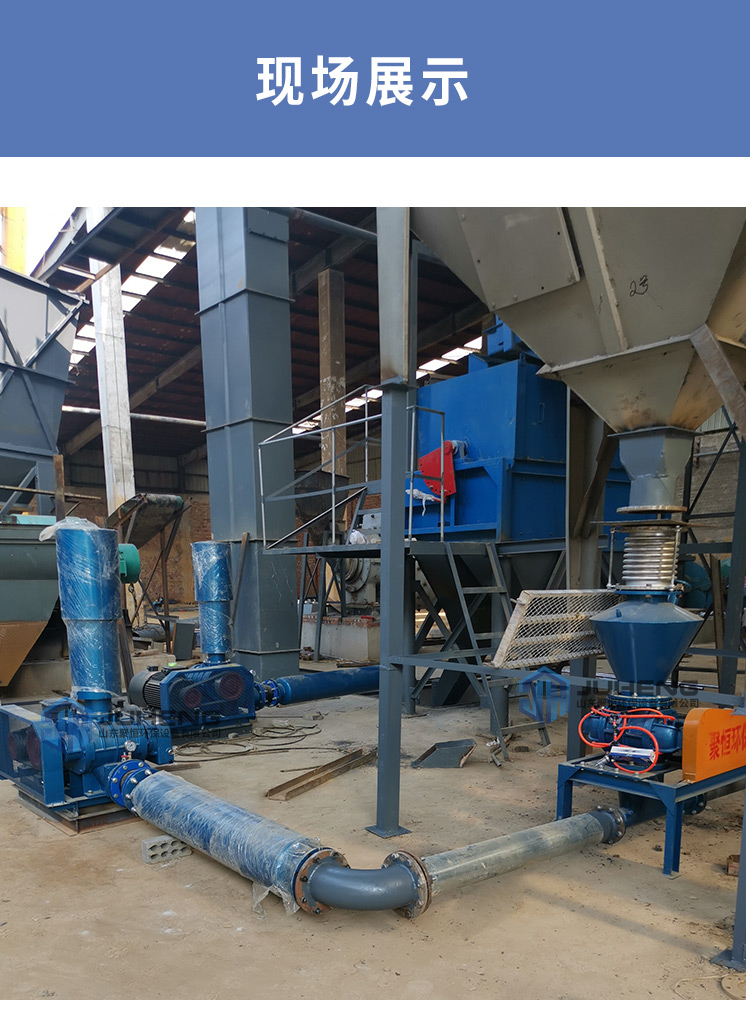
How to design gas transportation equipment to solve common problems in dilute phase transportation?
Starting from the main components of a single gas delivery device. Including the controller (PLC), which is an important equipment for gas conveying equipment; A rotating claw shaped long-distance pump (LDP) with variable speed drive (VSD) for producing deep vacuum at different levels; Material receiver, storing pre programmed recipes and communicating with the PLC; Patent pulse valve and servo valve; There is a material distribution box; There is also a speed sensor.
Users can program the waveform, velocity, and delivery rate according to the specific requirements of each material receiver. PLC allows gas delivery equipment to operate in conventional dilute phase mode, or in dense and dilute phase modes depending on the selected LDP pump and formula. It all depends on the application and the desired effect of the plant. This valve works together with PLC and VFD controlled vacuum pumps to achieve optimal vacuum pressure and material velocity. For example, the valve can be automatically adjusted to allow gas conveying equipment to transport materials at lower vacuum pressures and lower wave speeds when materials need to be transported over long distances. Using VFD, LDP pumps can operate at lower Hertz values to achieve the desired material velocity, while dilute phase gas conveying equipment operates continuously at 60 Hertz. Our laboratory tests have shown that compared to fixed speed pumps, VFD pumps save users 15% to 29% of energy per kilowatt hour.
At the same time, the speed sensor verifies that the movement speed of the material from the source to the destination is slow. We also recommend installing a clear pipeline for visual inspection of material flow. This PLC can control any combination of up to 128 material receivers and almost 40 vacuum pumps, whether gas conveying equipment uses LDP pumps with VFD for long-distance conveying or standard regeneration pumps for dilute phase conveying.
Shandong Juheng Environmental Protection Equipment Co., LtdWe are a manufacturer of pneumatic conveying equipment. If you need equipment such as fans, feeders, bin pumps, dust collectors, material sealing pumps, branch valves, etc., please feel free to contact us. We provide free on-site design solutions, free machine testing, one-year warranty, and lifelong maintenance services.