
Comparison between pneumatic conveying and mechanical conveying
In pneumatic conveying, there are pneumatic equipment such as fans and air compressors. The conveying methods of powder materials are different from mechanical conveying and pneumatic conveying. The most commonly used methods in enterprises are mechanical conveying and pneumatic conveying. However, in powder conveying, pneumatic conveying can achieve dust-free conveying and will not cause pollution to materials due to environmental factors. And the production environment will also be cleaner, with emissions meeting national standards.
Mechanical conveying system
Powder mechanical conveying equipment includes screw conveyors, belt conveyors, bucket elevators, etc. During the process of powder mechanical conveying, the air disturbance caused by the gravity of the powder falling at the feeding and discharging points causes dust to rise and form a dust source (unorganized emission). Mechanical conveying generally has short conveying distance, small conveying capacity, poor equipment airtightness, poor layout flexibility, high investment, and serious dust pollution. Pneumatic conveying based on fluidization theory has become the most commonly used method for conveying various powders in various process units and equipment.
Pneumatic conveying system
Pneumatic conveying is a device that uses gas as a power source to transport powdered materials from one place to another in a closed pipeline in the direction of airflow. It is a specific application of fluidization technology. Widely used in industries such as fine chemicals, polymer material synthesis and processing, battery manufacturing, grain processing, metallurgy, cement building materials, coal-fired power plants, etc. It is a modern logistics system suitable for bulk material transportation, which can replace various traditional mechanical and hydraulic transportation in many aspects.
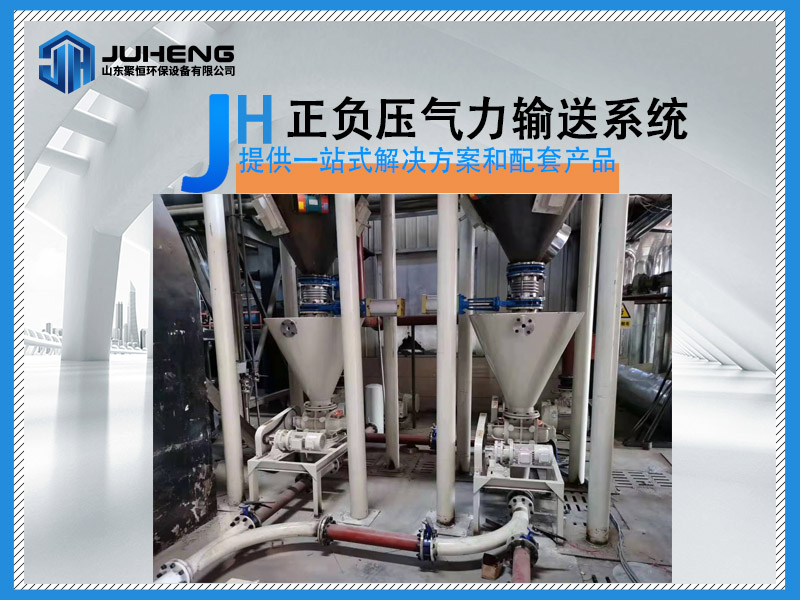
Pneumatic conveying diagram
Pneumatic conveying has the following advantages:
1. Simple structure, can be arranged according to the site, long conveying distance
2. No leakage or pollution during the transportation process
3. It can achieve flexible delivery from multiple points to multiple locations.
During the transportation process, other process operations such as crushing, mixing, heating, cooling, and drying can be carried out, and even chemical processing can be performed.
5. Automatic batching can be achieved according to the PLC control system, with a high degree of automation