Conditions for pneumatic conveying
The conditions for pneumatic conveying include the minimum pneumatic conveying wind speed, the characteristics of pneumatic conveying, and the characteristics of the fan. To achieve the conveying wind speed under the lowest pressure loss, it is necessary to understand the relationship between air mass flow rate and pressure difference, the relationship between air mass flow rate and conveying capacity, and the relationship between air mass flow rate and conveying wind speed. Below, let Juheng's editor introduce the impact of material and pneumatic conveying conditions on pneumatic conveying.
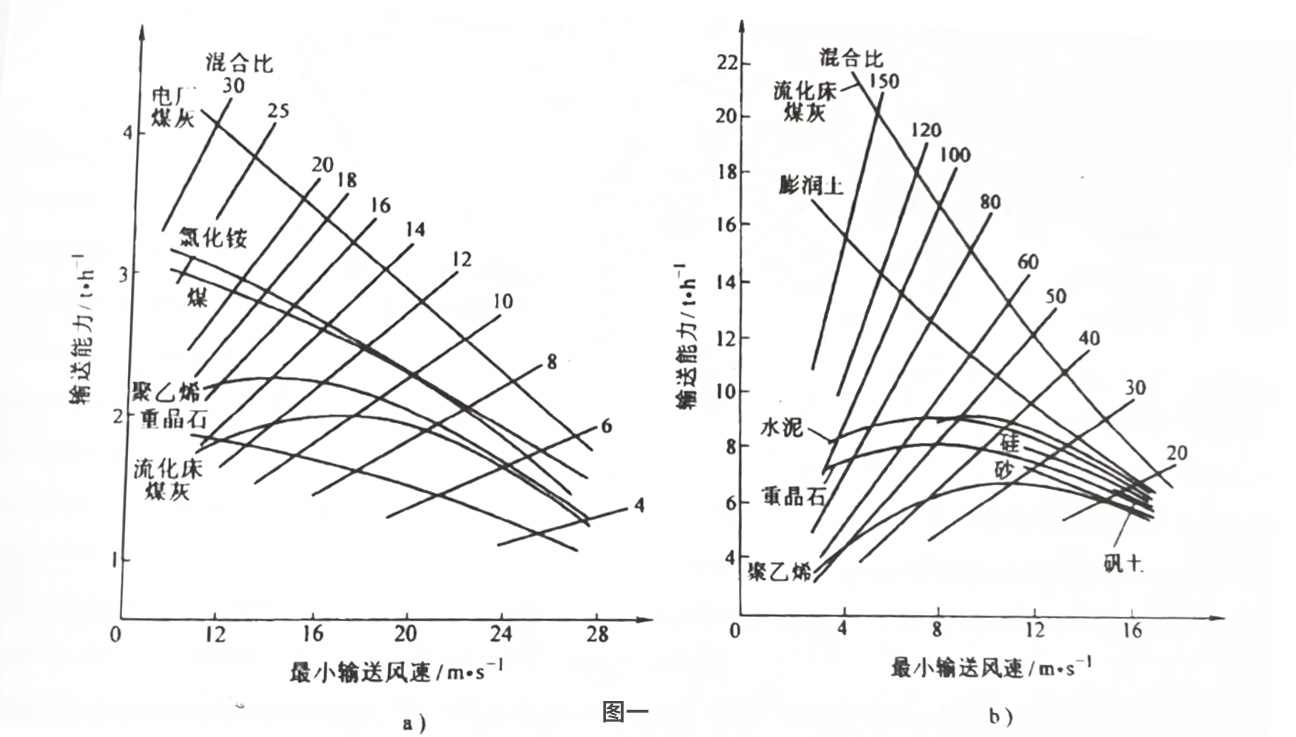
1. The minimum pneumatic conveying wind speed is an important parameter, as shown in Figure 1. As shown in the figure, reducing the minimum conveying wind speed will increase the conveying capacity. Among them, in high-pressure conveying, there is an optimal minimum conveying wind speed or corresponding optimal mixing ratio for the conveying capacity of many materials. However, in practical operation, it is often felt that in order to increase the conveying capacity, it is necessary to increase the pneumatic conveying wind speed, and the result obtained is the opposite.
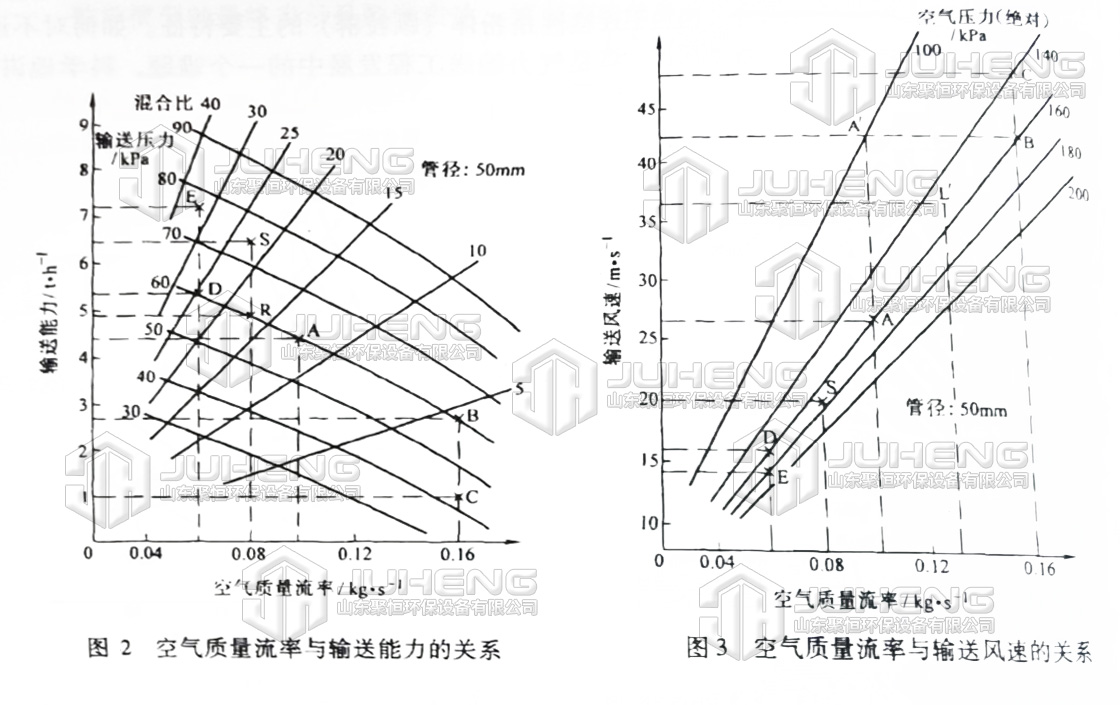
2. Pneumatic conveying characteristics Figure 2 illustrates the influence of supply pressure and air volume on conveying capacity, which is more complete in expressing conveying characteristics than the curve at a specific pressure shown in Figure 1. Figure 3 shows the relationship between the velocity and mass flow rate of air under pressure (inlet and outlet) in the same pipeline. Taking point A in Figure 2 as an example, at this time, the air flow rate0.1kg/s, The conveying pressure is 60kPa (gauge pressure), the conveying capacity is 4.4Vh, and is determined by A, A&# 039 in Figure 3; The inlet wind speed is 26.4m/s and the outlet wind speed is 42.2m/s.
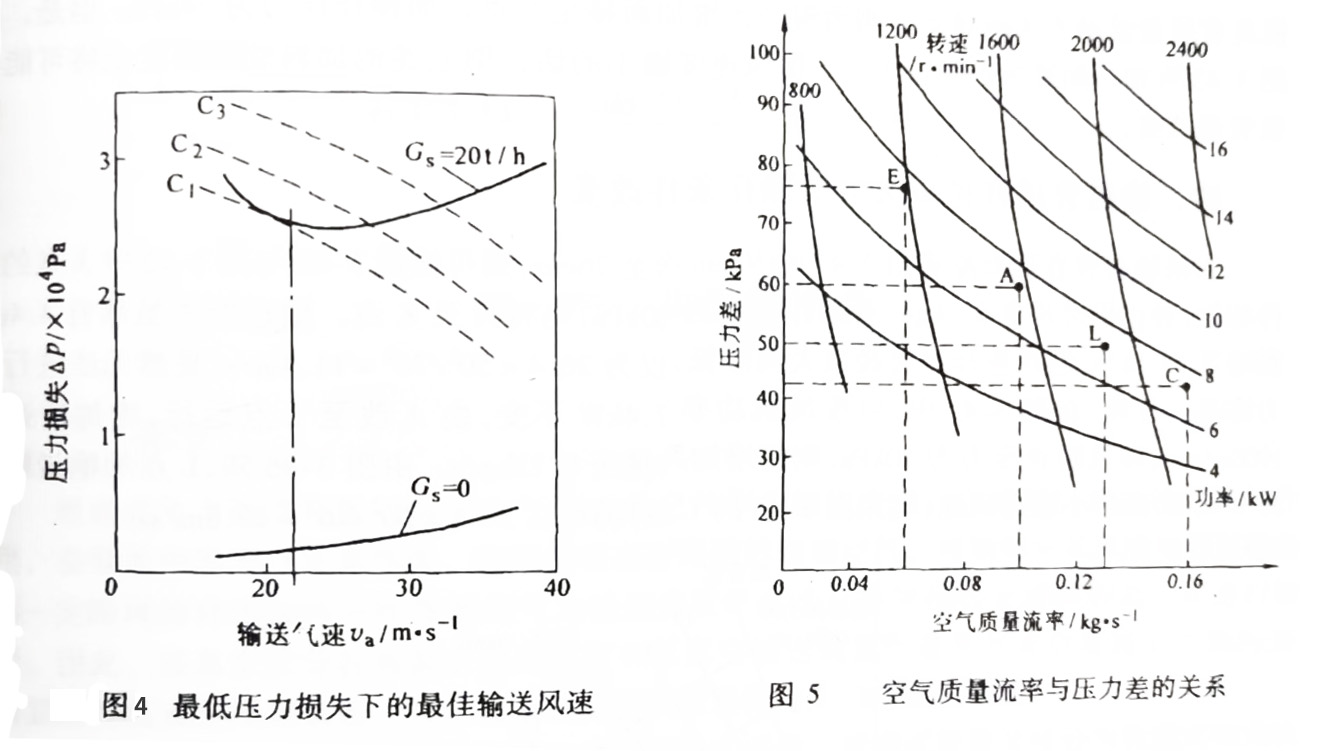
3. The characteristics of the fan are shown in Figure 4. When the conveying capacity is 20Vh, the minimum conveying wind speed is 22m/s. The characteristic ratio curves of the three types of fans are C, C2, and C. As can be seen from the figure, there is more room for the C fan, and the C fan is too large. Therefore, choosing the Cz fan is the most suitable. Taking the Roots blower as an example, its characteristics are shown in Figure 5. According to the conditions of point A above, it can be found that the required speed is 1600r/min and the power is 7.4kw.