
Attention points for pneumatic conveying suction nozzle
in the selectionNegative pressure pneumatic conveying systemWhen it comes to suction, attention should be paid to the design of the nozzle, as the corresponding pressure for different materials is different. Through continuous research by Juheng, the following summary has been made:
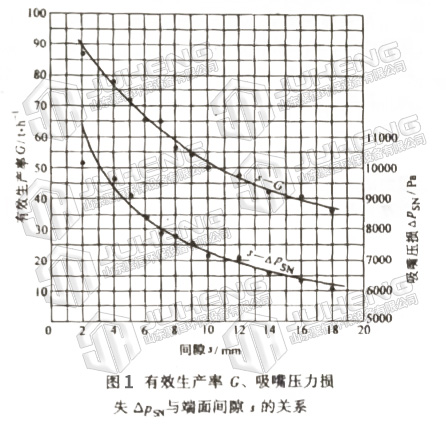
1) Adjust the end face gap between the inner and outer pipes correctly. According to extensive experiments on the suction of rice by inland grain suction machines, it has been shown that when the depth of the suction nozzle inserted into the material layer is maintained at 300-400mm, the end face gap s value changes between 2-18mm. The relationship between the measured s value and the effective productivity G and suction nozzle pressure loss Δ psv of the grain suction machine is shown in Figure 1. From the graph, it can be seen that both G and Δ ps increase significantly with the decrease of s, and the productivity is highest when the s value is between 2-4mm. However, in the experiment, there was a phenomenon where the annular space between the inner and outer pipes was blocked by rice, resulting in the end gap being blocked. At this time, the speed of absorbing rice actually slowed down, indicating that adjusting the s value to around 2-4mm is more appropriate. When suctioning different types of materials, the value of s varies. When suctioning wheat on the original 3/mm between floating grain suction machines, the optimal value of s is between 6-8mm. When suctioning oats, the smaller the value of s, the better. For easy control of the value of s during operation, a ruler indicating the end face clearance value should be installed on the suction nozzle.
2) Ensure that the nozzle is inserted into the material layer to a certain depth. As mentioned above, two sets of experiments were conducted on inland grain suction machines with s values of 8mm and 10mm. The depth h of the suction nozzle inserted into the rice varied between 200-500mm, and the effective productivity G and suction nozzle pressure loss Opsv of the grain suction machine were measured as a function of the suction nozzle insertion depth h. As the value of h increased, G also increased, while ps increased very little. Therefore, in practical operations, in order to fully utilize the self flow of materials and ensure that their energy source continuously flows into the suction nozzle, it is better to adjust the insertion depth to h ≥ 400mm.
3) Pay attention to selecting the appropriate position for inserting the suction nozzle into the material layer. The material should be evenly fed around the nozzle to avoid exposing a part of the nozzle and reducing the suction speed.
4) When it is necessary to move the suction nozzle to the suction position, the movement time should be shortened as much as possible.
5) If the conveying system has two or more suction pipes, each suction nozzle should be inserted into the material layer at the same time to avoid one or several suction nozzles being empty.
6) It is necessary to prevent materials from falling into the annular space between the inner and outer pipes of the suction nozzle, and to block the end gap.
7) Be careful to prevent large pieces of debris (such as burlap bags, broken cloth, large wood chips, etc.) and metal such as iron wire and nails from being sucked in. For this purpose, a grille protective cover made of welded round steel can also be installed outside the suction port, with a height of about 40-50mm to prevent loss of the protective cover.
8) If using a Roots blower as the gas source, the suction nozzle should be removed from the material pile before starting up to prevent accidents.