Application of pneumatic conveying technology in the grain industry
In the mid-20th century, the Swiss company BuHLER began designing pneumatic conveying systems for flour mills. In 1995, China introduced pneumatic conveying from abroad to transport barley, corn, etc. In 1958, Jinhua Flour Mill in Zhejiang Province built China's first pneumatic conveying system for flour processing, which was subsequently promoted and applied nationwide. Due to its beneficial effects on grain processing technology, pneumatic conveying not only completes material transportation but also increases yield, reduces grain mold and insect infestation, improves workshop hygiene, saves maintenance costs, and ensures safe production. Currently, most flour mills, rice mills, and grain processing factories have adopted pneumatic conveying, and it has gradually expanded to oil mills, feed mills, and other industries. In connection with warehouses, factories and stations, the distribution of flour, bran, bran, Youbing (Deep-fried round and flat dough-cake) and other finished products and by-products is also gradually using pneumatic conveying.
The application of pneumatic conveying in the grain industry mainly consists of two parts: in addition to the aforementioned port and dock pneumatic suction machines, the other is pneumatic conveying in grain processing plants. It includes flour mills, rice mills, oil mills, feed mills, distilleries, bulk trucks for flour transportation, and pneumatic conveying in the circulation links of warehouses and stations.
There are two forms of pneumatic conveying in the grain industry: negative pressure conveying and positive pressure conveying. In the flour milling workshop of a flour mill, pneumatic suction is widely used due to the need for cooling, dust removal, and moisture absorption of the conveyed materials. For flour mills that produce specialized flour, pneumatic conveying is often used for the transportation and bulk shipping of flour during the flour blending process, mainly due to the flexibility of transportation, long-distance, high concentration, and low air volume.
The negative pressure conveying in the milling workshop is composed of multiple vertical pipelines. The centrifugal fan serves as the central air network for the gas source and can simultaneously transport multiple materials. The vertical height of each pipe does not exceed 30m, and the material air mixture ratio is about 3. The wind pressure of the fan generally does not exceed 10kPa.
The positive pressure conveying in the powder mixing workshop is a single tube conveying system connected to a pipeline by a three blade Roots blower. It can only transport one type of material at a time, and can also achieve one feeding point and multiple unloading points. The distance of positive pressure conveying is generally between 30~80m, the mixing ratio of material and gas is between 10~40, and the air pressure of the fan is between 30~100kPa.
Figure 1 shows an example of a modern flour mill using pneumatic conveying. The entire process of cleaning, milling, flour blending, finished product packaging, by-product and finished product shipping from wheat entering the warehouse is completed in a closed factory building. In the entire flour mill, pneumatic conveying is mainly used for the bulk transportation and storage of flour, the process of blending flour, and the transportation of wheat in the cleaning workshop.
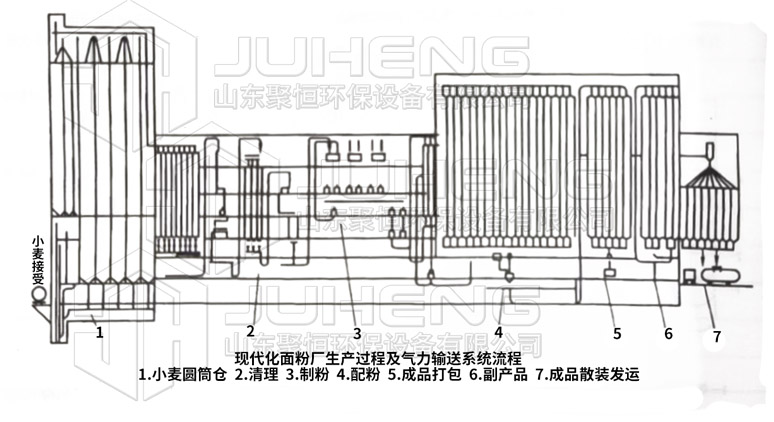
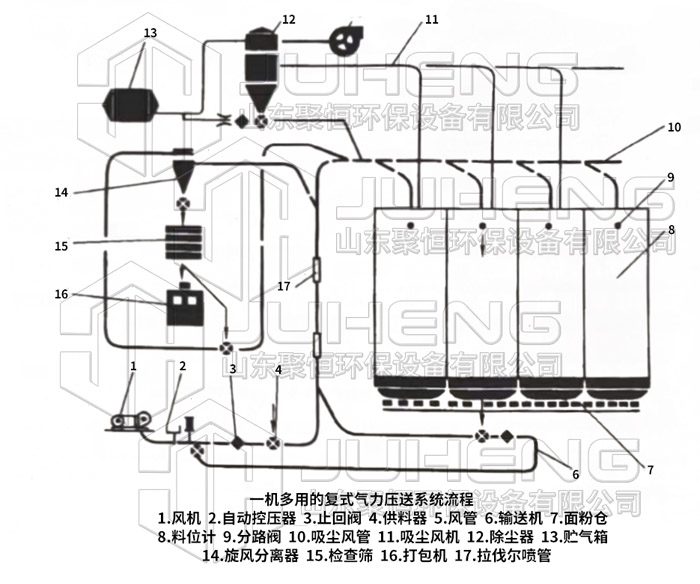
Figure 2 shows a composite pneumatic conveying system. By utilizing the same gas source and flexibly combining pipelines and valves, one machine can be used for multiple purposes. It can be used to complete the feeding of flour into the warehouse, as well as to complete the re screening inspection and pouring operations of flour. This system can save equipment investment, reduce energy consumption, and fully utilize the flexibility and superiority of the gas nine transportation layout. This arrangement has certain progressiveness and high technical requirements, so an automatic control system must be configured for operation management.