
How to solve the problem of blockage in pneumatic conveying
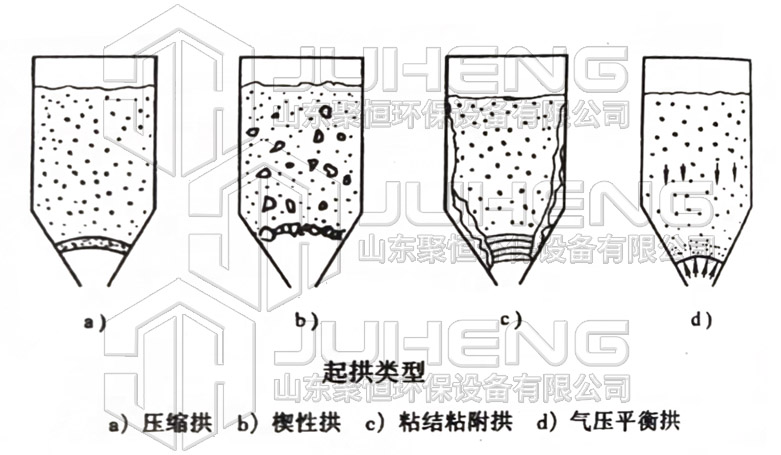
The types of arching and the reasons for preventing powder arching blockage are numerous and complex, which can be roughly summarized into four types, as shown in the figure.
1) Compression arch. The compression of the powder reduces the porosity, resulting in arching due to the increased strength of the powder itself.
2) Wedge shaped arch. The arching caused by the local force balance of granular materials.
3) Adhesive bonding arch. Materials with strong adhesion, due to their moisture content, moisture absorption, or static electricity, not only adhere to the warehouse wall, but also arch under the action of consolidation pressure and consolidation time.
4) Atmospheric pressure balance arch. When the rotary valve leaks high-pressure air upwards due to poor airtightness, a similar compression arch is formed due to the balance of local pressure. The reasons for blockage include consolidation, adhesion, static electricity, moisture, melting, etc. Most of them are due to changes in the surface properties of the powder, which increase the adhesion force. Knowing the reason for the blockage of the silo, we must thoroughly analyze the conveyed materials before selecting various pneumatic conveying devices in the design of the pneumatic conveying system. Only by being proactive can we effectively ensure the stable operation of the pneumatic conveying system.
At the beginning of silo production, measures can be taken to prevent arching and blockage from silo structure, fluid modification, vibration, and inflation fluidization. The following are measures to prevent arching from silo structure:
1. Deviation towards the discharge port: It has a vertical or non symmetrical wall surface to reduce its vertical pressure and eliminate the arch foot;
2. Curved hopper: A hopper with an exponential curve shape is not prone to arching;
3. Reasonably determine the top angle of the hopper and the size of the discharge port;
4. Warehouse wall coating: Use epoxy resin or other coatings to reduce the wall friction coefficient.
In addition, blockages can also be avoided from subsequent pneumatic conveying devices, which can be improved in the following aspects:
If the fly ash in the silo is stored for too long and the ash temperature is low, it is easy to get damp. The damp material is prone to blockage during transportation. Good insulation and heating measures should be taken to block the ash hopper, and there should be no outward or inward leakage of ash; When it is found that the unloading is not smooth, the first thing to check is whether the heating equipment is working properly, whether the electric heater has failed due to short circuit or overheating, and whether the steam heating coil has leakage or blockage; Is there any leakage in the ash hopper; Is the gas supply pressure and flow rate of the gasification device sufficient, and is the heating temperature of the gasification air appropriate; If there is, repair it. For those who often encounter difficulties or blockages in powder feeding, such as those without gasification heating facilities, it is best to configure them. The closer the gasification device is to the throat of the "arch", the better the effect of preventing arch formation.
2. The gap between the impeller of the feeder and the outer shell is too large, causing external cold air, especially the humid air inside the box type ash hopper, to be sucked in by the negative pressure inside the ash hopper, which hinders the unloading of the ash. At the same time, it causes the ash to condense and become damp, sticking into clumps, resulting in poor discharge and blockage. So the unloading system must use good quantitative unloading equipment, such as the rotary feeder produced by Shandong Juheng Environmental Protection Equipment Co., Ltd., which can continuously supply and unload materials with good airtightness; For existing rotary feeders, if the gap is too large and they need to be returned to the factory for repair or have the ability to be repaired, they can be welded onto the impeller and machined to maintain a single-sided gap of 0.3-0.5mm before being installed.
When there is oil ash or due to boiler combustion conditions, fly ash with lower ash temperature and higher moisture content needs to be stored in the ash hopper, the storage time should be minimized as much as possible, and gasification heating measures should be strengthened when unloading.
4. The discharge pipe and valve should be kept sealed and insulated as much as possible; The discharge pipe should be installed vertically as much as possible, with an angle of at least 60 degrees from the horizontal plane.
5. Keep the exhaust unobstructed during ash unloading; The exhaust pipe should maintain an angle of at least 45 ° with the horizontal plane to prevent ash particles from depositing inside the exhaust pipe and blocking it.