
Design of Power Plant Fly Ash Pneumatic Conveying System
The development speed of multi bin pump dense phase pneumatic conveying in the fly ash pneumatic conveying system of power plants is fast. In response to the characteristics of conveying dry ash from electrostatic precipitators and ash hoppers from economizers in combustion power plants, a parallel bin pump pneumatic conveying system has been designed.
Output and conveying distance of parallel bin pump dense phase pneumatic conveying system: The system output is determined by the number of electrostatic precipitators and ash hoppers configured in the electric field. Generally, 2-4 sets of bin pumps are connected in parallel to form a unit; When the electrostatic precipitator is equipped with 8 ash hoppers in the same electric field, a combination of 2 conveying units can be used; The output of the conveying system is the sum of the outputs of the conveying units operating simultaneously, therefore it has the advantage of high conveying capacity, especially suitable for the pneumatic ash removal system engineering of large capacity units in coal-fired power plants. Conveying distance: The parallel bin pump adopts dense phase pneumatic conveying technology, and the compressed air flow velocity at the starting end of the conveying pipeline is low, generally around 5.6m/s; By adopting measures such as segmented variable diameter in conjunction with the conveying pipeline, it can not only meet the requirements of medium to long-distance transportation, but also achieve a high conveying ash to gas ratio, with significant energy-saving effects.
At the same time, the final velocity of the conveying pipeline can be strictly controlled to be ≤ 20m/s to reduce pressure loss and wear in the conveying system. When transporting materials, compressed air fluidizes the materials and intermittently transports them along the pipeline in a regular manner. Thus, the sediment flow is kept in a highly ventilated state, and the powder material is fluidized and transported in a rope like flow at the bottom of the conveying pipeline; Due to the suspended dense phase transportation, the fly ash is in a camel hump state in the pipeline and is pushed to its destination by the airflow. After understanding its basic principles, the working procedure of parallel chamber pump pneumatic conveying is as follows:
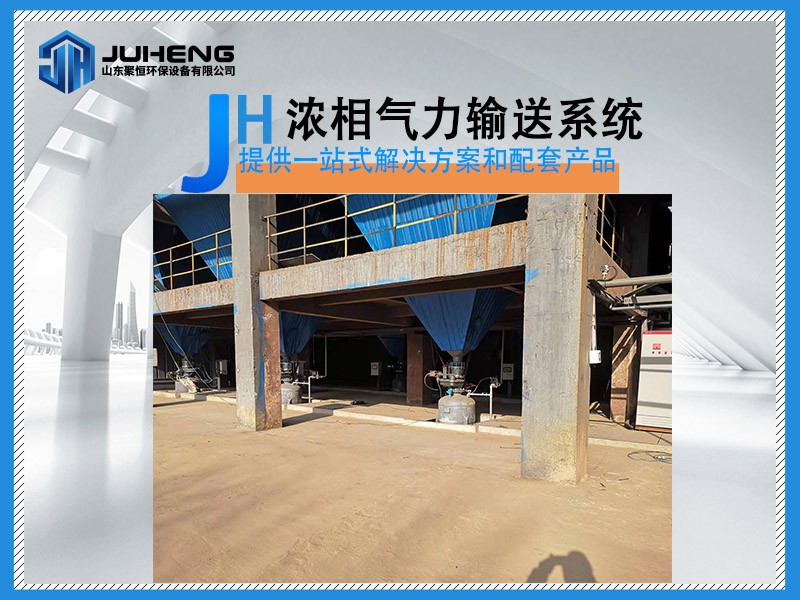
1. The state where the parallel bin pump stops working: The opening of all manual regulating valves in the parallel bin pump conveying system has been determined during the commissioning of the conveying system and does not need to be adjusted under normal operation; All pneumatic exhaust valves of the parallel chamber pump are open, while other pneumatic valves are closed;
2. Pneumatic ash loading status of parallel bin pumps: All pneumatic exhaust valves of parallel bin pumps are open, and all pneumatic feed valves are open; The common pneumatic intake valve is closed, and the common pneumatic discharge valve is closed; The parallel bin pump begins to load ash. When the level gauge of the bin pump outputs a full signal, close the corresponding pneumatic feed valve and corresponding pneumatic exhaust valve of the bin pump; When the pneumatic feed valve and pneumatic exhaust valve of the parallel bin pump are all closed, and a signal is output to indicate the end of ash loading;
3. Status of parallel chamber pump pneumatic conveying: When the pneumatic exhaust valve of the parallel chamber pump outputs a closing signal, the common pneumatic inlet valve is opened, and the compressed air is transported to start boosting and fluidization operations on the parallel chamber pump, while also inputting compressed air into the conveying pipeline of the series parallel chamber pump. When the pressure inside the conveying pipeline of the series parallel bin pump and the pressure inside the parallel bin pump reach the pump opening pressure, the common bin pump pressure switch outputs a signal to open the common pneumatic discharge valve, forming a situation where the pressure inside the parallel bin pump is greater than the pressure inside the conveying pipeline, and the parallel bin pump begins to transport.
4. End of transportation and restoration of ash loading state: When the pressure inside the parallel bin pump drops to the pump shutdown pressure, the pressure switch of the common bin pump outputs a signal; Close the common pneumatic inlet valve first, and then close the common pneumatic outlet valve. When the common pneumatic discharge valve outputs a signal, it indicates the end of transportation, and all pneumatic exhaust valves and pneumatic feed valves of the parallel bin pump are opened to restore the ash loading state of the parallel bin pump.
The design of the parallel bin pump conveying system for the power plant fly ash conveying system requires years of technical experience. If you need pneumatic conveying equipment, we will provide a free design solution.