
Case analysis of pneumatic conveying pipe blockage
During the use of the fuel pneumatic conveying system for sintering in a certain ironworks, the large particle size, high moisture content, and poor flowability of the coke powder caused significant resistance in the pipeline. In addition, the insufficient conveying output resulted in a gradual decrease in the conveying speed of the coke powder in the pipeline, causing frequent pipe blockages Improvement measures were proposed to address the causes of pipe blockage. The ash intake pipeline was modified by extending it into the bin pump and designing a section of Venturi tube at the front end of the ash intake pipeline; Material to gas ratio; Adjustments have been made By increasing the conveying speed and reducing the resistance of materials in the pipeline, the problem of pipeline blockage during the transportation of coarse particles such as coke powder and materials with high water content has been solved, and the applicability of pneumatic conveying to materials has been expanded.
Pneumatic conveying equipment is commonly used for long-distance transportation of materials. The equipment is simple, compact in structure, easy to operate, and has flexible process layout. The fuel for sintering in a certain steel plant is transported from the coke powder tank in the batching room to the receiving bin on the sintering platform. In the early stages of operation, frequent pipeline blockage faults occur, causing the system to malfunction.
Analyze this issue:
In the sintering fuel technology renovation project of a certain steel plant, dense phase pneumatic conveying is used. The system consists of an independent sending unit composed of a 2.5m ³ bin pump. The main equipment includes coke powder tank, feed valve, exhaust valve, bin pump, ash conveying inlet valve group, fluidized gas pipe, conveying pipeline, receiving bin and bin top cloth bag. As shown in Figure 1
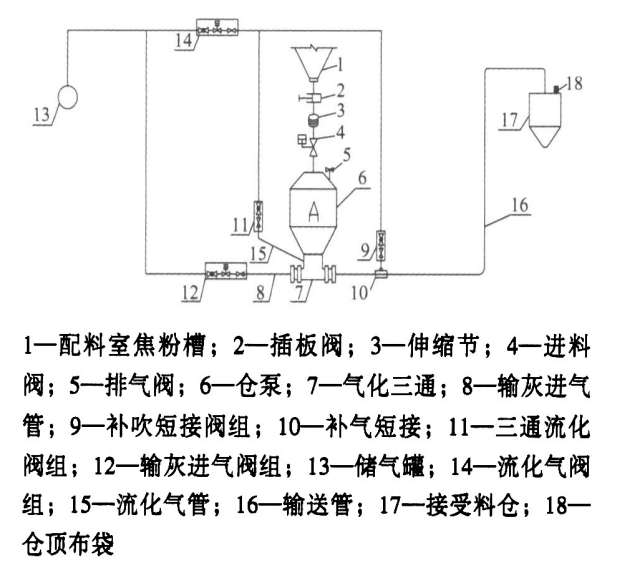
During normal operation, the coke powder is stored at the outlet of the coke powder tank in the batching room above the bin pump unit. The coke powder enters the bin pump under the action of gravity and is then transported to the receiving bin by the pneumatic conveying system through the rare earth alloy wear-resistant pipeline. Accept the installation of a top cloth bag on the top of the silo to avoid dust during ash transportation.
The bin pump pneumatic conveying device adopts intermittent conveying mode, and each conveying of one bin material is a working cycle. The conveying steps of each working cycle are as follows
When the pressure inside the bin pump is ≤ 0.03MAP, the exhaust valve and inlet feed valve are opened through solenoid valves, and the interior of the bin pump is connected to the coke powder tank, allowing coke powder to continuously enter the bin pump from the coke powder tank.
When the level gauge of the warehouse pump sends out the Liao Wei signal, the feed valve and scheduling valve are closed due to electromagnetic valve failure, and the status of the feed valve ends at this time
-
After a delay of 1-2 seconds when the exhaust valve is closed, the delivery air source valve and fluidized pneumatic valve will be opened by the energized electromagnetic driver, and the delivery air source will enter the bin pump. The coke powder in the pump will be discharged into the delivery pipeline. At this point, the mixture of coke powder and compressed air enters the conveying pipeline and is transported to the receiving silo. At the beginning of this step, the pressure inside the bin pump sharply increases, which is the pressurized fluidization stage. After that, the pressure remains stable, which is the conveying stage. When the bin pump completes the material conveying, the pipeline resistance decreases and the pressure inside the bin pump decreases. When the pressure inside the bin pump drops to the lower limit pressure value, the conveying stage ends and enters the next step, which is the blowing stage. The pneumatic inlet valves in the ash conveying inlet valve group and fluidized air valve group are still open, and compressed air blows the bin pump and ash conveying pipeline. At this time, there is no coke powder in the bin pump, and the coke powder in the pipeline gradually decreases, finally almost becoming an air flow state. The system resistance decreases, and the pressure inside the bin pump drops below 0.03MAP, sending a signal that the conveying is completed. The conveying air source valve and fluidized air valve will be closed. The purpose of this ash conveying process is to blow the residual coke powder in the pipeline and bin pump to facilitate the next cycle of conveying.
Analysis of reasons for pipe blockage
Under normal circumstances, during the pressurized fluidization and conveying stages of pneumatic conveying, materials can be fully fluidized in the bin pump and overcome the resistance of the conveying pipeline to be discharged into the receiving bin under the driving force of compressed air. However, materials suitable for pneumatic conveying have certain limitations in physical properties and particle size, and coarse and damp ash should not be conveyed. The main reason is that coarse and damp materials have poor fluidity and are affected by gravity, causing the materials to gradually settle in the conveying pipeline. Especially at the bend where the pipeline is vertically lifted and at the end of the conveying pipeline, the conveying speed decreases. At the same time, the higher the material to gas ratio, that is, the higher the concentration of the material, the greater the resistance it faces and the lower the conveying speed. Due to the decrease in speed, more material will deposit at the bottom of the pipeline. When the amount of deposited material is too large, it will cause pipe blockage. Even if it enters the blowing stage, it is impossible to completely blow away the material that settles at the bottom of the pipeline through compressed air. According to the analysis above, the fundamental reason for pipe blockage is the insufficient conveying force of compressed air on the material, which cannot overcome the resistance of the material in the pipeline
During the use of the pneumatic conveying system, due to the large size and high water content of the coke powder particles, the flowability is very poor, resulting in significant resistance in the pipeline. In addition, the conveying output is insufficient, leading to a gradual decrease in the conveying speed of the coke powder in the pipeline and ultimately causing pipe blockage. The blockage mainly occurs at the elbow of the vertical lifting.
improvement plan
In order to improve the conveying output of compressed air on materials and accelerate the conveying speed, we have renovated the ash conveying inlet pipeline.
Install a gasification tee at the bottom of the warehouse pump, and set an ash inlet pipe at the inlet of the gasification tee. The original ash inlet pipe is set at the flange of the gasification tee inlet; We will extend the ash intake pipe into the bin pump, leaving a distance of 60-100mm from the gasification tee outlet, and design a section of Venturi tube at the front end of the ash intake pipe. The pre renovation ash intake pipeline is shown in Figure 2, and the post renovation ash intake pipeline is shown in Figure 3. Fluidized gas knives are installed on both sides inside the gasification tee, and the fluidized gas flows through the knives to fluidized the coke powder in the bin pump. The conveying gas enters the silo pump through the ash intake pipeline and outputs the fluidized coke powder. Extending the ash conveying inlet pipe to the bin pump can reduce the interference of conveying air on the fluidization effect of the fluidized gas knife, ensuring uniform mixing of coke powder and compressed air in the bin pump. By utilizing the injection and suction effect of the Venturi tube at the front end of the ash intake pipe, the gas flow rate is accelerated and the conveying output is increased
Adjust the solid gas ratio
In two-phase flow, the ratio of the amount of material transported per unit time to the amount of air consumed during transportation at the same time is called the "material gas ratio", also known as the "solid gas ratio" or concentration. A high ratio is called the "rich phase", while a low ratio is called the "dilute phase". At the initial stage of operation, the pneumatic conveying manufacturer designed it according to the "dense phase" pneumatic conveying method. If the feeding time is too long, the amount of material output per unit time will be large; Installing throttle orifice plates on all intake pipes resulted in a smaller compressed air volume per unit time. The flowability of coke powder is poor, and the material to gas ratio tends to lean towards the "dilute phase", which means the concentration of the material needs to be reduced. To reduce the resistance of materials in the pipeline, we have adjusted the "material to gas ratio" to decrease the amount of material output per unit time. Firstly, the feeding time was set from 60 seconds to 30 seconds. At the same time, the opening of manual ball valves on the ash conveying inlet pipe and fluidized gas pipe was adjusted to control the intake of conveying gas and fluidized gas. Excessive fluidized gas can result in a large amount of material being fluidized per unit time, increasing the risk of pipeline blockage. Increasing the amount of gas supply can increase the blowing force of the warehouse pump and materials in the pipeline. After repeated experiments, the intake volume of the conveying gas and fluidized gas was adjusted from the initial 4:6 to around 7:3.
After the renovation and commissioning of the pneumatic conveying equipment, the pneumatic conveying device has been running stably, and there have been no pipe blockage faults since the renovation in October 2022. During the conveying stage, the highest pressure is around 0.13 MPa and the lowest point is around 0.03 MPa. Each working cycle lasts for 1 minute, and the conveying process is smooth and stable, fully meeting the production requirements for the amount of powder material.