
Working principle and structure of pneumatic conveying equipment
The advantage of pneumatic conveying equipment is that materials can be conveyed in completely enclosed pipelines, with less impact from climate and environment. Workers do not have to avoid dust pollution, and materials will not pollute the environment due to moisture in the air. Pneumatic conveying also has high conveying efficiency, simple equipment structure, easy maintenance, easy automation operation, reduces labor costs, and is conducive to energy conservation and emission reduction.
Shandong Juheng Environmental Protection Equipment Co., LtdWith over ten years of experience in manufacturing pneumatic conveying system production lines, we provide one-stop pneumatic conveying services for industries such as petroleum, chemical, pharmaceutical, lithium positive and negative electrode materials, rubber and plastic. Pneumatic conveying system, also known as pneumatic conveying or pneumatic conveying device, especially when used for conveying in factory workshops, can combine the conveying process with the production process, which is conducive to simplifying the process equipment. Today, I will briefly introduce the main equipment in pneumatic conveying systems.
1、 Pneumatic conveying system feeder and feeder
The feeder and receiver are devices that mix materials with air and send them to the conveying pipeline of the pneumatic conveying system. It is the throat of the air delivery device. The structure of the feeder in the pneumatic conveying system directly affects the conveying capacity, working stability, and energy consumption of the entire pneumatic conveying device. Therefore, how to correctly design and select a reasonable feeder according to the different working conditions of the equipment is an important link to improve the air supply effect.
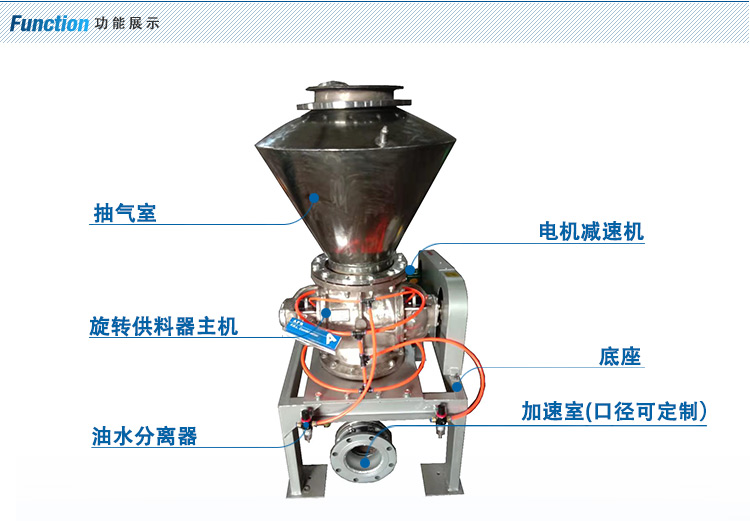
The structural requirements for the feeder are as follows:
Firstly, the material in the pneumatic conveying system feeder is fully mixed with air, that is, air is introduced from the lower part of the material, and the material is evenly dispersed in the airflow and carried away by the airflow, thereby effectively suspending or promoting the airflow, preventing material blockage and accumulation. Secondly, the structure of the air supply fan should ensure that air can enter smoothly without generating excessive disturbances and eddies, thereby reducing the resistance loss of the airflow. Finally, the material entering the airflow should be as consistent as possible with the direction of the airflow to avoid reverse feeding. In some cases, it is necessary to slow down the speed of the material or use its pulses to make it rotate. In this way, the energy consumption of materials driven by airflow can be reduced.
2、 Pneumatic conveying system conveying pipes and elbows
A conveying pipe is a pipeline that transports a mixture of materials and air, usually connected between a feeder and a unloader. The circular cross-section of the conveying pipe can evenly distribute the airflow throughout the entire cross-section. At the same time, the resistance of the conveying pipe is smaller than other shapes of pipes, making manufacturing and installation relatively convenient.
Conveyor pipes are generally composed of several parts. In order to reduce resistance losses, it is usually required that the interior of the conveying pipe be smooth and without steps. Therefore, the connection process of each pipeline connection is particularly important. For ease of installation, the conveying pipe can be divided into several sections according to the number of layers, and the length of each section is equal to the height of the floor. During installation, each section of the pipe is supported on the upper floor by an angle steel flange fixed at its upper end, and is fixed to the floor after the entire conveying pipe is aligned vertically.
The connection of the conveying pipe should be tight and leak free, the interior should be smooth and flat, and it should be centered as much as possible to prevent misalignment. It is generally believed that the wear of pneumatic conveying system pipelines or the wear of pipelines on materials is a prominent problem in air transportation, mainly occurring on horizontal or inclined pipelines, elbows, and deformed pipelines. The vertical feeding tube has less wear.
Due to the fact that wear is caused by continuous friction or collision between the material and the wall, the larger the particle size of the material, the higher the hardness, the faster the speed, and the greater the energy of friction and collision, the more severe the wear. The wear rate is approximately proportional to the power of the conveying wind speed. In addition, the higher the concentration, the more friction or collision occurs, and the more severe the wear. The first way to reduce wear and tear is to design the conveying pipes reasonably, minimize bends, horizontal sections, and inclined sections, keep the pneumatic conveying system conveying pipes from deforming, align joints, and minimize steps and misalignment inside the pipes. If necessary, wear-resistant materials can be added to easily worn parts.
3、 Pneumatic conveying system unloader and air closer
1. Unloader
Unloader is a device that separates materials from airflow. The requirements for it are:
Firstly, the separation efficiency is high. This is relatively easy for granular materials such as plastic pellets, wheat, and rice, but more difficult to completely separate for powdered materials. Secondly, the performance needs to be stable. That is to say, when the conditions of pneumatic conveying are slightly changed (such as changes in air volume or concentration), it should also have stable separation ability. Thirdly, the structure is simple and the volume is compact. Wear prone parts can be disassembled and replaced, and inspection and maintenance should be convenient. In addition, transparent mirrors can be installed inside the pipeline for observation and operation. Fourthly, for the particle separation unloader, it should have the function of "one wind for multiple uses". That is to say, it can not only discharge particulate matter, but also separate dust and light impurities. According to different purposes, unloaders can be divided into powder unloaders and particle unloaders. Cyclone dust collectors are commonly used in powder unloaders.
2. Breather
The airlock is also known as a star shaped unloader, ash discharge valve, airlock, rotary feeder, and rotary valve. The structure of the pneumatic conveying system's airlock generally consists of a rotor impeller, a housing, a seal, a reducer, and a motor with multiple blades. The inlet and outlet flanges are square or circular. Air sealers are generally installed at the lower part of dust collectors to ensure the sealing of the joints, and the upper part should always maintain (store) a certain material height.
Pneumatic conveying system star shaped unloaders (also known as rigid wheel feeders, star shaped unloaders, wind crushers, rotary feeders, rotary valves, etc.) are widely used in industries such as chemical, pharmaceutical, food, and energy. As a hopper discharge device for various dust removal equipment, it relies on the gravity of the material and the forced action of the feeding machine working mechanism to continuously and uniformly discharge the material into the hopper. It can also be used as a loading and unloading device for various crushers, dryers, silos, and other equipment, suitable for drying powdered and small particle materials.
Pneumatic conveying equipment adds materials into the airflow at a certain speed to form a suspended mixture, which is transported to the destination through pipelines. The materials are separated from the airflow and discharged. Pneumatic conveying equipment is mainly used for conveying powdery, granular, and small block materials with a dryness of 20-30mm or less, and sometimes it can also be conveyed in blocks. For different materials, different wind speeds should be selected to ensure that the materials can move forward in the pipeline without blocking the pipeline, and to transport as much material as possible, achieving both economy and rationality.