
Important parameters for pneumatic conveying design
in designPositive pressure pneumatic conveying deviceFirstly, it is necessary to understand and study the properties and particle shape of the conveyed material, the conveying equipment, and the on-site conditions. Based on this, the advantages of pneumatic conveying should be fully utilized, and the correct type of pneumatic conveying should be selected to improve production efficiency.
1. The properties and particle shape of the conveyed material. The average particle size of the material is often taken as the calculated particle size, and the distribution of material particle size should be understood.
The flowability of materials is generally indirectly represented by the size of the stacking angle and friction angle. The same material has different moisture contents. There is a significant difference in fluidity, which affects the moisture content of the materialIt is necessary to consider whether it is internal moisture or surface moisture, and to take into account the adhesive effect of the material.
(1) The density and bulk density of materials directly affect the external dimensions, structural form, and power consumption of pneumatic conveying devices.
(2) The material crushing rate determines the layout route, conveying distance, and selection of appropriate airflow velocity for pneumatic conveying.
(3) The corrosiveness of materials imposes special requirements on the material of conveying pipelines.
(4) When materials have electrostatic effects, necessary grounding wires and anti charging devices should be installed to prevent the generation of static electricity.
(5) For explosive materials, in addition to preventing static electricity, explosion-proof safety measures must be taken.
(6) When transporting hazardous materials, it is necessary to consider adopting sealed handling safety measures to prevent pipeline and equipment from being worn or damaged and leaking out.
When designing a pressure pneumatic conveying device, the capacity and specifications of the device should be determined based on the conveying volume per unit time. The pneumatic conveying device is often part of a complete set of equipment and must be matched with other main and auxiliary machines. If there is a contradiction in the conveying volume, the method of storing and buffering in the intermediate hopper can be adoptedResolve it.
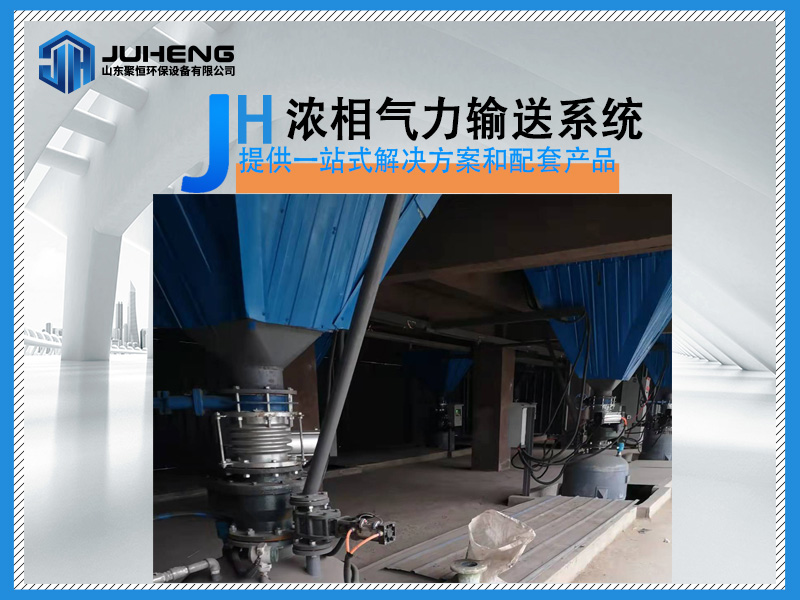
The conveying capacity is also related to the process, and the choice of intermittent or continuous equipment should be determined according to the process requirements. When selecting the compressed pneumatic conveying form, the reliability of the equipment should also be considered, and the impact of pneumatic conveying failure on production should be estimated.
3. The condition of the starting and ending points of the conveying should be minimized as much as possible while ensuring the process, fully utilizing the advantages of pressure pneumatic conveying.
The installation height and feeding method of the device should take into account the surrounding environment, not obstruct traffic, facilitate maintenance, and reduce equipment maintenance costs.
4. Noise reduction and environmental protection measures must be taken at the inlet and outlet of the gas source to reduce the impact of mechanical noise on the environment. Install fans or air compressors in separate rooms using mufflers, etc.
Pneumatic conveying devices must consider the dust removal effect of exhaust and adopt various types of dust collectors suitable for the characteristics of pneumatic conveying,To prevent air pollution, sewage treatment should be considered when using wet dust collectors.
5. The level of automation of the pneumatic conveying device can achieve centralized automatic control, which is remotely controlled from the central control room. This not only reduces the number of operators, but also achieves automatic interlocking to prevent accidents from occurring.
6. Installation points: When installing the pneumatic conveying device outdoors, rain and frost prevention measures should be considered. Forks, superchargers, pneumatic or electrical control components, valves, limit switches, etc. must have enclosures to prevent them from malfunctioning due to rain.
7. Special conditions require consideration of cooling factors when transporting high-temperature materials, and insulation and heating should be taken into account for conveying pipelines. Air source machinery (such as air compressors) should consider water cooling conditions and drainage measures.
The parameters of pneumatic conveying are important forpneumatic conveyingThe design is very important, as it relates to the efficiency and stability of the conveying system. If you need pneumatic conveying equipment, please feel free to contact us.